New report: Five gaps are holding back better obesity care in Canada. Learn more

Home • Scale Up Your Practice podcast • Reframing Nutrition in Obesity Management with Dr. Flavio Vieira



🎙️ This episode is sponsored. Obesity Canada received an unrestricted educational grant from Eli Lilly Canada to produce this episode. 🎙️
Nutrition in obesity management is complex, deeply personal, and shaped by biology, culture, mental health, access, and lived experience.
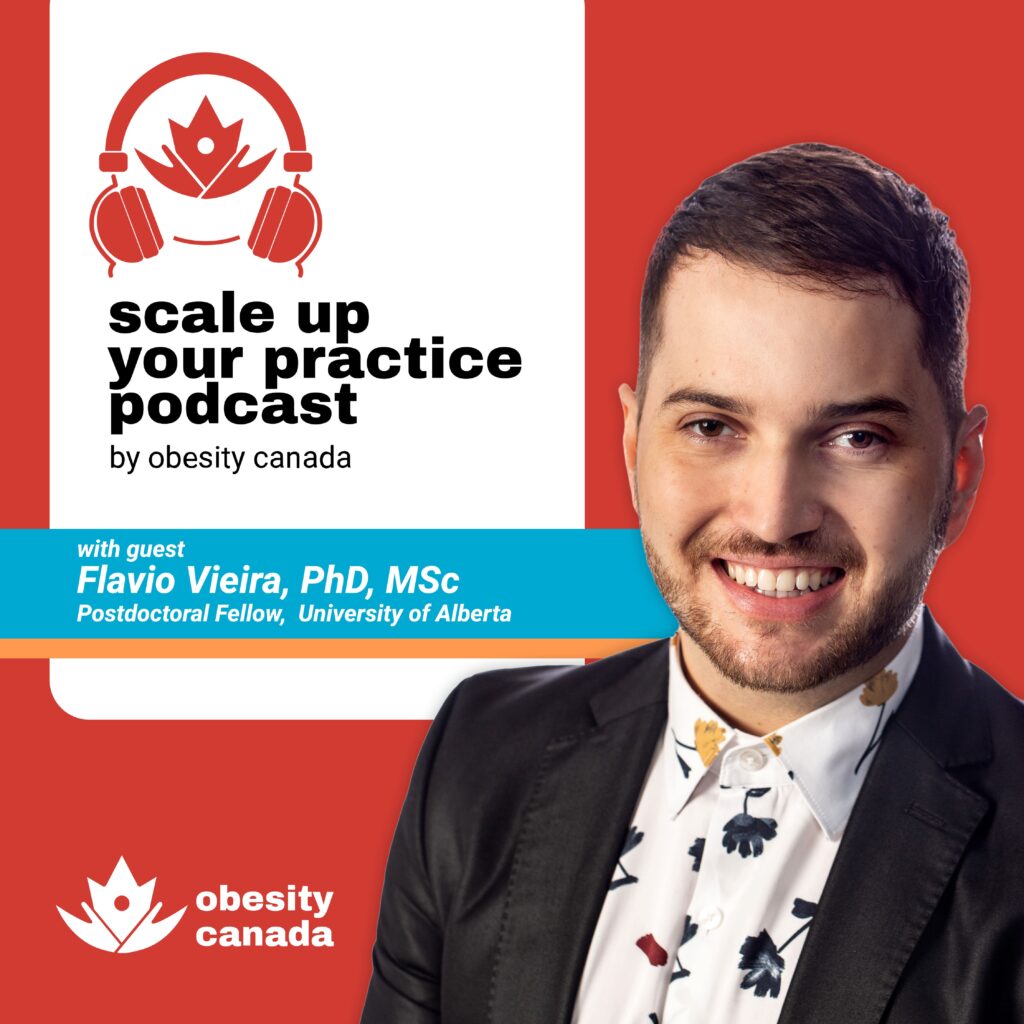
In this episode, we sit down with Dr. Flavio Vieira, Postdoctoral Fellow at the University of Alberta, to explore what personalized, evidence-informed nutrition can really look like in practice. From tackling misconceptions to addressing malnutrition and advocating for multidisciplinary care, Dr. Vieira helps us rethink how nutrition fits into obesity care that’s compassionate, practical, and person-centred.

Dr. Flavio Vieira is a Postdoctoral Fellow at the University of Alberta whose research focuses on improving obesity care through personalized, multidisciplinary approaches to nutrition, physical activity, and treatment—while challenging weight stigma. With a background as a registered dietitian and expertise in body composition and energy metabolism, he is passionate about advancing patient-centred, evidence-based care across the lifespan.
Email us at scaleuppod@obesitycanada.ca
✅ Share this episode with a colleague or student
✅ Subscribe on your favourite podcast platform
✅ Leave a review to help more listeners find the show
Thanks for tuning in—and stay with us as we continue to scale up your practice.
– Welcome to “Scale Up Your Practice”, the podcast from Obesity Canada. I’m Roshan Abraham, a family physician and associate professor at the University of Alberta.
– And I’m Michelle McMillan, a lived experience advocate. This podcast is where we explore what it means to offer care that’s grounded in both evidence and empathy.
– Managing a chronic disease like obesity takes more than just one tool. It takes a whole person approach that recognizes the complexity of each patient’s story. One area where the complexity really shows is nutrition, and today we’re serving up a fresh perspective on nutrition in obesity care.
– Because, let’s be honest, a one-size-fits-all approach to nutrition doesn’t actually fit anyone, whether you’re living with obesity or not. We’re joined today by Dr. Flavio Vieira, a postdoctoral fellow at the University of Alberta and an emerging leader in personalized, evidence-informed nutrition strategies and obesity care.
– Today’s episode is supported by an unrestricted educational grant from Eli Lilly Canada.
– Welcome to the show, Dr. Vieira.
– Thank you so much for the kind words and for having me here. It’s such a pleasure. The past three years that I have been living here in Canada, I fell in love by the amazing work that Obesity Canada does in advocating for obesity. And again, it’s an honor to be participating in those initiatives nowadays.
– We love to have you on the podcast. So, we often hear about nutrition as a cornerstone of obesity care, but that cornerstone is rarely a solid or straightforward as it sounds. The truth is nutrition advice often gets reduced to oversimplified rules, when in reality what we eat is shaped by biology, culture, income, personal experiences, and trauma, including more.
– We also know that eat less, move more is far from a complete approach to managing a complex chronic disease like obesity. Dr. Vieira, you’ve dedicated your research to changing the narrative. I’m curious, what first drew you to focus your work on the intersection of nutrition and obesity care?
– That’s a good question. So, I grew up living in a larger body myself. So I face bullies, challenges that all that comes with living in a larger body, especially in your teenage years. Even though I was pretty active, like involved in sports, engaged, I didn’t have a good relationship with food and this is one of the things that was kind of getting in the way of improving my health in general until I saw, I was blessed to see a dietician after many attempts that could try and change this narrative for myself. And after that period that I could see the results and the practice, I knew that I wanted to work with health, and also that I would to improve the lives of individuals living in larger bodies or with obesity. I navigated through kinesiology a little bit, so I have a minor in kinesiology. I thought for a second to specialize in physiotherapy, but inside my bachelor’s I fell in love with nutrition and then this was a no coming back for me. And then since then, I never quit college. It was one degree after the other. And here I am, starting my third postdoctoral fellow in August.
– Congratulations. So much education. We are going to borrow from that education today.
– Definitely, and what a journey as well and we appreciate you sharing that with us. And I hope we can hear a little bit more about that, about your personal sort of relationship with all of this. But how has your thinking evolved when it comes to the role of nutrition and obesity care throughout your career?
– I think we have been taught that at the beginning, like this is more than 10 years ago, that the dietician or the healthcare professional hold the knowledge, and then it was just a mere transmitter to the patient and that the patient should follow everything that we just tell them to do. And if they don’t do it, this is just on them, not on the healthcare professional. And for me, what changed more in the narrative, like in my personal trajectory as a healthcare professionals, is the patient-center approach and trying to listen more than to speak and try to develop, establish goals with the patient and not just myself as the professional and giving them what they need to do and what they need to focus on and building this trusted relationship with them. This is what drives all the relationship and also how it should be done in practice. And this is not just for clinical practice, but also in research. So at my master’s and PhD in Brazil, I wasn’t familiar with involving patient with lived experience in all the stages of research. And nowadays here in Canada, this is one thing that I always strive to include in all the stages that I can. Always, of course, we need to try to think about a plausibility and how can we incorporate them, but I always try to do this myself because they are the ones that needs to drive the knowledge pursuit. We are trying to do this, but they are the ones telling what should be researched and how it should be researched.
– Wow, we always love it on the podcast when researchers or physicians or other healthcare professionals talk about, you know, that patient-centric care. I love that bit. But I do have one question for you. If you had a magic wand and you could pick one assumption that healthcare professionals have around nutrition and obesity and you could ask them to let go of it, what would be your top pick of something that assumption that’s wrong and it just needs to go.
– Restricted dieting. So, we know that this is one of the things that needs to be done in order to triggers the weight loss, but it’s not the only thing. And we also need to have in mind that if you restrict dieting that much or severely do that, you can also bring other poor health outcomes. And this is one of the targets of my research. For example, losses in muscle mass throughout like weight loss journeys, losses in physical function, muscle strength. If you only focus on the weight on a scale as a number, as your primary outcome, and only incorporating restrictive dieting as your target, as your strategy, you are not shifting the narrative. We need to incorporate way more than that to have a health approach and not just a weight-focused approach.
– Wow, that’s so important. Sorry, Roshan?
– No, that’s essential and I think we’d like to take a bit of a deeper dive into that because there’s so much nuance, right? In which we need to approach this subject, specifically nutritional support for patients living with obesity. So from your work, what does the evidence tell us about the biological diversity in how people respond to dietary interventions?
– We need to face that everyone are their own individual. And for example, when you are developing a research or you’re trying to investigate a question, you do that in a group perspective so you can understand if something was effective or not. But after that, you need to understand that each one of those individuals has their own trajectories, their own perspectives, their biology might be completely different. Genetic plays a card here. We have past experience such as psychological and social. We have individualized metabolism, gut microbiota, yeah, and we could go on and on and on. And those individualities may play a card here in order us to reach a different target or reach a different set that was established before. And we need to understand, especially as healthcare professionals, that every type of health trajectories need to be individualized. You can manage as a group when you’re trying to do with research questions, but once you are seeing one-on-one your patient, it needs to be tailored to their own needs. And sometimes those needs might not align with your own needs. Like what you think are the best for them, but they are the ones that will be doing, they are the one with the lived experience. So you’re just there to guide them throughout this journey. You’re not the lead.
– Wow, that’s such an important message. But it does make me think, you as a researcher, right? You can’t, well, I suppose if you had unlimited funds and time, you could do an individual research study on every person living with obesity, but I’m guessing you don’t have that in your grant proposal. So, you know, how do you align larger research projects with then, you know, that individual approach that you are looking for with your patients?
– That’s a tricky question, Michelle,
– Yeah.
– because for research purpose you try to incorporate as many people as you can
– Yeah.
– and try to think that when you increase the sample size, the generalizability would be higher, and then it’s easier for you to find results that are translatable to the audience or to the other people. But as you said, we don’t have unlimited funds that we can do those approaches. But we can start from small, and then with time, when those approaches might be cheaper with time, then we can try to escalate this a little bit more. So we can see this in highly expensive centers with some assessments. So for example, I am conducting a research that only one assessment costs more than a $1000 for one assessment. So I cannot incorporate as many people as I wanted to answer this question and to try to individualize this way more and more. But at the same time, I need to start doing this because maybe with time and more industry partners and develop new technologies, those things might decrease the price and then we can escalate a little bit more. So as a researcher I would say just go for it. Try to find your funds and start doing your work. Spread the word because your work needs to be shared with everyone else. Like this is for a scientific community, but also the lived experience community and keep them going until we reach, for example, the government, in places where they can actually escalate this.
– That is incredible, and something I don’t think we’ve talked enough about on the podcast is the power of advocacy. We’ve talked a lot about that, but the power of advocacy in the face of, I guess the scientific method, that that requires you to have larger sample sizes in order to produce that generalizable sort of result that we then as clinicians will take as sort of a one-size-fits-all for a lot of patients when we have to actually get back to thinking about the individual patient, what their needs are. And advocacy’s a big part of that if we need to actually find large enough sample sizes for a group of individuals that have similar characteristics that could be actually related to your patient, let’s say, right? So the more advocacy that we have around this, the more opportunity we have for some of that individualized treatment to actually float to the surface as opposed to just sort of being muddled in with a lot of this other data. So I think that’s really powerful when we talk about advocacy and scientific research in this area. And as you mentioned, just sort of going to government, going to industry partners, trying to find ways in which to fund a lot of these studies so that we can at least have some information on that. So I’m so glad you brought that up.
– Yeah, definitely. And that kinda leads me to a thought of, of course, nutrition is one aspect of people living with obesity. Of course there are other treatments as well, you know, GLP-1 medications, surgery, behavioral interventions. I’m just curious from your research and your experience, how do you think those kind of dovetail in with dealing with nutrition?
– For me, it’s the most important part is not to think that you are the holder of what it’s most important. You need to get the best of all the areas and combined to provide a more comprehensive outcome. And not only in terms of weight, but in terms of health in general, quality of life, physical function. And for that, for example, when you think about nutrition, you can do a lot only with nutrition. But once you adjust and adapt with other interventions such as exercise, medication, pharmacology, behavioral changes, metabolic and bariatric surgery, you can go way beyond. So as the Adult Clinical Obesity Guidelines states really clear, nutrition and exercise needs to be kind of the foundation for the obesity management and therapy. But this is for everyone. It’s not different for obesity. Like everyone needs nutrition and healthy nutrition. Everyone needs to exercise and stay active not only for managing obesity, but those two are the foundation. And then we have the pillars that support and can help you achieve improved results. And you can start with psychological or behavior interventions. Those interventions might help you have a higher adherence to the initial treatments, and for that you can achieve, might achieve greater results in the end, or you can treat other, or for example, how the relationship with food. Only with nutrition, we cannot deal with that. We need to have a psychologist or a counselor associated with this treatment so we can treat the person as a whole in holistic manner. And then you can focus more in the quality of this food and quality of this nutrition and not only thinking about the quantity as individuals with large bodies might, most of the times be concerned about and might have some difficulty in controlling it. My masters and PhD were all dedicated to metabolic and bariatric surgery, but we also incorporated nutrition intervention and exercise intervention. So we can play around with all of those and see what’s first the participant or the patient have the accessibility to do and if they want to do. And with that, we can also escalate. So you can get nutrition with exercise and nutrition with pharmacology, exercise with nutrition and behavioral strategies. But I’m a pretty and big advocate for multidisciplinary approach, multimotor approach. And we can see by the literature that we can achieve improved results and outcomes that goes way beyond weight, but in general health.
– I think that’s a really powerful message and we have heard that throughout the podcast. I’m wondering, are there any strategies that you’ve seen for how that integration might come into practice? And granted, like in my work as a family doctor, I have the benefit of knowing my patient sort of holistically more so than probably their specialists or other clinicians. But then, there are some things that I don’t have as much, which is time, as well as sometimes resources. Although here in Alberta, we do have resources through our primary care network system as well as fairly reasonable access to sort of obesity specialists that do make it somewhat easier for us to look at how that integration would be like in real life, like with the patient. From your research or from sort of the trials that you’ve been a part of, or sort of any of the work that you’ve been a part of, is there anything that really sticks out as to how that could look like in practice?
– I love the model one of those multidisciplinary clinics, where the same participant or the same patient can see multiple healthcare professionals at the same time on the same visit. So you start with a physician, then you go for the dietician, and then you can discuss with a pharmacist about like treatments and how you can incorporate this. So, I believe that once you have, once you create the access, that’s one of the most important things to have. We can keep spend hours and hours here discussing what would be the ideal work, but if they don’t have the access of doing this,
– That’s beautiful. Absolutely.
– it wouldn’t matter in the end. And this is a discussion that we can keep having with the new medications for obesity. Having more healthcare professionals that could see a patient out of a patient in a multidisciplinary approach at the same time for clinical practice, for me this is the best way of incorporating. And as a researcher, we can incorporate this in so many other ways because we have more freedom that we are not the ones responsible for their treatment and we’re only trying to come up with new ideas of strategies that could be implemented. And with that, we’re investigating a specific strategy. We are not kind of worried about all the rest that is happening at the same time. And we know that these are equally important, but in the research side, we can’t. We don’t have the hands of incorporating this everything into the research, but we expect this from the healthcare professionals that are seeing the patients. And we know that even this, it’s really hard to have in practice because costs are, we have difficult with place, spaces. But yeah, this I would say that for me is the most ideal scenario in clinical practice. And I’ve seen quite a few one in Alberta that I have seen and I recruit patients from. There’s the Pediatric Wing Management Clinic at the Misericordia Hospital.
– Yeah, the Misea.
– They have that in their practice and has been helping a lot of those kids with living in larger bodies.
– I really can’t thank you enough for talking about access. It’s the most important word that we have in primary care. We talk about it all the time in our academic clinics. How do we improve access, how do we improve access? And it’s something that we talk a lot about in primary care circles, not so much in other healthcare circles or sort of, it’s sort of lower down access is always the main thing that we talk about. So I couldn’t agree with you more. And being able to see that in real life and almost having a patient-led approach as if, I mean, when they’re coming in to have sort of, which multidisciplinary sort of team members would you like to see today, right? As opposed to always having to see like a central triage person, if you will. I mean, AI and technology can be helpful with that as well to try to sort of piece through who’s available and how they can help, but having the patient ultimately lead that as opposed to always seeing the physician first, which is the way it works right now is that the family doctor or potentially an NP, you see them first and then they decide who you end up needing to see. And that can depend on what availability is there, but it can also depend on bias for that provider as well, right? So if they don’t feel like in that moment that you need something, well, I mean that could just be the way that their bias is actually showing through as well. If a patient can actually take the lead and feel supported and empowered to do that, I mean, we could change a lot of lives that way.
– Absolutely, and from a patient point of view, not to make this more complex ’cause heaven knows it’s already complex enough, but just that ability to, for those multidisciplinary teams, for that patient to be able to say, you know, “Yeah, I’m kinda struggling with nutrition. I don’t know exactly. Like, I’m trying to reduce the total calories, right? To get to that calorie deficit part, but am I making good choices? But you know, do I need to see the exercise physiologist? ‘Cause, you know, I had a pretty active life and I’m active. You know, 45 minutes an hour every day doing active things that I love, right?” You know, and just that combination of allowing a patient to kind of say, you know, “This is where I need help. I’ve kind of got this other piece.” Rather than a generic, “Okay, you shall see the physician, then you shall see the nutritionist, then you shall see the exercise person.” And I think if we’re trying to create space so we can see more people, having the ability
– Yeah.
– for the patient to lead will open up space rather than just kinda have this standard, you have to see person A, B, C, D, E, right? Just a thought.
– Which is how it works in primary care now anyways, regardless of the condition, right? You have to see either a nurse practitioner or a family doctor before a lot of these other ancillary services, if you will. ‘Cause they’re considered ancillary services as opposed to actually making all of the services available to patients, and either triaging appropriately, or better yet, especially with the way technology is to actually support the patients in their own decision making to really find the match that they need in that moment. Really, I guess giving them the care that they need in the moment as opposed to us dictating that care to them.
– Yeah, if I could add just something since we’re discussing about nutrition. I see that most of the times that a dietician are able to discuss with a patient, they need to have a referral from a physician before that.
– Yes.
– And this kind of gets in the way of the whole thing of prevention is looking like. Because if you only see them when you already have a problem, how are you going to avoid this to happen to other people or to the next generation
– Yes.
– that are coming here?
– Yes.
– Yes, yeah. That is such a brilliant point, right? Let’s wait till they’re sick and then we’ll refer them to, you know, some nutritional therapy. Yeah, that’s a really good point.
– There’s another big theme that we see, especially with medications now coming up, and that’s malnutrition in patients who are living with obesity. Probably not something that clinicians will really expect, with or without medications, right? Can you talk about what malnutrition can look like in this context? Why it matters for care?
– This is a topic that I hold dear in my heart. It’s one of the main outcomes of my research. So in malnutrition, most people would expect someone with a really low BMI where you can obviously see a low muscle mass or low fat mass. And this is kind of the stereotype of malnutrition. However, malnutrition is a nutrition-related condition that it starts with not achieving the requirements for nutrition. And this could be for energy, this could be for protein or any other nutrients. So malnutrition might be present in individuals with larger bodies living or not with obesity. And this would look a little bit different because this wouldn’t be visible to their eyes, because you wouldn’t be able to see the markers of low muscle mass with someone with larger body. You wouldn’t be able to see the markers with decreased fat mass. But you could incorporate frameworks that could give you a more comprehensive assessment. But we always start with screening, and you can screen by based on how are their eating practices, if they’re eating enough food. Individuals with obesity might come with cycles of restrictive dieting, restrictive dieting, and restrictive dieting, not achieving those requirements. And they could be with weight loss that are not based on fat mass, but also involved decreases in muscle mass as well. And with that, you can increase the risk of malnutrition. When you have other conditions associated with obesity, especially inflammatory conditions such as arthritis, Type II diabetes or cardiovascular conditions, this inflammation also can increase the risk to develop malnutrition and increase the risk of losing more muscle mass and also in a simulation of those nutrients. And you can build a full spectrum of an increased risk. So even in individuals living in larger bodies, the screening for malnutrition or other nutrition-related conditions such as sarcopenic obesity, which is the co-existence of excess fat mass with low muscle mass and low muscle strength, they’re overlapping conditions, malnutrition with sarcopenic obesity, you can incorporate some screening practice that would be fast, that could be a low budget, but that could be in the world moving forward. Because once you start a strategy for obesity management, one of the outcomes would be weight loss. One of them. Not the only one, but one of them is. And if they already suffer with low muscle mass or low physical function, so you’ll be aggravating this throughout the weight loss journey or the obesity management journey. So, this screening is highly important, especially when you are starting a new strategy. So you understand how far you can go in each one of those nuances. So if someone is already with malnutrition or low muscle mass, I would not be putting them to a highly restrictive dieting, for example. I would not have a targeted goal of highly fast in a massive weight loss in such a short amount of time. Or if I want to put them in a, or when I say I, it’s a decision that was made together with the patient, once you identify and you apply those screening tools and identify someone with a high risk for malnutrition or for sarcopenic obesity, you might want to dose the treatments that you are undergoing with this patient in order to avoid a more aggravation of this condition throughout the obesity management journey. If you screen and they are positive for the screen, you need to undergo a more comprehensive assessment and this could involve the assessment of body composition using a body composition tool such as DEXA scans, such as bilateral appearance analysis or even some anthropometric markers if you don’t have access to any of those such as calf circumferences. That is a good marker for muscle mass. One of the best that we have thinking about the limitations of anthropometry. Body composition, you can assess inflammation markers such as CRP in blood works. You would need to assess dietary intake of those individuals, and this could undergo a discussion of what will be a usual day of your dietary habits or this could entail a more comprehensive assessment such as three food records or journaling. So you can discuss in more details. You can investigate other associated conditions that could increase inflammatory markers and how controller are those markers in diseases and how this would affect the assimilation of the nutrients. Not just not achieving the nutritional requirements, but also what I’m eating, am I using everything that I’m eating? Because some of those conditions might impact those two. So you can have a way more comprehensive assessment before you started intervention if you screen for this before. If you don’t screen, you’re going to go blindsided. You’re going to treat everyone as the same person.
– Yeah.
– And someone that is already starting with low muscle mass, for example, they would have a way increased risk of keep losing this and even lose way more than someone that started off with higher amounts of that.
– And I think, what I guess I’m hearing is that it’s not that everyone needs to have this ’cause that’s not necessarily equitable or possible, but that if you’re screening positive enough in certain areas where there this concern is raised, then to try to do a little bit more, have a little bit more data before you actually do start whether it’s your nutritional interventions or your pharmacological interventions, because they’re going to be impacted by that. And I think it’s really important. Again, it comes back to the fact that one size does not fit all. It’s not the same person that’s sitting in front of you. That there is a different person literally under the skin, right? Their muscle composition, how their basal metabolic rate is, and again, the person, but having a little bit more information can be helpful. But, yeah, I think that’s great that we’re having this conversation.
– Yeah, I think we talk about that a bit on the podcast. You know, people living with obesity walk into the room and they present
– Exactly.
– their chronic condition. But what you’re really, if I had to take away from your point is, is that you’re seeing one thing, but you kinda need to look a little bit deeper and ask a few questions before you start being like, “Okay, there’s a standard treatment. Do this, do this,” without, you know, fully considering what additional underlying conditions you might be have to deal with first. And yeah, that’s a tricky thing to do. I’m lucky I am not a healthcare practitioner, but yeah, I can definitely see the value of trying to find some means to do that kind of framework quickly and easily.
– Definitely.
– I don’t know what it is, but it’s an important idea.
– But the first part is that you need to identify. If you don’t identify, those people might go under looked. And malnutrition or any of those nutrition-related conditions that are more prone to low muscle mass or that shifts in the body composition in someone living with larger bodies are overlooked, not only in clinical practice but also in research. We are trying to shift this narrative. One thing to have on the top of my mind is that we don’t have any specific tool to assess malnutrition in obesity. We don’t have any specific screening tool to screen for malnutrition in obesity. So, all of those tools are an adaptation of tools that were developed for individuals within desirable range of BMI, let’s say by that. But some of those markers inside those tools are not applicable. And you’re not using the same validated tool as other people are using ’cause you’re losing important markers for that. So, we are trying to adapt what is already there, but in the near future we definitely need to see more individualized tools for individuals living with obesity in this matter.
– I think this is actually a great segue into our bias break because this does really speak to bias at its core. I mean, it’s not the only thing that this speaks to, but it definitely speaks to bias. So this is on the podcast where we step out of the theory and a little bit of clinical practice and into the real world, your world, because weight bias doesn’t just exist in data or headlines. It shows up in clinics, conversations, and decisions and life in general, right? Often in quiet ways that can still have lasting impact.
– Yeah, I’d be curious, Dr. Vieira, if you could share a moment you’ve witnessed, heard about, maybe you were a part of ’cause you said, you know, as a kid you struggled with living in a larger body, and reflect on those weight biases and those stigmas that can affect nutrition research now that you’re a researcher, or maybe when you were a patient, or now when you’re in a clinical setting and working with people who deal with patients on a daily basis?
– As you said, like weight bias, we can identify this in all this spectrum of the care. Things like the chairs that you arrive in the clinic and you don’t have the space to sit, and someone don’t want to go there anymore because they feel so ashamed of being there in the same room of other people sitting and they don’t have a place to sit. So I have been seeing this as a kid, I have been seeing this as a healthcare professional working in practice, and also now as a researcher. I want to focus now as a researcher, what I have been doing, trying to incorporate those changes and this shifting this change of screening tools, assessments for individuals with obesity or larger bodies is that most of the body composition tools that we have, that they have weight capacity. So a DEXA scan,
– Right.
– sometimes they only have until 200 kilograms. We have some CT scans or MRI scans that, like the radius that does not, someone with obesity might not fit inside. So they cannot perform the assessments. By a light conpirience analysis, the accuracy is decreased when someone has a larger body. This could go by not meeting some assumptions of the method or not being able to stand in the device, or not being able to move their arms away from their trunks and not touch them because of the anatomy of someone living in a larger body. So it’s so hard to incorporate those assessments in practice, both in research, both in clinical practice, but we keep hearing that. Weight should not be the measure. The body composition should be. But then, we cannot properly assess body composition either.
– This is it.
– So what should we do?
– Yeah.
– Yeah. And then you go beyond. So body composition is part of a more comprehensive tool of nutritional status, and we don’t have many of those tools developed for individuals with larger bodies or obesity. They’re focused for individuals within normal weight or range, but they’re not entirely applicable. And we can only keep guessing about it. What are the best or the ideal world that we want them to have, because we say BMI, it’s not ideal. BMI it’s not a measure of health, but we keep using BMI as a marker for diagnose of obesity or part of the diagnosis of obesity. If you’re thinking more in the epidemiological way, BMI is still a big marker when you’re thinking at the populational level. But once you go to the individual, we know that BMI should not be the one used. We need to move towards body composition assessment. Okay, body composition, we have lots of additional challenge for individuals with obesity that others would not have. And we need to overcome those challenges if we want to improve the care for those individuals.
– That’s actually a great segue into our next set of questions, which is, when it comes to how nutrition is addressed in obesity care, where do you see the biggest knowledge in system level gaps right now? I mean, you mentioned just in the last couple of minutes about the challenges with how we look at screening and even diagnosis. Just from a nutrition standpoint, where do you see some of those gaps?
– First gap for me would be BMI. That we can understand that in a populational level, it might still be a good marker of excess fat mass when you’re thinking a group of people once you don’t have access to a more sophisticated assessment method and you need to understand how a group of people, or even like a country. Like, the trends help. So I would say the BMI could be still an associated method for assessing, following up individuals with larger bodies, but we need to move away from it. And if we don’t have access to body composition methods, some other anthropometric markers might be associated such as waist circumference, waist-to-hip circumference, waist-to-height circumference, as a marker of muscle mass could go calf circumference as I said. There’s a good marker and association, and we have the mild adjusted cut of points to identify low muscle mass using calf circumference because we wouldn’t think that individuals with larger bodies would have a bigger circumference. So we wouldn’t be able to assess low muscle mass, but we have some data and BMI adjusted cut off points for calf circumference and we can indeed have an anthropometric based index for assessing low muscle mass even in a group level, in a populational level.
– Wow, that’s the first time that I’ve heard about using calf circumference to, you know, deal with muscle mass. And, you know, it sounds like something that as easily as you could do weight circumference and heights in the office, you could do that measurement probably too. It probably would only take a minute or so more. It would be a valuable tool if that’s, you know, if we’re concerned about people living with obesity and loss of muscle mass, that seems like a pretty reasonable tool to use, yeah. I mean, now you’ve blown my mind with that one. So are there any other things that you think, on both sides, we’ve talked about BMI and it has its usable precipices, but in some ways that we use it it’s a little outdated in the way that we use it. Are there other things that you think, simple things that people who are listening to this podcast might be missing that they could incorporate into the practice? Or things that they’re spending time in their practice, you know, it’s really not a good use of anyone’s time?
– I think I have been discussing a lot like how we’re missing specific tools for the area that I was discussing. But one thing that I think is still missing for the realm of nutrition, it’s a proper way to assess dietary intake. We still rely on lots of assumptions and self-reported measures that are really hard. So it starts with, someone has memory problems of like, “What did I eat yesterday?” “I cannot,” for example, “try to estimate the samples, like the size of the portion that I ate.” Or, “I don’t know the correct ingredients that I ate.” So this makes a completely different from, like, this could jump a meal from 200 calories to 600 calories easily if you under report some of those ingredients or you are just not familiar of those ingredients, or because you ate outside home or because you are not the one responsible for cooking yourself. And this is one of the metrics, but dietary intake is a big part important of how you can incorporate nutrition practice and health practice for obesity management. And if you cannot do a correct follow up, if those advisors or counselor are putting into practice, it’s really hard for you to understand what is going wrong and what is going good at the same time. And this is not for clinical practice side. Like in research, we can totally recognize that there are lots of limitations of assessing dietary intake and we need to do better. Like, there are some newer studies trying to use precision nutrition or specific metabolite from your body called metabolomic studies to use it as to assess the dietary intake. So, by a blood assessment in the future, we could be seeing like what you ate in the last 24 hours and some specific nutrients. So we can do way better in how we’re assessing dietary intake, both before to understand what is kinds of the problems that you need to address or even to follow up an intervention.
– So, one thing that we always challenge our guests with, and we hope in this podcast to provide information to healthcare professionals, something that you can take away from this podcast and apply to your practice tomorrow, as we say. So, I know it’s a hard question, but if there was one thing that you could give the listeners of the podcast to take with them tomorrow that would improve their relationship with their patients or their practice, what would that one thing be?
– I would encourage their awareness and what I have been doing my research in the past couple of years is that, you need to see the patient beyond a number on a scale and a larger body. So, you need to go deeper. It could go in a screening for low muscle mass, a screening or a comprehensive assessment for malnutrition, for sarcopenic obesity, but just go beyond. Try to overcome this barrier, that is the initial thing that could, is the weight bias, that it starts everything. That you start everything already with a bias. Could be unconscious bias or not, but try to go beyond. Someone living with larger bodies are really struggling a lot from many, many reasons, and you as a healthcare professional needs to be the one to listen, to be an advocate for their health and not someone that is causing more and more bias with that. And conditions such as nutrition-related conditions, malnutrition, sarcopenic obesity are constantly overlooked both in clinical practice and in research settings and we can do better in screening those. But from what we currently have, one thing that I would incorporate would be the assessment of the calf circumference to provide a screening of low muscle mass, not just for a BMI.
– Wow, that’s so great. I feel like I’ve learned so many things on this podcast that, you know, that are new and interesting and it’s just amazing. This episode was such a great reminder that nutrition care doesn’t have to be complicated. You know, we can measure calves. We can do it. Even I can do it and I didn’t go to med school.
– Tell your family doctor next time.
– No, I’m not going to do that, but. But I guess it all comes down to, you know, what we talk about often is that we need to be connected to the person in front of us.
– So whether we’re talking about biology, behavior or beliefs, it’s clear that nutrition and obesity care has to be personal and practical. Dr. Vieira, thank you so much for your insights today.
– And to our listeners, if this episode sparks something for you, we hope you share it with a colleague, a student, or someone in your circle who’s ready to rethink the way we approach nutrition.
– Make sure to follow or subscribe to the podcast for more conversations like this. Until next time, stay curious, stay kind, and keep scaling up your practice. This podcast is intended for informational and educational purposes only and does not constitute medical advice. The content shared in this podcast should never be used as a substitute for professional medical advice, diagnosis, or treatments. Always seek the guidance of a qualified healthcare professional with any questions you may have regarding your health or a medical condition. The information and treatments discussed in this podcast are based on Canadian guidelines and approved practices as of the time of recording. If you’re listening from outside of Canada, please consult your local healthcare professional to ensure compliance with your region’s medical standards, guidelines, and recommendations. The creators of this podcast disclaim all liability for any decisions or actions taken based on the content discussed. Listening to this podcast does not establish a professional or patient client relationship.
Be the first to know about new education and resources for healthcare professionals from Obesity Canada.