New report: Five gaps are holding back better obesity care in Canada. Learn more

Home • Scale Up Your Practice podcast • Understanding the connection between sleep & obesity with Dr. Michael Mak

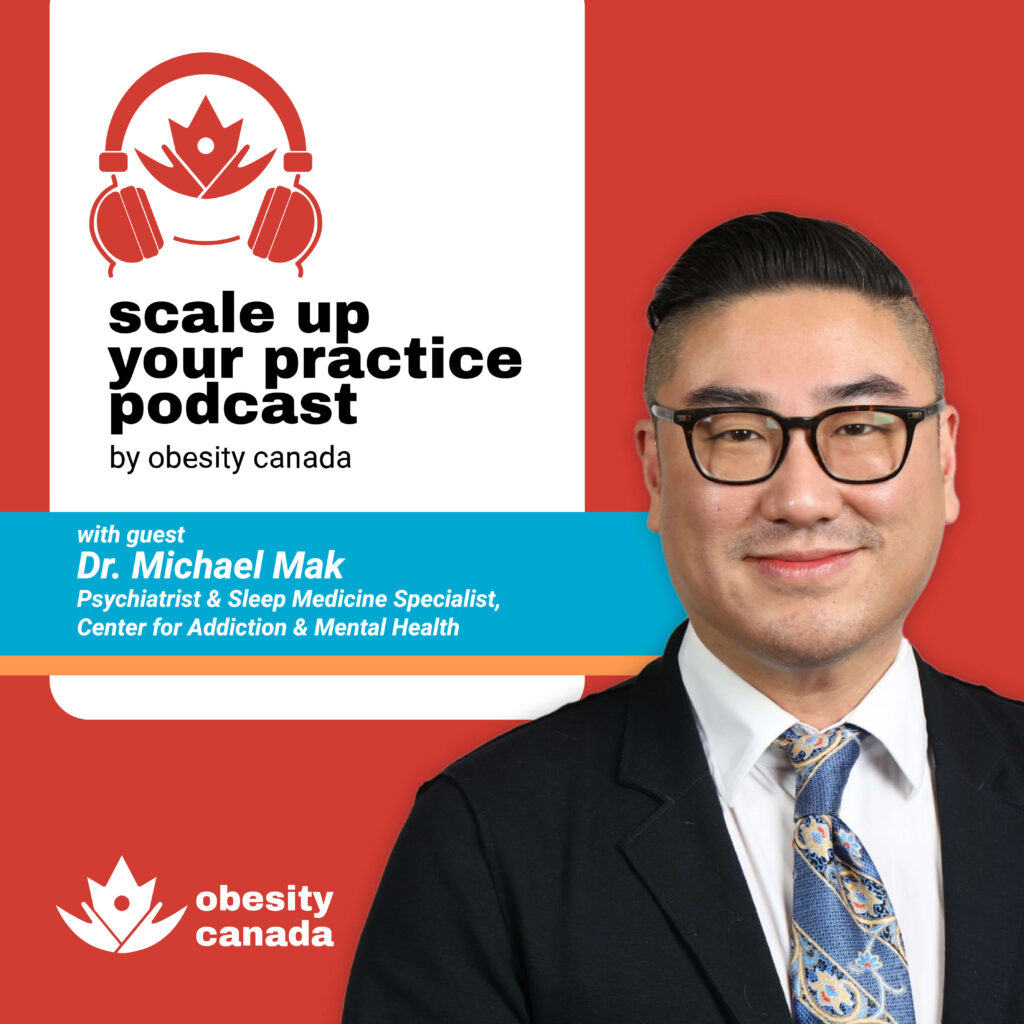


Psychiatrist and sleep medicine specialist Dr. Michael Mak returns to explore how sleep health fits into the patient journey of obesity care.
For many people living with obesity, sleep challenges are part of the story—but they’re often left out of the care conversation. In this episode, we take a practical look at how poor sleep contributes to obesity, how obesity impacts sleep, and what clinicians can do to better support patients at every step.
From hormones and appetite to mood, behaviour, and stigma, we unpack the science and systems that shape sleep—and why it’s time to treat sleep as a vital sign.

Dr. Michael Mak is a sleep medicine specialist and psychiatrist at the Centre for Addiction and Mental Health and Assistant Professor of Psychiatry at the University of Toronto. He serves on committees for the Canadian Psychiatric Association and the American Academy of Sleep Medicine, and is Vice President – Clinical of the Canadian Sleep Society. A Fellow of the American Academy of Sleep Medicine, Dr. Mak is passionate about advancing sleep health through research, education, and patient care.
📩 Send us your questions or topic requests: scaleuppod@obesitycanada.ca
✅ Share the episode with a colleague
✅ Subscribe on your favourite podcast platform
✅ Leave a review—it helps more people find us
Thanks for listening—and stay tuned as we continue to scale up your practice.
– Welcome to “Scale Up Your Practice,” the podcast from Obesity Canada. I’m Dr. Roshan Abraham, a family physician and associate professor at the University of Alberta. In my work, I see every day how complex and challenging obesity can be and why our evolving care is so important.
– And I’m Michelle McMillan, a lived experience advocate with Obesity Canada. This podcast is where we have honest conversations about how we can improve obesity care that’s grounded in both evidence and empathy.
– So, for many people, sleep challenges can be a big part of their story, but they also can be left out of care conversations. Today, we’re exploring why sleep matters and how we can build more holistic, supportive approaches to obesity care.
– We’re continuing our conversation with Dr. Michael Mak, who is a psychiatrist and a sleep medicine specialist at the Centre for Addiction and Mental Health in Toronto. Welcome back to the podcast, Dr. Mak.
– Thanks for having me, Michelle.
– In the previous podcast, we talked a little bit about this, about how sleep belongs in every conversation about overall health. And one of the things we do on this podcast is, you know, there’s a lot of things that are important for obesity care, but there are a lot of things we talk about that are good for everyone, right? When we talk about nutrition.
– Mm-hmm.
– When we talk about moving our bodies. And, you know, I think sleep falls into that category, right? And so, if we start at the beginning, as an expert, I’m going to ask you why is sleep such a critical pillar for everyone’s overall health?
– Yeah, like, so we’ve all seen, you know, like let’s say provincial and federal government investments in, you know, getting the message out there for healthy nutrition and adequate exercise. When I was a young person, I don’t know how many episodes of “ParticipACTION” I’ve watched with Hal Johnson and Joanne McLeod, you know, about exercise. And then, you know, they would also throw in, you know, some tidbits about, you know, good diet and nutrition, et cetera.
– Nutrition as well.
– And the truth is, sleep is the third pillar alongside those two pillars that ties them together. When we exercise, we are, you know, putting our muscles and bones in a state of stress. We’re straining them. We’re putting them to the points of limits sometimes so that we can build greater and greater exercise capacity, increasing our strength and endurance. And in that process, those things get broken down. And, of course, we eat to live and to survive and also for, on a personal basis, I eat for enjoyment, but that gives us the building blocks on which, you know, our muscles and bones and other, you know, facets of our bodies are being repaired, and the time that occurs is not while we’re awake. It’s while we’re asleep. So that really ties together those two concepts, nutrition and exercise. Sleep, as Roshan has mentioned in the last episode, it’s a non-negotiable part of human life. You know, we spend 1/3 of our days essentially in sleep, and it’s the time when our muscles and bones are being repaired. It’s also the time when we do growing. It’s the time when we learn. You know, all the things that we, let’s say, if we’re going to school and we’re studying our textbooks, you know, that kind of information is encoded in working memory and short-term memory. But if we want to be able to, you know, take facts back at will and, you know, do well in school and, you know, put into play like things that we learned, whether it’s riding a bicycle, driving a car, playing a piano, you know, these are things that are solidified in sleep. And, you know, I’m not just telling you this and making it up. There’s science that backs this. You know, for all those people out there that are still studying for exams, young people, you gotta have that sleep after you’ve done your cramming for it to integrate, and we know that you’re going to get higher marks and that. So the truth is not only is it non-negotiable, it’s something that is not passive. There are ways that we can improve sleep on an active basis. So, you know, I’m delighted to be here to get our message out there.
– I think an extension of that, in primary care, you mentioned the ParticipACTION imagery is just beautiful because, I mean, that was such a huge, you could say it was a public health effort, right, in not so recent times to really improve the way that we looked at exercise, and to a certain degree, as you mentioned, nutrition, and yet sleep was left out of that. Why do you think sleep can be left out of those conversations, but more importantly, so many of our care conversations, especially in primary care?
– Well, I think, you know, clinically speaking, like if we’re talking about, you know, people that we work with, colleagues of ours, you know, any sort of clinician, I don’t think we have enough education out there, to be honest, that, you know, pushes sleep as something to be asked about, to be screened for, as like sort of like a forefront of all care contact. You know, it doesn’t matter what kind of medicine or, you know, clinical care that you provide. So I think that, you know, one part of it is education. And the second part is we simply don’t have a lot of advocates that, let’s say, push for, you know, that bring, you know, sleep as an important part of our lives to everyone’s, you know, thoughts. I think that that’s changing, though. And I think that, you know, and it’s based on, you know, work, you know, that I’m doing with you. We have a Canadian Sleep Society that represents the interests of Canadian sleep researchers and clinicians, and we do advocacy work alongside our sister organization, the Canadian Sleep Consortium. So we actually have visited Parliament Hill to try to convince senators and MPs to enact, you know, health-related bills that add investment into, you know, sleep health and bring to the forefront the idea of sleep health alongside the preexisting investments in nutrition and exercise. So there’s, right, like, you know, lack of, let’s say, education that it’s an important thing, lack of advocacy. And the third part is I think all of us have assumptions. You know, there is still stigma towards, you know, sleep, that it’s not that important. It’s a passive thing. You just, you know, at night, when it gets dark, close your eyes, and you’re going to go to sleep automatically. And if you don’t sleep well, there’s something wrong with you, you know?
– Yeah.
– You must’ve done something. So, you know, and we see that echoed. We see that reflected in our care for people living with obesity. So, you know, it makes perfect sense for me when I see that there’s so much overlap, and that’s why I think we have a great opportunity to work together. And, you know, improving sleep health is improving health in people with obesity.
– Yeah, I mean, I think that’s so important to highlight to our listeners because both you, Dr. Mak and Roshan, you’ve shared that you’re both good sleepers. I am not. And when we talk about the getting less than six hours sleep a night, yeah, that’s me. And it’s not that, you know, I think people don’t realize that they want more sleep. Trust me, I want more sleep. But I think, you know, the complexity of it’s not just lie down, close your eyes,-
– Yeah.
– and be out for seven hours. If it was, I think I’m a reasonably intelligent human being. You know, I think I can handle those instructions. And so, I guess my question would be, you know, well, it’s simple to try to encourage people to sleep more. It’s a complex relationship with getting more sleep. And so, maybe I’ll get you, if you can kind of untangle that a little bit, that it’s not quite as easy as it might sound, and the reasons why it’s not quite so easy as it sounds.
– The first part is asking if people have sleep problems, right? The second part is not to tell people, oh, just go ahead and sleep better, ’cause that’s never going to work. In the history of humankind, anybody that’s, if you tell somebody don’t think of pink elephants, all they’re going to do is think of pink elephants. You know, we saw that in a movie, “Ghostbusters One,”-
– Ghost, yeah.
– if you’re of a certain vintage, right? You know, Dan Aykroyd, he thought of the most benign thing you can think of, and then, of course, what they call the Stay Puft Marshmallow Man, which is it’s a corruption-
– Yeah.
– of the Michelin Man-
– Oh my God.
– that came to attack them.
– What imagery. Wow.
– Yeah, to destroy New York City, and they saved, you know, them, and also there was Bill Murray and everybody. But so, you know, yes, the second piece, right? The intervention piece, the part where you make efforts to improve sleep, that is not as simple as just, you know, letting things occur passively. So, in that aspect, I want to bring attention to something called cognitive behavioral therapy for insomnia. So I mentioned before that, you know, there’s insomnia symptoms that may come and go, but if you have it at nighttime, it causes daytime dysfunction. And it’s there for three months, three times a week for three months straight, that kind of insomnia demands treatment, and the treatment would be cognitive behavioral therapy for insomnia, which is a very short, time-limited type of therapy. And we’re not going to be asking you about your childhood. You know, it’s not about that. We give people very practical ideas and methods to improve their nighttime sleep. So, you know, as one example, if a person has trouble falling asleep and staying asleep habitually, we want them not to stay in bed as they’re, you know, lying there wide awake, right? Because sleep is subject to the psychological concept of conditioning. More often you’re wide awake in bed, the more likely it is for you to have more, you know, sleepless nights because your brain’s going to think it’s totally okay to be in bed not asleep. So that’s where having, you know, some assistance, whether it’s from, you know, a doctor or some other form of healthcare clinician or social worker is going to, you know, really help and improve a person’s sleep. Also, I want to, before I forget, there’s also, you know, a place here to rule out the other related sleeping disorders that can mess up a person’s sleep quality. So, we talked about sleep apnea before, and it’s very easy to screen for it. Does the person snore? Do they have a new hypertension that’s been diagnosed? Do they have excessive daytime sleepiness? And there are some other metrics, like let’s say, you know, male patients are more likely to have it compared to female patients. You can look at neck circumference, waist circumference, et cetera, as a way to, you know, have a pre-test probability. Like, without having to send somebody for a sleep study, you know, what is the estimated risk that this person has a sleep-related breathing disorder? But something else that needs to be focused on is also the presence of restless leg syndrome. It’s a common reason why people have poor sleep quality, have trouble falling asleep and staying asleep. And we know that, you know, people living with obesity, their odds ratio of having restless leg syndrome is like 1.44. They’re much more likely to report this condition. So, correcting all the other ancillary, like all those auxiliary type of sleep disorders that go towards decreasing sleep quality is also part of this comprehensive sleep care for everyone.
– I think this is actually a great opportunity to unpack some of the biological, behavioral, and psychological forces that keep people feeling stuck when it comes to sleep. Could you expand a bit more on the bidirectional relationship between poor sleep and obesity as it pertains to hormones, appetite?
– Yep, so, so previously, we talked about sleep duration. People with sleep duration that’s too long, so defined as, you know, nine hours or more habitually, that’s associated with increased body weight and obesity, probably because that person is not expending, their metabolic expenditure is not high enough. You’re not engaging in necessary physical activity. And then, there’s the opposite side, people with short sleep duration, and usually that’s, you know, less than seven hours, and it gets much worse when you’re less than six hours. And in there, we start having, you know, especially if the person has insomnia disorder, we see inappropriate activation of inflammatory factors secretion, so things like interleukin six, tumor necrosis factor alpha, you know, a reduction of insulin sensitivity in response to eating. So we talked about that. And on top of that, there’s also this circadian influence on weight and sleep. So, you know, all of us, we’re governed by an internal body clock, and our internal body clock regulates bodily processes to make sure that, you know, it makes sense that your body is doing a certain thing or focused on a certain task when it’s appropriate. So, you know, during the day when it’s light out, we need to be, you know, having good physical strength, having good physical endurance, concentration or cognition should be at its highest, our alertness and vigilance should be at its highest. And then, at nighttime, when it’s dark out, there’s going to be other things that need to be processed. So one example is when we sleep, you know, our immune system starts to build for the next day in preparation for more physical and social contact with people that might carry germs. So there’s actually studies now that demonstrate that there’s a right, that there are suggested times for, let’s say, eating and suggested times not for eating. So one mismatch that can occur is if a person tends to, you know, wait until very, very late to eat, we know that that, for whatever reason, that’s associated with more increases in weight, even if the person is taking in, you know, taking in the same number of calories. Let’s say at 6:00 PM versus 10:00 PM, same number of calories but increased weight from the later time. So, you know, lots of experiments are being done. You know, at some point, you know, we’ll be able to get a better idea, yeah, as to, you know, what types of, you know, interventions that we can institute on a day-to-day level that doesn’t require doctors.
– Yeah, and that, as usual, learning new things on the podcast. Love it, right? Because that simplistic, you know, calories in, calories out, you know, you know, it’s so much more complex than that, you know? And just what you were saying about timing and whether that, you know, I can’t even imagine the complexities of it. It’s not simply, I’m sure, a direct, yes, we see the correlation between when people eat and the impact of body weight, but all of that messy stuff in the middle of the why is the stuff that’s hard, right? Is it hormones? Is it metabolism? Is it, there are so many things to unpack. So, yeah, thank you for starting the conversation about it because it’s important, very important.
– Let me just close the circle on those, like, you know, other sleep disorders and how it might, you know, the pathophysiology of how it might cause obesity. So, in people with sleep apnea, right, we know that increased weight is a risk factor for having and developing that condition. But we know that people who suffer from sleep apnea, because of their substantial daytime, excessive daytime sleepiness, they’re less likely to be able to engage in, you know, physical exercise. They’re more likely to crave caloric-dense foods, especially if they sleep, you know, short sleep duration again. And we also now know that in people who are night owls, people who have tendency to sleep late and wake up late, as opposed to morning larks who like to, you know, sleep early and wake up early, night owls have a tendency to have greater caloric intake, you know, and cravings for carbohydrates and things like that that can affect, you know, one’s weight. So there’s just, there’s even more factors. And I could go on and sit here and dominate the conversation, but I’m not going to do that. I’m going to turn it back to you guys.
– Oh, I kinda want to ask you something because this is something I hear from my patients all the time. What’s causing some of that late-night eating, that push for it? Is there something that we know that’s, I guess, flipping that switch on? Because I would have to say, most people have experienced that at some point in time in their lives, and so we can understand that. And then, for some people, it plays a substantial role in their overall health and well-being.
– Yeah, like in sleep medicine, we study, you know, many, let’s say, you know, sleep or time-related eating disorders, one of which is night eating disorder. And we know that, you know, people, let’s say, if they’re under stress, like let’s say a person that’s like stress level’s like 50 versus a person that’s stress level’s 85, the person with the higher stress is going to have a tendency to have more, to have greater hunger particularly close to bedtime. And we know that has to do with changes to ghrelin secretion and leptin secretion. Moreover, when we see people who are like, let’s say, they’re suffering from depression, there is a tendency to eat more close to bedtime.
– Hmm.
– Right, right.
– Now, I just have to explore this for one more second, and then we can get off the topic. But I just find it so fascinating. You know, do we know, we can see that people are eating more later in the evening. Do we know why above, is it simply a correlation between lack of sleep and this, or is there something that’s being researched that’s been happening in the middle?
– Right now, I think our understanding of like, you know, you know, what influences the timing of a person’s, like, let’s say, you know, time of hunger or like, you know, their desire to have like a meal like later on in the day is probably multifactorial. It’s probably not just coming down to just any one factor. I think one identified factor is one’s chronotype. So when I talk about, you know, being a morning lark versus being a night owl, we know that night owls disproportionately will eat more later on at night and really eat dense calories. We know that there’s going to be another factor there, which is the mental health side. So people who are undergoing, you know, more stress, having affective disorders like depression or anxiety, I think those people are going to have that, that sort of same drive. And then, the third side would be physical disorders. So, like in the context of sleep, having, let’s say, sleep apnea, other internal body clock issues, I think that these are all, you know, factors that govern, you know, that tendency to eat at a certain time.
– I’d love to shift our focus to some of the practical ways because there’s so much coming to my mind about what I should be asking my patients. And we had talked in the last podcast about, you know, do you wake up feeling refreshed, right, as being one of those questions, as a simple screening question. Are there any other simple screening questions that clinicians should be asking about sleep in patients with obesity? You mentioned the morning lark versus the night owl. I kinda like that, too, if it helps hone in on maybe a certain time at which patients are maybe eating a little bit more.
– Yeah, like if we’re talking about just one question, right? Like, you know, in my head, in my world, I’m always trying to think of things that are, you know, high enough resolution that we’re, you know, being sensitive and be able to capture diseases that are there, but also being specific to know that, you know, they are bad things that we need to treat. But, if we’re talking about just one question, a nice flip side to the original question that we talked about the last episode, which was, you know, after a good night, after your average night’s sleep, when you wake up in the morning, do you feel refreshed enough to get through your day to do the things that you want to do and need to do, right? That’s the original question.
– Yeah, yeah.
– The flip side is, after your average sleep, are there times in your day where you’re feeling so sleepy that you can’t do what you need to do?
– [Roshan] Hmm.
– And, you know, those two questions don’t answer the same thing.
– No, they don’t.
– Interesting, so, yeah, yes.
– That’s my opinion.
– I like that. I really like that.
– Yes, so I guess another thing I’d like to explore is that, and maybe I’m stealing Roshan’s question maybe here, you know, as a family physician, you know, I guess, in a world of unlimited resources, we could send everyone who said that they didn’t feel refreshed in the morning off for, you know, a full sleep workup. I don’t know if that’s possible in our system.
– It’s a good point.
– Roshan’s like, “That’s not happening.”
– It’s a very good point.
– So, I guess, you know, considering our audience, right, of healthcare practitioners, do you have any advice for some basic sleep hygiene or behavioral strategies that they could start with their patients who aren’t feeling refreshed before they, you know, move to the next steps?
– Yeah, the most common issue that you’re going to encounter, right, is just the person that says that they have poor sleep quality. And then, you know, that’s yes or no. The question after that is, is it because you have problems falling asleep or staying asleep? Like earlier on in this episode, I mentioned that there’s the cognitive behavioral therapy for insomnia, and, you know, accessing this therapy, historically speaking, has been very, very difficult, right?
– Yeah.
– Like, a lot of therapists are not doctors. They’re not covered by public healthcare. And to receive therapy, sometimes it costs anywhere between, let’s say, 100 to $200 per hour, so-
– Correct.
– to mitigate, right, to bridge that like sort of gap between supply and demand, we’re leveraging the use of technology. So something that’s very simple, like if a person needs CBT for insomnia, and instead of, you know, having to look for a good trained therapist, first of all, second of all, being able to pay for it, there are free smartphone apps-
– [Roshan] Mm-hmm.
– that deliver this therapy. So one study that we did with our old student, now colleague, Dr. Armin Rahmani, in conjunction with Colleen Carney, who’s the director of the Sleep and Depression Laboratory at the Toronto Metropolitan University, we looked at what were validated applications that actually give CBT-I on your phone because a lot of ’em just play relaxing music or like, you know, using sound.
– Yeah, exactly. Yeah.
– You know, the sound of like the beach, which I love and enjoy it recreationally, but there’s no evidence that that treats insomnia. So, about the validated CBT-I apps. So things that we can access here in Canada, so there’s CBT-I Coach.
– [Roshan] Mm-hmm.
– And if your phone is like from like a different country and your app store’s from a different market, it might be Insomnia Coach. But those two things are the same, and it’s free. And it comes with its own integrated sleep tracker, right? To find out, you know,-
– Yeah.
– where you’re at is one half of the battle, right? So I think that that’s one tip that’s useful. And other things that you can look into. Let’s say if the person, you know, being, like, let’s say, if I’m focused on, let’s say, people living with obesity, I think asking if they snore is an obvious question. If they snore and have daytime sleepiness, you know, that might be the time to refer to like, let’s say, a sleep center for a home sleep apnea test if you’re, as an example, you guys are in Alberta, and out west, home sleep apnea testing is available. If you’re in Ontario, you’re most likely coming into a lab. There’s nothing wrong with, you know, referring on-
– Ooh.
– when you have suspicion that a person has sleep apnea to get that sleep test. And let’s say we want to be good stewards of, you know, public healthcare resources and funds. Well, there’s a simple questionnaire, and I’m sure we’ve all heard of it, STOP-Bang Questionnaire, which was developed around the corner from us at the Toronto Western Hospital by Frances Chung, who’s an anesthesiologist and the resident chair of critical care, anesthesiology, and sleep medicine. Eight-question questionnaire, very simple. And, you know, if you score five to eight in this questionnaire, then you probably have sleep apnea. Less than that, you might want to think about it, right? So, you know, these are sort of the resources and steps that I would point, you know, for our clinician audience to consider.
– I’d love to pick your brain, actually, about AI ’cause I’d be curious to see whether or not any future apps or programs might actually utilize AI around CBT-I ’cause that’s always been an interest of mine. But I want to bring it back to the primary care perspective. And oftentimes, patients are coming in, I actually can’t remember the last time somebody came to me with their chief concern on my electronic medical record as being sleep, right? It’s usually fatigue or mood issues or anxiety concerns or something else, right? How can patients be empowered to bring sleep concerns forward and really self-advocate?
– Yeah, like in that situation, right? Like, you know, that’s where public, like, you know, podcasts like this is very helpful and also like public engagement. For anybody that doesn’t feel fully refreshed, doesn’t have the energy to get through their day, there’s periods of the day where you have to take a nap, in the absence of substantial, like, you know, medical comorbidities, like that shouldn’t be the case. So, I think that for anyone that has trouble falling asleep and staying asleep, so these are material things, you know, that you’re aware of about your own sleep. If you wake up, you know, four or five times. You’re, you know, peeing in the middle of the night constantly. I think these are all signs for, you know, the patient side to consider going to see your medical professional and asking for, you know, a checkup, at least, you know, having that screen to see whether, you know, you need to go to do a sleep test or not, et cetera. It also helps when you have people that can give you, you know, hints and tips. So, usually, I’m talking about bed partners. If, you know, you share a bedroom-
– Hmm, right.
– with somebody, right? So, you know, they’ll be able to tell you if you snore, if you sleepwalk or sleep talk or not, if you grind your teeth, if you stop breathing. So having, you know, somebody in your family that can bear witness to your sleep just even once in a while is very helpful. I don’t know how many times like patients have been referred for an assessment of sleep apnea because they went on like, you know, their once yearly trip with their kids, they went on like, you know, a cruise, or like they shared like, you know, a hotel room, and they’re like, “Wow, I had to like, you know, sleep in the hallway, you know, in a staircase, and my back’s broken now because of your runaway train snoring,” which, by the way, I learned I have sleep apnea because of that.
– No way.
– I have terrible sleep apnea, so.
– Oh, wow.
– Yeah, I’m not just, you know, the president of the hair, you know, company. I’m also a client. You talk about practicing what you preach, you know, here we are. Well, I think, you know, like, you know, to go back onto topic, a simple tip that everyone can share with their patients or clients is to ask them to wake up every day at the same time and then go to sleep only when you’re feeling sleepy, which is defined by that head nodding feeling that we get, right? If, you know, we’re in a meeting for 45 minutes straight, you look around, people are nodding their heads involuntarily because they’re sleepy. So your wake time, if you keep it consistent Monday to Friday and into the weekends, right? Most people don’t do that. There’s a difference between their school and work week and their time off, and you’re giving yourself artificial jet lag, and that, again, that artificial jet lag increases risk of overweight obesity and inappropriate eating. So, you don’t give yourself that social jet lag if you keep a wake time every day at the same time. It stabilizes your internal body clock because when you wake up is also the proxy for the time when you’re exposed to sunlight and to artificial lighting for the first time, which sets our internal body clock. And don’t try to go to sleep every night at the same time. It’s never going to work out because when you feel sleepy at night depends on what you did during the day,-
– During the day.
– and if you had a relaxing time, right? You know, if you watched TV for four hours, and you read a book for 15 minutes, and you had a nice meal, you’re not going to feel as sleepy as the day that you went to the gym, and then you did something mentally strenuous, you did four presentations, you’re going to be sleepy earlier because, you know, you extended yourself more. So your sleep time will be different from night to night, but try to wake up every day at the same time. That’s the simplest way to improve sleep quality.
– That’s awesome.
– Yeah, I love that ’cause it kind of flips things on head. You know, most of us kinda have a standard go to sleep time, and, you know, Monday to Friday, the alarm clock goes off ’cause we have jobs and children and things that have to go, and on Saturday and Sunday, if you have a Monday to Friday job, you’re like, oh, my indulgence. The alarm clock’s off. I’m going to sleep till I sleep. So, yeah, as someone who suffers from not sleeping well, I’m going to take that away from this podcast and, yeah, flip that. Bedtime is when I’m sleepy, and wake time is going to be the same time as close as I can every day.
– That’s awesome.
– So thank you.
– I’ll volunteer, I don’t have a choice. I’ve got a five-year-old and a two-year-old. They wake me up at the same time every single day. So I have a built-in evolutionary alarm clock. But I think once they get older, I will definitely take this into account ’cause I can definitely see that happening.
– True.
– Yeah.
– And it also speaks to children, right?
– Mm-hmm.
– So you just said what evolutionary or biologically we need, right? Your children go to sleep. They wake up at the same time every day regardless of…
– Every day.
– [Michelle] I know.
– Every day.
– I know it doesn’t help you, but.
– Oh, God.
– I guess, you know, we’ve talked about how things are now. And I similarly have been diagnosed with sleep apnea. So, you know, I’d be interested if you could maybe explore where you think the future of dealing with sleeping disorders is going. And, you know, will we ever not have to wear the Darth Vader mask at night? That’s what I want to know.
– I think that that’s a realistic expectation at this point. At some point, we’re going to get there. I mean, I don’t want to name specific medications, but, you know, it’s a very exciting time. I just came back like not too long ago, like maybe two weeks ago from Seattle, which was our American sleep conference. And we see more and more data, you know, from, you know, specific GLP-1 agonists, where alongside substantial weight loss, there’s a huge reduction of the apneic-hypopneic index. That’s the number of times per hour that you stop breathing.
– Yeah.
– It’s our way to, you know, categorize apnea from mild, moderate, to severe.
– To severe, yeah.
– In the original trial led by Atul Malhotra at UCSD, along with all these geniuses in sleep apnea, they enrolled people that wore CPAP or no CPAP, but on average, they had terrible sleep apnea. Their average AHI was 50 in both groups.
– Whew.
– Whoa.
– 50 times an hour, you stop breathing for 10 seconds or more.
– Wow.
– So it’s almost once a minute that you stop breathing for 10 seconds or more. And obviously, it’s not just 10 seconds. Like, you know, if you look at the data, it’s probably going to be more than 10 seconds on average per person. So they were able at the end of a year, you know, after getting this treatment by injection, like the reduction of the apneic-hypopneic index was something like, you know, in both groups, the CPAP and no CPAP group, was huge. It was like 25 to 27 apneas per hour.
– Wow.
– Wow.
– And like, more than half, I think, or about half were able to achieve the threshold below which we would tell people to stop wearing CPAPs,-
– Wow.
– which is defined as-
– Wow.
– going down below five apneas per hour, which is first, the most obvious, no apneas zero to five times an hour. And then, the second one is, let’s say they have like a mild apnea, so five to 14.999, but no obvious sleepiness and no cardiometabolic comorbidities. And we say that in that situation, treatment is optional, so we can tell people to stop CPAP. So, I think we are getting to the stage where we’re like, you know, maybe not having to wear CPAP is a realistic future expectation.
– Wow.
– Wow.
– Wow. I’m taking that with me. 50 to, like, that is a mind-boggling change. I mean, I knew there was research being done on this. I haven’t looked at the studies myself. Thank you for sharing that. That is incredibly relevant emerging research that we’re seeing now that can change the way that we look at sleep and obesity.
– Yeah, and like, we know that, you know, we’re also improving their diabetes, or we know that they’re also improving, you know, other cardiometabolic conditions like alongside sleep apnea and obesity itself. And, you know, to be honest, I’m just happy. I’m very lucky. When I was a young person, I worked in retail, so I knew how to sell things that were inherently not sellable. So, you know, my experience at the flea market selling-
– Oh my goodness.
– old-school calculators for my uncle directly allowed me to sell CPAP to, right?
– Oh my goodness.
– Because it’s a selling. It’s a spelling process. Nobody grows up and says I’m going to wear, you know, like a full face mask like a jet pilot or like a nasal mask or even the smallest ones, nasal pillows. It’s an adjustment, especially if they’re not people that wear glasses. They’ve never had anything on their face before. And in the context of a person with both conditions, obesity and sleep apnea, I think that that’s going to be a game changer. The question is, where is it going to sit alongside the other preexisting treatments? We have CPAP, which is the gold standard currently. We have mandibular advancement devices, which are effective for mild to moderate sleep apnea. There’s two types of surgeries, uvulopharyngoplatoplasty and then mandibular advancement surgery, where they actually, you know, they break the muscle, sorry, they shift the configuration of your bones in your face and jaw. And, you know, where does this sit in the matrix of treatments? So it’s a very exciting time for all of us.
– So much to unpack there, but I think we actually have to wrap up. And with that, I mean, I loved hearing just I think the potential that’s out there for the conversations that we have with patients around sleep. I know we talked about it in the last podcast. So I really loved hearing that. It’s energized me in my practice and sort of what I’ll bring even tomorrow to really think about asking about sleep. We talked about it before. Is there one thing you really want to highlight that every clinician listening should take away when it comes to implementing into their practice around sleep?
– Please ask questions about sleep in all your patients, whether you’re a primary care physician, if you’re a psychiatrist, an internist, if you’re a surgeon. We know that improvements, let’s say, sleep that’s poor is going to lead to a detriment of outcomes, no matter what kinda treatment that you’re proposing or implementing or procedure that you’re doing. And preserving good sleep and/or instituting good sleep means the opposite. So just keep it in top of mind.
– Thank you again, Dr. Michael Mak, for joining us on the podcast today. If you’ve enjoyed today’s episode, make sure you follow or subscribe to the podcast so you’re notified when the next episode is live.
– And if you found today’s conversation helpful, as I definitely have, share it with a colleague, a friend, a relative. And you can help us out by leaving a quick rating or review. That helps more people find us, get more information, and have them join this amazing conversation. Thank you so much for listening. Until next time, stay curious, stay kind, and keep scaling up your practice.
– This podcast is intended for informational and educational purposes only and does not constitute medical advice. The content shared in this podcast should never be used as a substitute for professional medical advice, diagnosis, or treatment. Always seek the guidance of a qualified healthcare professional with any questions you may have regarding your health or a medical condition. The information and treatments discussed in this podcast are based on Canadian guidelines and approved practices as of the time of recording. If you’re listening from outside of Canada, please consult your local healthcare professional to ensure compliance with your region’s medical standards, guidelines, and recommendations. The creators of this podcast disclaim all liability for any decisions or actions taken based on the content discussed. Listening to this podcast does not establish a professional or patient-client relationship.
Be the first to know about new education and resources for healthcare professionals from Obesity Canada.