New report: Five gaps are holding back better obesity care in Canada. Learn more

Home • Scale Up Your Practice podcast • How ADHD can shape obesity care with Dr. Lisa Ma



🎙️This episode is sponsored by an unrestricted education grant from Eli Lilly Canada
Advice like “prep your meals,” “build a routine” or “just be consistent” can sound straightforward in a clinical setting. But for someone living with ADHD and obesity, that advice may carry a much higher cognitive cost than it appears to on the surface.
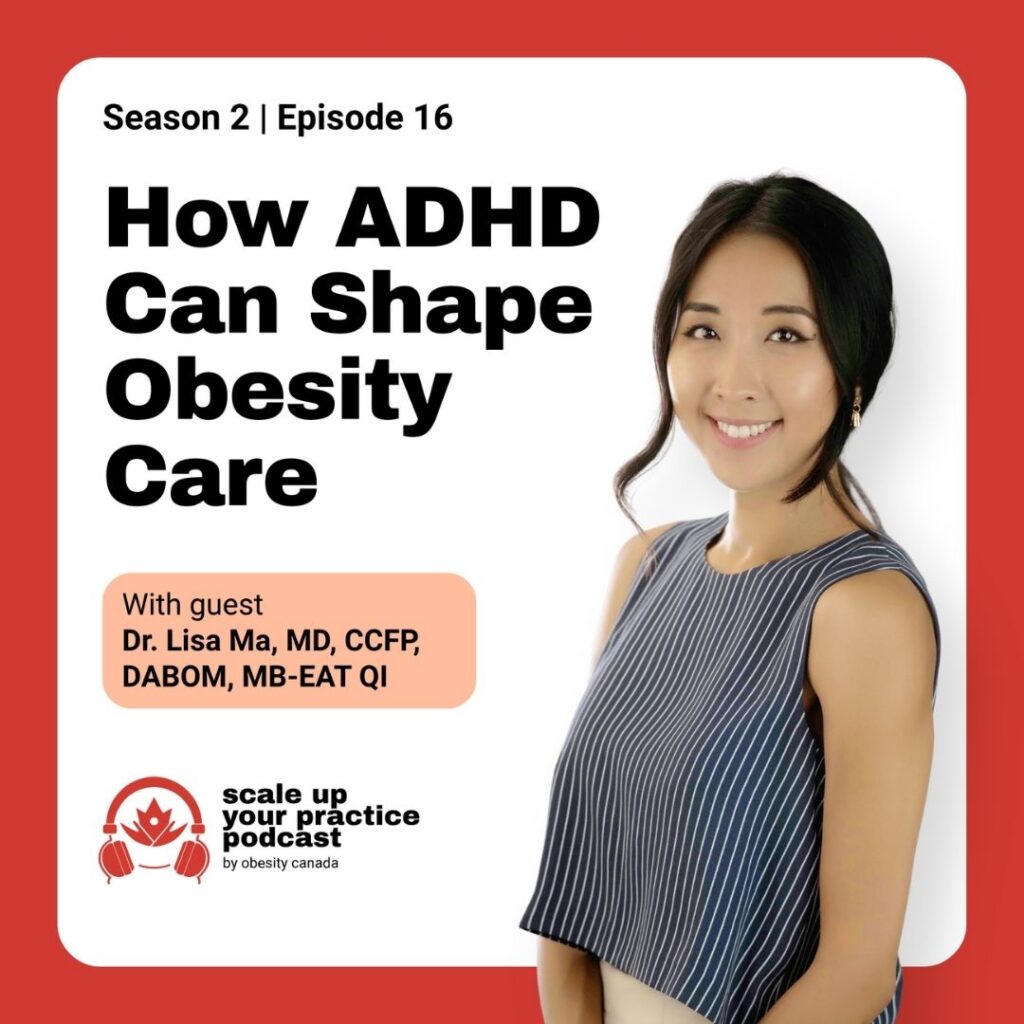
Dr. Lisa Ma joins us on the podcast to explore how ADHD can intersect with obesity care through attention, executive function, reward processing, impulsivity and emotional regulation. We talk about what can happen when difficulties with execution are mistaken for a lack of knowledge or motivation, and how clinicians can make treatment plans more realistic for the person in front of them.

Dr. Lisa Ma is a family physician and obesity medicine specialist with additional training in psychotherapy and mindful eating. She is the Medical Director of Thrivology Health and Clinical Director of the TELUS Health MyCare Weight Management Program.
Her clinical work sits at the intersection of medicine, psychology, and behaviour change. Drawing on years of supporting people living with obesity, mental health conditions, and complex relationships with food, her philosophy of care is grounded in the belief that meaningful change begins with understanding the whole person, not just the condition.
Her work focuses on delivering evidence-informed, compassionate weight management care that supports both metabolic health and patients’ relationships with food, weight, and themselves.
Today’s conversation is a good reminder that obesity care takes knowledge, compassion and a commitment to reducing stigma. For healthcare professionals with experience in obesity care, Obesity Canada’s Certified Bariatric Educator exam is one way to have that knowledge recognized and stand out in the field.
The next CBE exam takes place on November 28, 2026 and applications must be submitted by November 2 to be eligible to write.
Support Scale Up Your Practice by:
Email us at scaleuppod@obesitycanada.ca
This episode script was developed using NotebookLM to synthesize complex source materials into a structured educational format. The tool was used to analyze the Canadian Obesity Education Competencies (COECs), the Obesity Canada Strategic Plan, and guest-specific research. Specific prompts were utilized to extract relevant learning objectives, map them to CanMEDS roles, and generate competency-based interview questions.
While NotebookLM assisted in drafting the narrative arc and educational framework, all content has been reviewed, fact-checked, and refined by the podcast hosts and Obesity Canada’s clinical experts. This ensures the script aligns with current Clinical Practice Guidelines and authentically represents the lived experience perspective.
00:00:00:05 – 00:00:26:04
Dr. Lisa Ma
Particularly with ADHD, you can also often have issues with task initiation. So you know what you want to do exactly, but just getting started on that sequence can have some limbic resistance and make it harder. The first lesson here is, as clinicians, that it’s worth us paying attention to the cognitive cost of our recommendations.
00:00:26:07 – 00:00:35:25
Dr. Roshan Abraham
Hello, everyone, and welcome back to Scale Up Your Practice, brought to you by Obesity Canada. I’m Roshan Abraham, family physician and associate professor at the University of Alberta.
00:00:35:28 – 00:00:53:02
Michelle McMillan
And I’m Michelle McMillan, a lived experience advocate with Obesity Canada. Roshan, one thing we talk about a lot on this podcast is how advice sounds simple in the clinical setting but can be much harder to implement in everyday life.
00:00:53:05 – 00:01:13:18
Dr. Roshan Abraham
Absolutely. And ADHD is actually an interesting example of that. In clinical practice, we may mistake executive dysfunction for a lack of motivation or noncompliance. Advice like “prep your meals,” “build a routine,” or “just be consistent” may not account for the neurobiology behind how our brains regulate attention, reward, and impulse control.
00:01:13:19 – 00:01:19:20
Michelle McMillan
And when the advice doesn’t fit the person, it can feel like they’re the problem.
00:01:19:23 – 00:01:26:02
Dr. Roshan Abraham
Exactly. So the question for clinicians becomes: what are we missing when the usual approach isn’t working?
00:01:26:03 – 00:01:39:11
Michelle McMillan
So today we’re focusing on how ADHD can shape someone’s experience of obesity care and management, and what clinicians can do to help adapt care to the patient’s individual needs.
00:01:39:16 – 00:02:02:04
Dr. Roshan Abraham
To help us navigate this, we’re thrilled to welcome Dr. Lisa Ma. Dr. Ma is a family physician and obesity medicine specialist with a clinical focus in weight management, psychotherapy, and disordered eating. She is a diplomate of the American Board of Obesity Medicine and has advanced training in acceptance and commitment therapy, or ACT, cognitive behavioural therapy, or CBT, and mindfulness-based eating awareness training.
00:02:02:08 – 00:02:04:11
Dr. Roshan Abraham
Dr. Ma, thanks so much for joining us today.
00:02:04:15 – 00:02:10:05
Dr. Lisa Ma
Thanks so much, Roshan and Michelle. I’m really happy and excited to be here and have this conversation with you both.
00:02:10:10 – 00:02:25:11
Michelle McMillan
We’re excited to have you. To start us off, let’s talk about the connection itself. What do we know about the connection between ADHD and obesity, and what do clinicians need to understand about that relationship?
00:02:25:17 – 00:03:02:29
Dr. Lisa Ma
Yeah, absolutely. So I’d say the first thing is there is a very well-established association. There’s one large meta-analysis of more than 700,000 people that found that obesity prevalence was about 70% higher in adults with ADHD. And in people with obesity who seek treatment, ADHD is about 2 to 3 times higher than the general population. But speaking to the second part of your question, I think what’s more useful than just simply knowing that this relationship exists is understanding how ADHD actually intersects with the different factors that influence weight.
00:03:03:01 – 00:03:31:25
Dr. Lisa Ma
Because as you guys talk about, and as we finally know, obesity as a health condition is multifactorial, and it’s never just one thing contributing. So clinically, I actually find it helpful to organize the different influences using what I call the weight triangle. That is our biology, psychology, and environment. I’m a very, like, analogy kind of person, so the way I like to explain this to patients is it’s kind of like driving a car.
00:03:31:27 – 00:03:59:05
Dr. Lisa Ma
The car is our biology. That’s things like hormones, appetite, metabolism, sleep, and our health conditions and medical profile. The driver is our psychology, and I think for many of us growing up in diet culture, that’s often been reduced down to how disciplined you can be. But as you both know, there is a lot more that goes into driving a car than just willpower.
00:03:59:06 – 00:04:27:07
Dr. Lisa Ma
So of course, it’s important to name that self-regulation skills like discipline and impulse control are a part of that, but it is also our self-talk, how we’ve been taught to cope with stress and emotions, our identity and beliefs, as well as what I love to focus on, which is our relationship with food, weight, and our bodies. The third part of the triangle is what I call the road, or our environment.
00:04:27:07 – 00:04:56:18
Dr. Lisa Ma
So that, of course, means things that are a bit more dependent on where we live. So what is our access to nutritious, affordable, and convenient foods? But also it’s everything else around us and what’s on our plate in life. So this is family and work responsibilities, our relationships with the people around us, which can be healthy or unhealthy and impact everything else, as well as our daily routines and schedules.
00:04:56:22 – 00:05:29:10
Dr. Lisa Ma
Talking about that intersection in particular, ADHD is especially relevant because it impacts how the driver navigates the road. So things like regulating attention, executing tasks, and managing emotions and impulses are all gonna affect what happens behind the wheel. From a clinical perspective, I think it is so important that we understand how these processes come together, because that can help us not just see what our patients might be struggling with, but also why.
00:05:29:12 – 00:05:34:11
Dr. Lisa Ma
And I find that that gives us a much better foundation for then tailoring their care.
00:05:34:17 – 00:05:49:14
Dr. Roshan Abraham
That’s amazing. And as you’ve been mentioning already, your work really brings together medicine, psychology, behavioural change, and our relationship with food, and that analogy was incredible. So what initially drew you to that intersection?
00:05:49:16 – 00:06:14:08
Dr. Lisa Ma
Thanks so much, Roshan. I appreciate it. I’ve always been a very curious person, and so when I got my first chance to actually decide what I wanted to study in school, I just went to what interested me. So something I really find fascinating is some people, I’d say like my partner, he eats to live, but I identify as someone who lives to eat.
00:06:14:09 – 00:06:36:24
Dr. Lisa Ma
And so when I was doing my undergrad, I was really interested in how our relationship with food can be really simple, or it can actually be incredibly complex depending on our lived experiences. And that’s what kind of led me to my degree in integrated sciences, where I got to study the nutrition, psychology, and physiology of eating behaviours.
00:06:36:27 – 00:06:59:26
Dr. Lisa Ma
From there, I knew that I wanted to do something in that realm. I think, Roshan, maybe you identify, I also wanted to help people. Like, at that age, all I knew is I wanna help people. And so I really fell in love with family medicine and preventative care, because I find that at its core and at its very best, it really is centred in getting to know someone in the context of their life over time,
00:06:59:26 – 00:07:28:23
Dr. Lisa Ma
and that’s such an incredible privilege. What I also learned very quickly, though, once I was actually in practice was, a lot of the things we were taught in school, like how to educate our patients on what’s healthiest for them, weren’t actually enough to create change. So it was then that gap that became the question I really got focused on trying to help answer, which is: how do we help someone go from knowing what they wanna do to actually doing it consistently in their real life?
00:07:29:01 – 00:07:42:18
Dr. Lisa Ma
And that’s where my work naturally evolved into my current clinical practice, where I get to bring together medicine and psychology to understand the person, them as a driver in their car on their road.
00:07:42:24 – 00:08:09:27
Michelle McMillan
Yeah, I love that analogy. We can keep that analogy. I love it. Yeah, so if we kinda go beyond the analogy, right? I’d be interested, on a practical level, what does that look like once you’ve explained the triangle to your patients? How do you translate that from your metaphor into how do they practically put those things into practice in their life?
00:08:09:28 – 00:08:32:22
Dr. Lisa Ma
So I think it really depends, again, on when we’re there together. Like, what I’m really focused on is the person in front of me. And so we’ll talk about the biology, the psychology, and the environment, and what we focus on first is really what’s most relevant to them, what’s front of mind. And then I think the incredible thing about being human is that everything is kind of connected,
00:08:32:22 – 00:08:51:03
Dr. Lisa Ma
right? So we might start working a little bit on environment design for them, something that is very simple, like you’d want to take your vitamins in the morning, but if they’re in the cupboard, like, I don’t take them. So I put them right in front of me on my nightstand, right? So it’s kind of doing one thing at a time first with whatever’s kind of at the front of their mind.
00:08:51:05 – 00:09:23:00
Michelle McMillan
And so you’ve kind of talked about how to make things more simple, right? So a lot of things around weight management depend heavily on planning and routines and consistency, right? However, if someone is living with ADHD, where does that advice start to break down, and where do you kinda have to adapt what you’re trying to work with them on based on their diagnosis of ADHD?
00:09:23:05 – 00:09:48:05
Dr. Lisa Ma
I think this is where, as clinicians, I find that helping people move from the what to do, which is stuff they probably already know, to the how to do it of behaviour change is just what becomes really important. So earlier on in my career, I would give, I think, pretty good advice. Something like, “If you prep your meals on Sunday, you’ll have enough for maybe the first couple days of the week.”
00:09:48:08 – 00:10:07:11
Dr. Lisa Ma
But then I’d have patients come back and not follow through on it. And if I actually step back and unpack that advice for myself, there are actually a lot of steps and executive function involved, right? So it’s very easy to say, but to actually do and execute, you have to decide what you’re gonna eat,
00:10:07:13 – 00:10:30:15
Dr. Lisa Ma
check what you have at home, make a list, go grocery shopping, prep the ingredients, cook them, clean, which is the bane of my existence, and then you have to repeat it all again, right? Particularly with ADHD, you can also often have issues with task initiation, so you know what you want to do exactly, but just getting started on that sequence can have some limbic resistance and make it harder.
00:10:30:15 – 00:10:56:00
Dr. Lisa Ma
So a reflection that I had is that advice that can sound simple and straightforward on the surface might not actually be accounting for what’s actually entailed in practice. And this is where I find that as clinicians, we can often trip ourselves up when we mistake an execution problem as a knowledge problem, and then we’re reiterating the same thing about what someone should do when they already know it.
00:10:56:00 – 00:11:24:26
Dr. Lisa Ma
So I find the first lesson here is, as clinicians, that it’s worth us paying attention to the cognitive cost of our recommendations. So really concretely, it’s how many steps and decisions are we actually asking of someone? Being strategic about where can we remove unnecessary barriers, I think especially nowadays, because the positive of being in our modern society is that we do have conveniences that we can sometimes consider.
00:11:25:00 – 00:11:48:11
Dr. Lisa Ma
So I like to use an acronym I call HEY, which is healthy, easy, and yummy. So it just needs to be healthy enough, but it also has to be easy enough, and it also has to be yummy enough for us to keep doing it, right? So it’s not just about the healthy piece. And I find that having a more nuanced approach in this way than what is the perfect advice can really help us,
00:11:48:12 – 00:12:14:19
Dr. Lisa Ma
because when our well-intended advice isn’t taking into account that person’s life, then it can create a bit of a relational disconnect. So it’s not just about giving good advice or telling people what to do. It’s actually the piece of making the advice doable, and then helping them problem-solve the how. I’d love to mention here too, Michelle, just a bit about specifically with ADHD.
00:12:14:22 – 00:12:43:27
Dr. Lisa Ma
One lens I really like is to think about that person’s functional profile. As we know, ADHD is diagnosed based on persistent patterns of inattention and/or hyperactivity-impulsivity. But just knowing that isn’t necessarily that clinically helpful. The way that I find, actually looking at it like, “Okay, who is this person? What’s going on in their life, and how can we kind of help them with their daily function?”
00:12:43:27 – 00:13:07:02
Dr. Lisa Ma
So I actually like to break down ADHD into four key functional domains, and then kind of work on it with them from that perspective. So just to name them, the first is attention and executive function, so those are things we talked a little bit about, like planning, organizing, task initiation and switching, as well as time management. The second thing is reward processing.
00:13:07:02 – 00:13:29:12
Dr. Lisa Ma
So people with ADHD can tend to have more biases towards immediate rather than delayed reward, such as the yummy food that’s in front of us right now versus our A1C in 3 months. So that can sometimes make it harder to work towards a health goal if it feels distant or abstract. I think as clinicians, it’s important to know that because we’re so focused on, “Let’s make your blood sugars better.”
00:13:29:13 – 00:13:51:17
Dr. Lisa Ma
But if that person can’t actually feel that motivation, then it requires a change in our approach. Third is impulsivity, which, the way I think of it, is essentially this amount of space between an urge and an action. And then finally, I think something that as a society we could do a bit better on as well is our emotional health,
00:13:51:17 – 00:14:14:20
Dr. Lisa Ma
so emotional regulation and processing, including noticing what you’re experiencing, being able to understand and interpret it, and then deciding how we want to respond. So of course, too, I mean, I’ve created these neat little boxes for us, but in real life, all these domains overlap. So again, it goes back to sitting down with the person, trying to figure out which domain we can help them with,
00:14:14:20 – 00:14:16:16
Dr. Lisa Ma
and then kind of targeting those pieces.
00:14:16:22 – 00:14:39:14
Dr. Roshan Abraham
That’s incredible. And I don’t think it’s just in ADHD that we would see this. I think we were mentioning this before. This applies to everyone. And again, I always like to think of things beyond obesity. This is about chronic disease management, especially in primary care. As you’re talking, I can see this apply to so many of my patients who I manage chronic disease for.
00:14:39:17 – 00:15:01:14
Dr. Roshan Abraham
And so yes, we’ll be talking a bit more about ADHD, but I think there’s really an opportunity for our listeners to hang on to what you’re saying for all chronic disease management. We’re specifically talking about obesity management, because again, there are applications to all of our patients in this case. And what I love is that it’s giving us something at least a little bit practical.
00:15:01:17 – 00:15:26:03
Dr. Roshan Abraham
And then just as you said, it actually helps with the relationship, too, because it actually does sound like we’re listening. I think patients do understand that we are listening, but that maybe we don’t necessarily have the toolkit to sort of get down to that detail that you’re talking about. But I think with these sorts of prompts, if you will, or opportunities for reflection and discussion with your patient,
00:15:26:03 – 00:15:40:29
Dr. Roshan Abraham
I think there’s real opportunity to actually get some moments of clarity on both sides. So yeah, I think, yeah, we’re talking about ADHD more broadly, but I really do think that this applies to a lot of patients who we’re managing chronic disease for.
00:15:41:00 – 00:15:59:25
Dr. Lisa Ma
Oh, I love that, Roshan. Absolutely. I mean, that’s the cool way to clap nowadays, right? Absolutely. Yes, I’m there with you, and I think that’s the thing is, like, the beauty of family medicine is we really are sitting with that person figuring out what’s going on in the context of their life, and ADHD doesn’t create a completely different set of rules, right?
00:15:59:26 – 00:16:14:21
Dr. Lisa Ma
Really, it’s for any person. We’re looking at what’s their functional profile. Some of us are gonna require more scaffolding or a different approach than the standard advice, and I think that’s the beauty of being human, that we’re, like, actually here with each other trying to figure it out.
00:16:14:22 – 00:16:34:23
Michelle McMillan
I just wanted to follow that through. Yeah, we’re focused on ADHD today, but you mentioned the simple example of, like, your A1Cs, right? Like, “Oh, I could have ice cream today, and that would be delicious and taste lovely and then have a lovely social engagement with the people around me, or I could worry about what the blood work’s gonna say in 3 months.”
00:16:34:23 – 00:17:01:22
Michelle McMillan
And yeah, it probably applies on a spectrum of how impulsive people would be about that. But I think that people in general, all of your patients, are probably gonna struggle with which choice do I make today? So yeah, I think this is just great that I think it applies to a lot of places for our listeners and not just their patients dealing with ADHD and obesity.
00:17:01:24 – 00:17:23:20
Dr. Lisa Ma
No, absolutely, Michelle. Just to layer a bit on that, too, a really big part, kind of what Roshan was saying as well, is this is about our relationship with our patient, right? And it’s also their relationship with food. So I’m trying to avoid black or white, but I never say, “Don’t eat the ice cream,” right? It’s about the context of, “Okay, what does this ice cream mean to you today,
00:17:23:22 – 00:17:35:06
Dr. Lisa Ma
and then what else is going on in life?” Right? So we also wanna make sure that we’re helping to kind of build that healthy relationship with food as we move through this weight management journey.
00:17:35:09 – 00:17:53:17
Dr. Roshan Abraham
So patients living with ADHD may have experienced being labelled as lazy, disorganized, or lacking discipline, and those are unfortunate judgments we hear in weight stigma as well. How do those two experiences overlap and compound internalized blame and shame?
00:17:53:20 – 00:18:29:16
Dr. Lisa Ma
Yeah, this is such an important topic, and I’m so glad you guys brought it up here. First, I’ll say I am very optimistic, and it’s because of platforms like this that we’re really starting to talk about and understand how those judgments that can be internal or external can really create barriers to progress. I’d say historically, in both ADHD and weight management, I think there’s been maybe a human tendency to take something complex and just reduce it down to someone’s character, because often it’s easier.
00:18:29:19 – 00:18:52:19
Dr. Lisa Ma
It’s a mental heuristic, right, just to label something than to actually sit and understand why something that might be simple for us is hard for them to do. Being in the experience, if you have spent years, maybe even from childhood, hearing things like, “You’re lazy,” “You just need to be more disciplined,” or, “Weight loss…” I hate this one.
00:18:52:21 – 00:19:13:27
Dr. Lisa Ma
“Weight loss is so simple. Just eat less and move more.” Then obviously it’s gonna make sense that those scripts become part of how you see yourself. And I think that’s where self-criticism and shame can really start to layer is when they become entrenched in our identity, and that’s when it can make the behaviour change process much more difficult.
00:19:13:29 – 00:19:51:20
Dr. Lisa Ma
I like to talk a lot about the concept of shame in practice as well, because I find that it can be an especially sticky emotion. Shame takes something that we’re struggling with and it turns it into a judgment that there’s something inherently wrong or defective about who we are. And clinically, shame really matters because if every setback keeps reinforcing that underlying schema or belief of “I am a failure,” it makes it way harder to actually just step back and look at what happened objectively to actually learn from it.
00:19:51:21 – 00:20:26:23
Dr. Lisa Ma
On a positive note, I think that this is also exactly why I really feel it is genuinely a privilege that as clinicians we can have these spaces and these conversations with our patients that can be more vulnerable and more intimate. And if at that place we can offer a bit more of a nuanced and also a more accurate lens, then I think that that allows not just for what we talked about with that relationship, but also it makes it way easier to build a roadmap for how they function,
00:20:26:26 – 00:20:34:17
Dr. Lisa Ma
and something I always talk about, which is how do we navigate setbacks without reinforcing those same self-blaming schemas?
00:20:34:19 – 00:20:47:24
Dr. Roshan Abraham
So you’re talking about a lot of amazing concepts here, but when a patient is caught in that loop of executive dysfunction and shame, how do we then help them reframe their expectations and sort of draw them out of that cycle?
00:20:47:27 – 00:21:11:07
Dr. Lisa Ma
Yeah, absolutely. So I think this is where it actually is an education piece, right? Because I think from… Again, I’m, like, very much about our emotional health and our society. We don’t necessarily get to have these conversations day to day. So I’d say a few concepts here that I like to talk about with my patients. The big one is really taking the struggle out of their identity.
00:21:11:10 – 00:21:37:04
Dr. Lisa Ma
And the way we do this is, I say this in the most loving way possible, they’re not special. Like, it’s not just you. I mean this in the best way. Struggle is an essential part of the human condition. And like we talked about, whether someone has ADHD or not, it is very common to think, “I know what I want to do, so I should be able to do it.”
00:21:37:11 – 00:22:07:15
Dr. Lisa Ma
We actually call that disconnect the intention-behaviour gap, and I think even just naming it is actually very powerful for the person so that they see it’s not just them. And the other piece of this is helping that person understand what the process of change actually looks like. Because I don’t know about you guys, but definitely for me and for many people I work with, we don’t decide to do something and then we suddenly execute it perfectly and consistently from that point forward.
00:22:07:16 – 00:22:28:01
Dr. Lisa Ma
I mean, some people do, good for them, but I don’t identify that way. So what I like to say is that typically, when we look at behavioural science, when we look at sustained change and also that identity piece, it actually is a way slower, way less linear, and often it’s a messy process.
00:22:28:08 – 00:23:06:22
Dr. Lisa Ma
So a part of reframing and resetting those expectations is helping them understand that first, change does not usually happen all at once, unless we’re, like, in a movie. And second, that struggle is actually a part of learning what works. This way, we can start to relate to the process differently. And key here is that if we can start to see a setback as information rather than evidence that you are a failure, then we can actually use it to adjust our approach, which is way more exciting.
00:23:06:25 – 00:23:26:17
Michelle McMillan
No, I love that you said that you tell your patients that struggle is part of the process. We live in a society of, like, instant, right? So we kind of think that, “Okay, you gave me advice. I’m gonna do the advice perfectly. It’ll be great. We’ve solved the problem,” right? But it’s actually kind of a feedback loop that you’re talking about, right?
00:23:26:20 – 00:23:47:05
Michelle McMillan
We try to solve the problem, we develop a plan, we try to implement the plan, there are some struggles involved, then we have to go back to the plan again, right? And do that loop over and over again. And I love that you tell your patients that, because I can imagine there’s just, like, this sense of relief in hearing that when
00:23:47:05 – 00:24:11:29
Michelle McMillan
I struggle with something, it isn’t all about me. It isn’t my failings. And you simply saying, “It’s not a failure. We just may need to approach this differently.” I’m curious just to hear, you’ve gone through this process, I’m sure, with many, many patients, and how does that affect the patients?
00:24:11:29 – 00:24:16:05
Michelle McMillan
What do you see in your patients when you develop this system with them?
00:24:16:09 – 00:24:35:19
Dr. Lisa Ma
Yeah, absolutely. I mean, some of the things we’ve already touched on and talked about, right? The way I look at most conversations is that we do have this logical layer, so it’s the stuff we’re talking about, and then right underneath that is the beauty of the emotional layer, right? So that’s the tone and how we’re connecting with one another.
00:24:35:19 – 00:25:07:25
Dr. Lisa Ma
So I find that when we can shift our language, it can change the tone of the conversation. For many people that I get to work with, they can come to me feeling pretty defeated and stuck. So they’ve already tried hard, they’ve already kind of done the diet, they’ve already talked to many different kinds of people, and often I find that maybe it’s a simple approach, but it’s just kind of having that relief that there’s someone on their team who gets it, who’s not just talking at them, they’re talking with them.
00:25:08:01 – 00:25:38:17
Dr. Lisa Ma
And I find that as a clinician, me changing this approach for myself, where I’m trying to understand the barriers rather than tell them what to do, can really make our questions land differently. So really coming from a place of curiosity and wanting to genuinely understand and help, rather than, I think, what is also normal and human when you really want to help someone, is sometimes maybe feeling that frustration or disappointment and that coming across as judgment.
00:25:38:17 – 00:25:47:02
Dr. Lisa Ma
So I find that this perspective really is key because it is about that therapeutic relationship, but it’s also about moving forward together.
00:25:47:07 – 00:26:04:17
Dr. Roshan Abraham
So this has all been incredible. You should write a book about this if you haven’t already. Like, this is actually amazing. I just actually wanna pause for a second and just say that… So I’m involved in a lot of education work at the U of A, and we talk a lot about patient-centred communication
00:26:04:17 – 00:26:31:28
Dr. Roshan Abraham
and now moving to relationship-centred, focused communication, and we find that it’s a lot easier to say this stuff on paper, but then when we’re in practice and actually putting it into practice, we actually don’t necessarily get that feedback. And I do think patients do appreciate when we are patient-centred, but the more that we can actually understand the relationship in various ways, and you’ve actually highlighted some incredible ways in which we can actually understand the relationship for our patients,
00:26:31:28 – 00:26:58:27
Dr. Roshan Abraham
and I’ll just take it broadly from chronic disease management or obesity, but even more broadly than that, if we’re talking about change management within healthcare, or when we’re talking with a patient or behavioural change, it doesn’t just apply, again, to patients with chronic disease management or obesity. So I do think there’s a lot here that we can take away from. I’m wondering… so that’s a lot sometimes for physicians to do on their own.
00:26:59:00 – 00:27:27:28
Dr. Roshan Abraham
Have you seen anything in the way of interdisciplinary care? So how might that actually be shared practically amongst, let’s say, other members of the healthcare team, if they’re available? So dietitians, chronic disease nurses, mental health professionals like psychiatrists or behavioural health consultants or psychologists, and then of course our physician colleagues, not just primary care physicians. Have you seen any sort of, I guess, ways in which we can do that in a reasonable fashion?
00:27:28:00 – 00:27:50:00
Dr. Lisa Ma
I mean, I can only speak of my own experience. Probably is the best I can do that way. I think, again, it’s offering clinicians frameworks that actually make sense in practice, and then us using our methods of communication to kind of have that in notes that we can carry across the care team’s journey with the patient,
00:27:50:01 – 00:28:08:23
Dr. Lisa Ma
right? So I would actually go back to those four domains we talked about earlier. The strategy here, I’m a pretty simple person. I just think, what’s the strategy for what’s the barrier? And that’s something that we can then… If we have those four domains, we can see which parts of our team can help with which pieces.
00:28:08:23 – 00:28:35:23
Dr. Lisa Ma
So I would say there are specific things we can do for attention and executive function, like reducing the cognitive load, and maybe that’s a piece that we have a behavioural health specialist help with. Or even if it’s just those little bites in practice, in clinic together. Things like emotional processing and our emotional health can be an area where our mental health colleagues are especially helpful,
00:28:35:27 – 00:28:59:07
Dr. Lisa Ma
just because if you have more complex patterns, it can take more time to unpack. But those are also things that we can work on together, like mindfulness. Especially, I’m, like, a major proponent of mindful eating. I think it’s, like, a beautiful way to reconnect with food and our body, building interoceptive awareness and helping them expand their toolbox with things like CBT or DBT or ACT.
00:28:59:08 – 00:29:14:17
Dr. Roshan Abraham
So then we mentioned ACT, CBT, and you mentioned mindfulness-based eating awareness. How realistically… And this is hard to do. This is really hard to do. How would you fit these types of tools into a busy clinic day?
00:29:14:22 – 00:29:36:16
Dr. Lisa Ma
It absolutely is, Roshan. And I think I have a counseling practice where I get to spend a bit more time with each person, so I do have to speak from that too, is like, it’s not like I figured out a perfect plan for a 10-minute visit. But I also work at a women’s health clinic where I get to work with people in person, and we only really get that 10, 15 minutes together, unless I run late.
00:29:36:19 – 00:30:00:05
Dr. Lisa Ma
So I’d actually say here is that, to take some pressure off the clinician, right, we can actually mirror how behaviour change is supposed to work by just doing that one small bite at a time. So maybe our overarching philosophy here is one tool or one habit. We give that person the chance to practise it, and then we can layer on the next.
00:30:00:05 – 00:30:22:09
Dr. Lisa Ma
So I like to introduce the hunger-fullness scale pretty early on. I ask them to check in with it, let’s say before and after lunch on weekdays, and then they come back and tell me how it went. Another time we’ll talk about the ACT choice point, which… we’ll talk about, like, one recurring situation where they want to practise a towards move instead of an away move.
00:30:22:10 – 00:30:38:16
Dr. Lisa Ma
I mean, a personal one for me is like when my partner doesn’t do the dishes, I want to nicely and kindly ask him to do it rather than going, “Why is it not done again?” So just those little movements towards unhooking from the frustration. And then they come back, right? They come back, they let us know how it went,
00:30:38:16 – 00:31:10:24
Dr. Lisa Ma
and then we can further refine our hypothesis and approach. I think great clinicians really do care, and they want to change things for that person. But for me to name this for us is that our job is not to transform someone’s life and solve their relationship with food in one pivotal visit, right? I really think the power of creating these relationships over time is that we’re sharing these moments, and it just gives that person a chance to have that little pause from autopilot and self-reflect.
00:31:10:26 – 00:31:31:21
Dr. Lisa Ma
I found that in my clinical practice, and this wasn’t even the counselling piece, this is more of, like, my women’s health practice, a lot of the more important insights and perspective shifts aren’t from that visit itself where I’m, like, changing their mindset, right? They go, they do something, they notice, they apply it, and they come back and say, “Holy smokes,
00:31:31:21 – 00:31:43:04
Dr. Lisa Ma
that pause before I ate and just, like, enjoying the first three bites made a difference.” And I think that’s really what’s cool about getting to spend time with someone over time.
00:31:43:10 – 00:32:03:14
Dr. Roshan Abraham
I think there’s so much that you’ve been able to talk about so far around all these practices that we can put into place. And I don’t wanna take away from that, but I do wanna quickly chat about the role of medication in our toolbox because it is relevant.
00:32:03:14 – 00:32:17:10
Dr. Roshan Abraham
We’re seeing it now more and more, obviously. When we’re talking about ADHD treatments, obesity pharmacotherapy, or potentially both, what should clinicians be thinking about when we’re putting it into the context of what we’ve already been talking about throughout this podcast?
00:32:17:14 – 00:32:39:21
Dr. Lisa Ma
Medication’s important. Like, you and I are family docs, like, we get it. Like, it is incredibly helpful. And so there are a few things I like to talk about around medication with how we use it as responsible builders, right? So I like to talk about, when we build a house, we don’t just use a hammer. We have our whole toolbox of what we can kind of equip ourselves with.
00:32:39:21 – 00:33:06:03
Dr. Lisa Ma
So first off would be framing the role of medication in our patients’ journey. I think it’s incredibly important, and often it is necessary just because of the way their brain functions in this kind of neurotypical world, which I have other comments on. But essentially what we wanna talk about here is that, first off, medication does directly target the underlying biology, or how the car works.
00:33:06:08 – 00:33:37:15
Dr. Lisa Ma
I think those are the… like, the incredible game-changing obesity management medication that we’ve had has really highlighted that role and actually helped a lot of the weight stigma piece that a lot of us have to encounter. But the other part of the role that I think is very, very valuable and important to name is that because medication can reduce some of the biological friction, it doesn’t replace the need for behavioural strategies, but it can make it easier to help build the skills and systems.
00:33:37:19 – 00:34:03:23
Dr. Lisa Ma
I have patients who, after they start on a medication that reduces food noise, they actually have a bit more of that mental load back, right? To actually look at the other pieces that they’ve always wanted to do. So I think that is really important, is understanding what the role is directly and indirectly. And the next thing I like to talk about is how do we choose which tool, or which medication?
00:34:03:24 – 00:34:27:29
Dr. Lisa Ma
And we talked a little bit about this before, but I like to just start with what’s on that person’s mind, or what’s on their heart, right? Like, what is getting in the way the most right now, so that we can match the tool to the barrier. And this really matters to me because ADHD and obesity intersect so much, but we also want to treat each condition for its own indications.
00:34:27:29 – 00:34:53:01
Dr. Lisa Ma
So something that I’ll sometimes see that will make me pause is if someone comes to me already on a stimulant medication and they keep escalating it for that side effect of appetite suppression. Yeah, Roshan, you get it, right? It’s like one of these things where I don’t necessarily love that, just because once the medication wears off, there can be a bit more of a tendency towards overeating.
00:34:53:01 – 00:35:14:14
Dr. Lisa Ma
So I would rather we look at an obesity management medication that actually directly targets appetite and weight regulation. And of course, we treat one condition, it can make the other one easier to manage, but that’s still very different than asking one medication to do two different jobs and then having to treat side effects, right?
00:35:14:21 – 00:35:53:27
Dr. Lisa Ma
The other piece I like to mention here as well is something that I’ll sometimes also see is someone who comes to me on only a stimulant medication, but as we know, mood and anxiety disorders are incredibly common with ADHD. It’s about, I think, like 5 times higher for anxiety and 4.5 for depression. So I always do wanna make sure that I’m screening and treating for those conditions as well, just because it is a very important part of the picture, especially if someone maybe has had higher functioning through their life, and it’s more of an adult diagnosis, and they already have had to kind of go through the
00:35:53:27 – 00:36:23:05
Dr. Lisa Ma
mental hurdles of managing ADHD within our society. And then I’d be remiss to also mention kind of what you said there too, Roshan, is that for a holistic approach to care, we’re not just kind of looking at one pillar, right? We’re making sure that that foundation is solid with nutrition, movement, stress regulation, and something that I’m finding is especially important nowadays, especially when we talk about ADHD and weight,
00:36:23:08 – 00:36:47:17
Dr. Lisa Ma
is sleep, right? Because poor sleep can impact all of the domains we’re talking about. It impacts weight and appetite regulation. I’m much kinder once I’ve had more sleep, I find. So that’s where I also like to step back with my patients. I actually had one come in recently who was just having her Vyvanse escalated higher, higher, higher, higher,
00:36:47:24 – 00:37:18:21
Dr. Lisa Ma
and I just paused and I thought, “How’s your sleep?” And she told me she’s actually never talked to her doctor about her sleep before, and that’s sometimes difficult, I find, because with ADHD, sometimes there can be some difficulty organizing thoughts and speech. And so I think maybe that’s why there just wasn’t enough time in that visit. But I found that with her, us just pausing and doing a more thorough sleep assessment allowed us to reduce the amount of her stimulant, and she actually is functioning way better because of it.
00:37:18:29 – 00:37:26:24
Michelle McMillan
Today’s conversation is a good reminder that obesity care takes knowledge, compassion, and a commitment to reducing stigma.
00:37:26:25 – 00:37:51:00
Dr. Roshan Abraham
If you’re a healthcare professional with experience in obesity care, Obesity Canada’s Certified Bariatric Educator exam is one way to have that knowledge recognized to stand out in your field. The next CBE exam takes place on November 28th, 2026, and applications must be submitted by November 2nd to be eligible to write. Scan the QR code on screen or visit the link in the show notes to learn more and apply.
00:37:51:05 – 00:38:31:12
Michelle McMillan
So we’ve talked a little bit about the challenges for someone living with ADHD and obesity, and then working to treat them as separate but comorbid challenges, right? But what I’m curious about, ’cause I imagine you have lots of success stories with your patients, is that as a patient myself, when I go to a clinician like you who does things differently, how does that impact not just the outcome, which we think probably will be muchly improved, but also the patient themselves and how they feel about how their life is improving?
00:38:31:13 – 00:38:48:23
Dr. Lisa Ma
Yeah, I mean, I think it’s exactly what you said, Michelle. It’s about how we feel, right? So often we almost default to what the mind knows and what we think, but if we can actually just come back into body, come back into heart and go, “Okay, how did that visit go? How was I feeling afterward?”
00:38:48:26 – 00:39:20:09
Dr. Lisa Ma
I think it actually is something where, again, as a clinician, we’re very in our mind, and we want to fix things and swoop in and get things done. Unintentionally, that person can sometimes feel like they’re just being told what to do and not actually feeling heard, right? So this is something I had to kind of learn and practise myself with mindfulness, which is just really pausing, being present with them, and just taking a moment to listen to their experience for a couple minutes
00:39:20:09 – 00:39:40:09
Dr. Lisa Ma
first. Like, it actually is, I find, much more effective in the therapeutic process over time when that person can actually feel a moment of connection and that the person across from them actually, genuinely is trying to understand why it’s harder, rather than just assuming they’re not trying hard enough or that they don’t get it.
00:39:40:10 – 00:39:46:25
Dr. Roshan Abraham
And the flip side, what can we be doing as clinicians to actually check in and make sure that we’re on the right track?
00:39:46:26 – 00:40:15:26
Dr. Lisa Ma
We talked a little bit about this before, but I’d say that there are kind of three things I’m always just trying to listen for. Of course, it’s the information itself, but underneath that is gonna be the emotions and then their thinking patterns. I found that to really be kind of key to change. When I sit down with a patient, the way that I kinda like to think of it is that we are like scientists trying to build an experiment together.
00:40:15:28 – 00:40:38:10
Dr. Lisa Ma
And then what I keep in mind, though, is, like, I can create the perfect hypothesis of what should be done, but I’m not the one out on the field, right? It’s really that person who has to go out and test our hypothesis in their real life. An important principle of science, too, is that we’re not gonna force the same experiment over and over again if it’s not working, right?
00:40:38:12 – 00:41:01:29
Dr. Lisa Ma
We’re not gonna try to manipulate our results here for what should happen. Instead, we wanna take in that data and adjust the method and try again. So first off, information. Clinically, I think it’s so important to keep in mind that what patients share with us is really useful and valuable, and that we need to treat it as such rather than as an excuse.
00:41:02:02 – 00:41:19:14
Dr. Lisa Ma
Something that I often hear, and I used to get stuck in, is if someone would say, “I wanted to cook, but I was too tired,” or, “I bought the healthy snacks you talked about, but I forgot they were there.” So I think it’s normal and human for me to go, “Oh, why can’t you just do it?” Right?
00:41:19:15 – 00:41:44:04
Dr. Lisa Ma
Like, we talked about it, you should be able to do it. But what I learned is that instead, changing my approach, understanding that those answers actually can give us clues about where the process is breaking down, and then they actually indicate to us as clinicians where we can switch up our strategy, because we want that plan to fit the person, not the other way around. Then the deeper layers, right?
00:41:44:04 – 00:42:08:08
Dr. Lisa Ma
So we talked about the logical layer, and then the deeper layer here is the emotional tone, and also how they think is probably how they speak to themselves. So things like shame, frustration, hopelessness, or overwhelm, as well as the core cognitive distortions we learn in CBT, like all-or-nothing thinking, or those should statements, when people should all over themselves.
00:42:08:10 – 00:42:10:15
Dr. Lisa Ma
I find that, right? Like, people…
00:42:10:16 – 00:42:13:03
Dr. Roshan Abraham
Haven’t heard that in a while, but yeah…
00:42:13:03 – 00:42:14:19
Dr. Lisa Ma
One of my faves.
00:42:14:19 – 00:42:15:11
Dr. Roshan Abraham
I remember that, yes.
00:42:15:12 – 00:42:43:29
Dr. Lisa Ma
I’m like, “Stop shoulding all over yourself.” Good one. Yeah, I find, like, if we don’t talk about this, right, these things can cloud our driver’s perspective, so they can’t see as clearly, and they can’t notice as well about what we want to address. So essentially, for the clinical process, bringing together all three of those pieces, what I like to focus on is helping that person stay in more of, like, a scientist mindset, which is curious, objective,
00:42:44:02 – 00:43:08:16
Dr. Lisa Ma
and, for me especially, a little bit of that nerdy excitement about, “Okay, what are we discovering out on the field? What can we play with next?” And I found that the key to the change in my practice, in refining and adapting the approach, is not just about the facts and the strategy. It’s also, very much so, importantly, about the feelings and the mindset.
00:43:08:19 – 00:43:21:10
Dr. Lisa Ma
How can we help someone reorient toward a perspective where they want to keep learning and experimenting and refining? Because that is really the longer-term journey we are able to go on with our patients.
00:43:21:12 – 00:43:29:21
Dr. Roshan Abraham
Dr. Ma, thank you so much for sharing your clinical insights and keeping them so practical, and for the entire conversation. We really appreciate it.
00:43:29:24 – 00:43:31:23
Dr. Lisa Ma
Oh, it’s my pleasure, Roshan. Thank you, guys.
00:43:31:25 – 00:43:51:09
Michelle McMillan
Yeah, I love it. It’s just been so insightful. There have been so many things. I think this is one of those podcasts that you’re gonna have to listen to a couple of times, ’cause you’re gonna pick out things. Every time you listen to it, you’re gonna be like, “Oh, yeah, I can apply that.” One of the primary things that I’ve picked out from it is educate your patients,
00:43:51:09 – 00:44:17:11
Michelle McMillan
and then it becomes a process, right? One little bite, first visit, try to make a plan. Then the next visit, see how did the plan go, and just kind of build on that with your patients and making them understand that it’s a process and that you’re working with them. And yeah, and leaving that shame and blame and “you should have” and all of that out of the conversation and building their confidence that these are changes that they can make.
00:44:17:18 – 00:44:20:18
Michelle McMillan
And I love that you’ve brought up all of those points.
00:44:20:23 – 00:44:26:06
Dr. Lisa Ma
Thank you. And we can have fun together, right? This can actually be a fun time together to figure things out.
00:44:26:11 – 00:44:45:02
Dr. Roshan Abraham
I do wanna also make mention that even though… And I love this as a generalist, that we took it more broadly than just ADHD, but also we did talk about how ADHD may affect things like planning, attention, eating patterns, and follow-through, and I think you highlighted that incredibly well. And then obviously adapting and individualizing treatment plans to work for the patient.
00:44:45:04 – 00:44:54:01
Michelle McMillan
Yeah. And again, just working with your patients. Just ’cause it didn’t work the first time doesn’t mean we can’t make a different plan and it won’t succeed.
00:44:54:02 – 00:45:03:05
Dr. Roshan Abraham
For all our listeners who wanna access resources, guidelines, or professional education programs like Calibre and CBE, head over to the link in our show notes.
00:45:03:08 – 00:45:11:20
Michelle McMillan
New episodes of Scale Up Your Practice drop every second Thursday, so be sure to subscribe on your favourite podcast platform so you never miss an episode.
00:45:11:21 – 00:45:23:15
Dr. Roshan Abraham
And if today’s episode gave you an actionable takeaway, and I’m sure it did, for your practice, please leave us a rating or review. It takes less than a minute and helps clinicians across Canada find this podcast.
00:45:23:20 – 00:45:35:18
Michelle McMillan
And until next time, stay curious, stay kind, and keep scaling up your practice.
00:45:35:21 – 00:46:06:25
Dr. Roshan Abraham
This podcast is intended for informational and educational purposes only and does not constitute medical advice. The content shared in this podcast should never be used as a substitute for professional medical advice, diagnosis, or treatment. Always seek the guidance of a qualified healthcare professional with any questions you may have regarding your health or a medical condition. The information and treatment discussed in this podcast are based on Canadian guidelines and approved practices as of the time of recording.
00:46:06:28 – 00:46:28:17
Dr. Roshan Abraham
If you are listening from outside of Canada, please consult your local healthcare professional to ensure compliance with your region’s medical standards, guidelines, and recommendations. The creators of this podcast disclaim all liability for any decisions or actions taken based on the content discussed. Listening to this podcast does not establish a professional or patient-client relationship.
Be the first to know about new education and resources for healthcare professionals from Obesity Canada.