Call for Authors: Contribute to the Canadian Adult Obesity Clinical Practice Guideline. Learn more

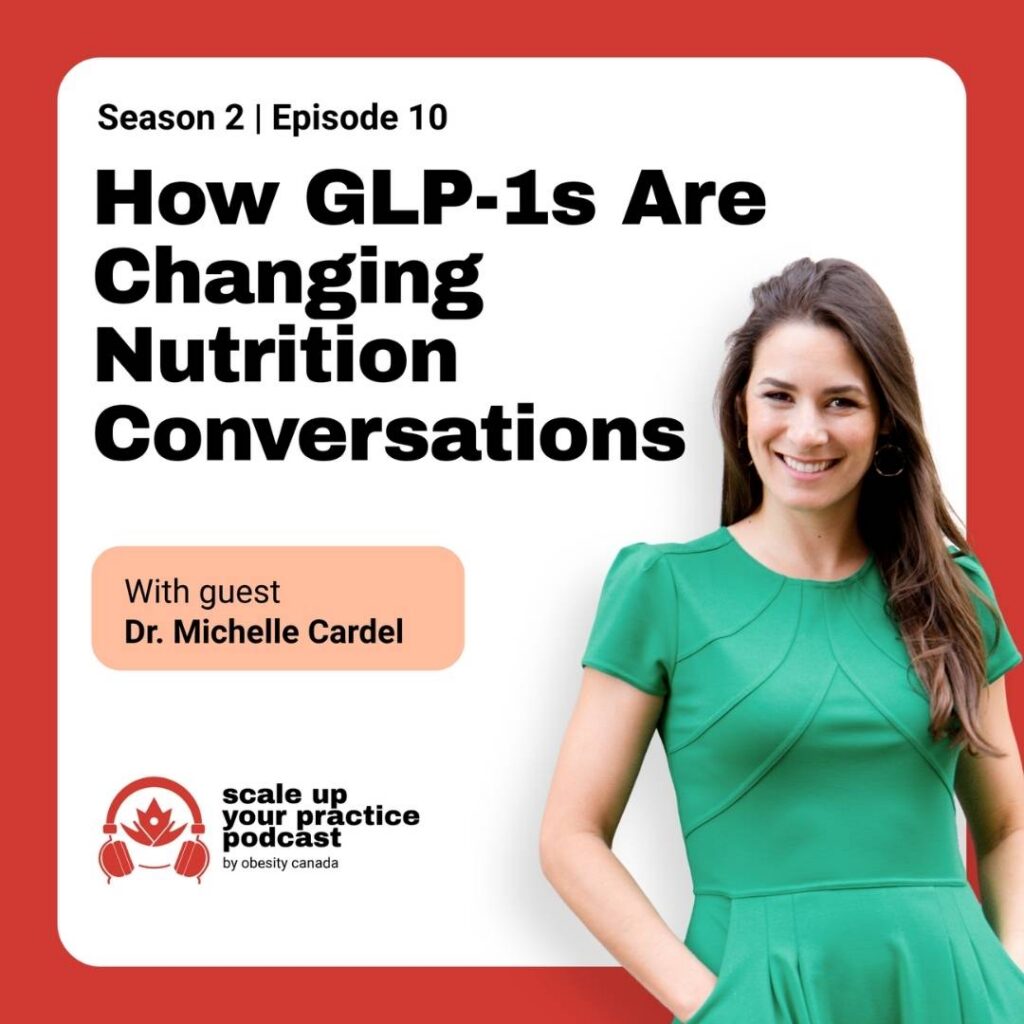
Home • Scale Up Your Practice podcast • How GLP-1s are Changing Nutrition Conversations with Dr. Michelle Cardel



🎙️This episode is sponsored by an unrestricted educational grant from Eli Lilly Canada
Obesity treatments are creating new opportunities for nutrition support that focuses on meeting nutritional needs rather than simply eating less.
Dr. Michelle Cardel joins us on the podcast to explain how GLP-1 medications are changing nutrition conversations in obesity care, and why the focus must shift from eating less to helping patients stay nourished, supporting their health and healing their relationship with food.

Dr. Michelle Cardel is a registered dietitian and obesity scientist with more than 20 years of experience in obesity, nutrition and cardiometabolic health. Her work focuses on developing and evaluating evidence-based approaches to obesity care across diverse populations and care settings.
She is a faculty member and Co-Director of the Center for Integrative Cardiovascular & Metabolic Disease at the University of Florida. Dr. Cardel has authored more than 135 peer-reviewed publications and is a Fellow of The Obesity Society.
If this episode leaves you thinking about how to strengthen your own approach to obesity care, Obesity Canada’s Calibre course is designed to help.
Calibre is an accredited course for healthcare professionals who want practical, evidence-based tools they can apply in real clinical settings. The course combines self-paced learning with live, interactive sessions, helping learners build confidence in obesity assessment, treatment, communication, and patient-centred care.
The next cohort runs September 3 through October 7.
Support Scale Up Your Practice by:
Email us at scaleuppod@obesitycanada.ca
This episode script was developed using NotebookLM to synthesize complex source materials into a structured educational format. The tool was used to analyze the Canadian Obesity Education Competencies (COECs), the Obesity Canada Strategic Plan, and guest-specific research. Specific prompts were utilized to extract relevant learning objectives, map them to CanMEDS roles, and generate competency-based interview questions.
While NotebookLM assisted in drafting the narrative arc and educational framework, all content has been reviewed, fact-checked, and refined by the podcast hosts and Obesity Canada’s clinical experts. This ensures the script aligns with current Clinical Practice Guidelines and authentically represents the lived experience perspective.
00;00;00;03 – 00;00;04;07
So the focus switches from defending that calorie
00;00;04;08 – 00;00;09;16
deficit to nutritional adequacy, actually making sure that patients
00;00;09;16 – 00;00;13;09
are getting enough: Enough calories, enough protein,
00;00;13;09 – 00;00;16;09
enough fiber.
00;00;18;19 – 00;00;20;10
Hello, and welcome to the Scale Up
00;00;20;10 – 00;00;23;18
Your Practice podcast, brought to you by Obesity Canada.
00;00;23;19 – 00;00;25;00
I’m Doctor Roshan Abraham,
00;00;25;00 – 00;00;28;28
family physician and associate professor at the University of Alberta.
00;00;28;29 – 00;00;33;06
And I’m Michelle McMillan, a lived experience advocate with Obesity Canada.
00;00;33;12 – 00;00;35;12
For decades, dietary advice
00;00;35;12 – 00;00;39;06
and healthcare has been reduced to one phrase, “Eat less and move more.”
00;00;39;10 – 00;00;43;18
We treated nutrition as a math equation and body weight as a measure of willpower.
00;00;43;22 – 00;00;47;13
Today, the science of obesity has evolved, and our approach to nutrition
00;00;47;13 – 00;00;49;04
must evolve with it.
00;00;49;04 – 00;00;53;17
We’re moving away from blame-focussed calorie restriction and toward highly
00;00;53;17 – 00;00;55;23
personalised medical nutrition therapy,
00;00;55;23 – 00;00;59;13
ensuring our patients are nourished, supported, and heard.
00;00;59;16 – 00;01;01;13
Today’s episode is supported
00;01;01;13 – 00;01;05;10
by an unrestricted educational grant from Eli Lilly Canada.
00;01;05;12 – 00;01;10;23
We thank them for helping us bring this podcast to clinicians across the country.
00;01;10;25 – 00;01;15;05
Today, we are focusing on medical nutrition therapy.
00;01;15;07 – 00;01;19;14
Specifically, we want to look at how clinicians can work with patients
00;01;19;14 – 00;01;24;18
to understand their nutritional needs and build care plans with their patients
00;01;24;18 – 00;01;27;24
that feel realistic, respectful,
00;01;27;24 – 00;01;30;24
collaborative, and individualised.
00;01;31;10 – 00;01;33;28
Today, we’re joined by Doctor Michelle Cardel.
00;01;33;28 – 00;01;38;25
Doctor Cardel is a registered dietitian and an obesity and nutrition scientist
00;01;38;27 – 00;01;40;09
who has spent twenty years
00;01;40;09 – 00;01;43;11
focused on developing evidence based lifestyle strategies.
00;01;43;11 – 00;01;48;04
She is also the Co-Director for the Center of Cardiovascular and Metabolic Disease
00;01;48;04 – 00;01;53;26
at the University of Florida and a Senior Medical Director at Kailera Therapeutics.
00;01;53;27 – 00;01;55;21
Welcome to the show, Michelle.
00;01;55;21 – 00;01;58;09
Thank you so much for having me.
00;01;58;09 – 00;02;01;10
So we wanted to get started with a question.
00;02;01;10 – 00;02;06;07
Why is now such an important time to rethink our approach to nutrition?
00;02;07;11 – 00;02;08;11
With the advent
00;02;08;11 – 00;02;12;21
of GLP-1s and increased utilisation of GLP-1s,
00;02;12;24 – 00;02;15;12
I think we’re learning a lot of different things.
00;02;15;12 – 00;02;20;13
One, we’re seeing more acceptance that obesity
00;02;20;13 – 00;02;24;23
is a chronic disease and deserves long term care and treatment.
00;02;24;23 – 00;02;28;06
And simply telling patients to eat less
00;02;28;06 – 00;02;32;16
and move more is not just incorrect,
00;02;32;16 – 00;02;36;16
but actually doing much more damage than it is good.
00;02;36;16 – 00;02;42;12
And with the advent of GLP-1 and increased utilisation of those medications,
00;02;42;12 – 00;02;43;22
we really need to take
00;02;43;22 – 00;02;48;12
a very different approach to nutrition and lifestyle than we did
00;02;48;12 – 00;02;51;28
when we were thinking about standard behavioural weight management alone.
00;02;52;12 – 00;02;55;12
Yeah, it’s a brave new world out there, right?
00;02;55;19 – 00;02;58;07
There’s been a fundamental shift in things.
00;02;58;07 – 00;03;02;07
I’d be interested because I know that you’ve been in this field a long time.
00;03;02;07 – 00;03;06;04
I’d be interested to know what brought you to this field
00;03;06;04 – 00;03;09;11
and why you’ve stayed in this field for,
00;03;09;11 – 00;03;12;13
I believe, over twenty years at this point. Yes.
00;03;12;21 – 00;03;16;08
I actually thought I wanted to be a physician.
00;03;16;08 – 00;03;20;12
And when I was in undergrad, I did three medical mission trips,
00;03;20;15 – 00;03;25;13
really positive experiences, and also showed me
00;03;25;13 – 00;03;27;29
that that probably wasn’t the right route for me.
00;03;27;29 – 00;03;34;05
And so I basically graduated college not really knowing what my next step
00;03;34;05 – 00;03;37;29
was going to be, but I had started
00;03;38;00 – 00;03;41;25
being a hospice volunteer when I was in undergraduate.
00;03;41;25 – 00;03;44;28
And being part of that experience was a real privilege.
00;03;44;28 – 00;03;48;14
I got to be a hospice volunteer for about ten years total.
00;03;48;18 – 00;03;53;15
But it’s a real privilege to be with people at the end of life.
00;03;53;15 – 00;03;58;09
And oftentimes you see that people want to share
00;03;58;09 – 00;04;03;17
and they want to talk about their memories and the best things
00;04;03;17 – 00;04;07;25
that happen in their life, but also some things that they regretted.
00;04;07;25 – 00;04;12;24
And during that time, some patients that I was lucky enough
00;04;12;24 – 00;04;17;11
to work with shared how they felt that
00;04;18;09 – 00;04;21;01
their lifestyle and, in particular, nutrition
00;04;21;01 – 00;04;26;12
may have played a role in their disease risk.
00;04;26;12 – 00;04;31;25
And ultimately what led to their terminal disease that put them in hospice.
00;04;31;25 – 00;04;35;22
And, you know, I was nineteen years old when I started in hospice.
00;04;35;22 – 00;04;41;17
I was not thinking about how nutrition or lifestyle would impact,
00;04;41;23 – 00;04;44;23
you know, quality of life or, you know,
00;04;44;23 – 00;04;48;25
how we live or even how we die, you know, decades later.
00;04;48;29 – 00;04;52;06
And those conversations really prompted
00;04;52;22 – 00;04;56;28
my interest in nutrition and I started a master’s
00;04;56;28 – 00;05;01;08
in nutrition, never having taken a single nutrition course.
00;05;01;08 – 00;05;07;23
But in that first class, I knew I had found my thing.
00;05;08;02 – 00;05;10;09
I had never had that feeling before.
00;05;10;09 – 00;05;13;11
And so I ended up doing the master’s in clinical nutrition,
00;05;13;12 – 00;05;15;06
the PhD in nutrition sciences.
00;05;15;06 – 00;05;20;08
And about halfway through my PhD, I said, I still want that clinical side.
00;05;20;08 – 00;05;22;00
That’s really important to me.
00;05;22;00 – 00;05;26;02
And that’s when I did the registered dietitian training as well. Wow.
00;05;26;02 – 00;05;29;02
Thank you for sharing that. Yeah.
00;05;29;13 – 00;05;32;24
So obviously your interest came from a very,
00;05;33;01 – 00;05;37;17
you know, human based, you know, caring for people place.
00;05;37;20 – 00;05;40;20
You’ve said a little bit about it, but, you know,
00;05;41;10 – 00;05;44;27
if we expand on that a little, what did the experience teach you
00;05;44;27 – 00;05;50;03
about the role food and nutrition can play in the overall quality of life?
00;05;50;17 – 00;05;55;29
We know from the data that nutrition can play a significant role in a variety
00;05;55;29 – 00;06;00;08
of aspects of our life in terms of physical health, mental health.
00;06;00;10 – 00;06;04;01
It has, you know, connections with social health,
00;06;04;02 – 00;06;05;19
emotional health, all these things.
00;06;05;19 – 00;06;10;28
I mean, food is such a central part of who we are as humans.
00;06;10;28 – 00;06;13;02
It’s how we show love.
00;06;13;02 – 00;06;15;06
It’s how we connect with others.
00;06;15;06 – 00;06;16;27
It’s how we grieve.
00;06;16;27 – 00;06;20;12
And the fact that it’s so integral
00;06;20;13 – 00;06;25;10
to every part of the human experience is such a beautiful part.
00;06;25;10 – 00;06;29;08
And it’s, it’s such a privilege to be part of this field.
00;06;29;08 – 00;06;31;25
I really love hearing that.
00;06;31;25 – 00;06;36;24
For a long time when we talk about obesity, medicine and science,
00;06;36;24 – 00;06;41;07
the systemic message from health care professionals was to limit intake,
00;06;41;08 – 00;06;45;08
leaving patients to constantly push back against their own biology.
00;06;45;08 – 00;06;49;08
Now, just as you mentioned, with treatments that regulate appetite,
00;06;49;10 – 00;06;54;04
how does the clinician’s role really shift to supportive eating patterns.
00;06;54;27 – 00;06;57;04
There is a fundamental shift.
00;06;57;04 – 00;07;02;15
Before, what we did with standard behavioural weight management is thinking
00;07;02;15 – 00;07;08;19
about managing those external factors that drive eating behavior, whether it is
00;07;08;27 – 00;07;12;25
emotional eating, stress, alcohol.
00;07;13;04 – 00;07;16;29
You know, we often would prescribe self monitoring
00;07;17;01 – 00;07;20;04
as a way to, really
00;07;20;04 – 00;07;23;28
all of this was in service of defending that calorie deficit.
00;07;23;29 – 00;07;28;28
But now with GLP-1 medications, we have treatment
00;07;28;28 – 00;07;33;07
that actually addresses the biological drivers of obesity.
00;07;33;07 – 00;07;38;07
So the focus switches from defending that calorie deficit
00;07;38;08 – 00;07;41;09
to nutritional adequacy, actually
00;07;41;09 – 00;07;44;09
making sure that patients are getting enough
00;07;44;22 – 00;07;48;27
calories, enough protein, enough fiber that they’re hydrating enough
00;07;48;27 – 00;07;54;08
that they’re, you know, prioritising physical activity and resistance training,
00;07;54;09 – 00;07;57;26
prioritising that restorative sleep and that stress management.
00;07;57;26 – 00;08;02;05
And it really thinks about things in a much more holistic perspective.
00;08;02;23 – 00;08;03;07
Yeah.
00;08;03;07 – 00;08;06;12
I mean, I think it’s one of the pieces that,
00;08;06;13 – 00;08;09;21
you know, we’re still coping with a little bit with the new treatments.
00;08;09;23 – 00;08;13;02
I mean, I can speak from my personal experience, I’ve been around this planet
00;08;13;07 – 00;08;18;03
a little while and I’ve lived in the eat less, move more culture for much more,
00;08;18;03 – 00;08;21;27
much longer than the current culture around
00;08;21;28 – 00;08;25;03
obesity being a chronic disease, you know, driven by biology.
00;08;25;03 – 00;08;29;18
And I know when I started treatment because I had always been told eat less,
00;08;29;18 – 00;08;30;02
move more.
00;08;30;02 – 00;08;32;29
I’m like, this is perfect. I’m not hungry.
00;08;32;29 – 00;08;37;10
I don’t have to eat, which was great until I did some blood work
00;08;37;10 – 00;08;38;13
and I didn’t feel so hot.
00;08;38;13 – 00;08;39;06
And it was like,
00;08;39;06 – 00;08;44;09
oh, you’re deficient in, oh, here’s six things that you’re deficient in, right? So
00;08;45;08 – 00;08;45;25
I’d be
00;08;45;25 – 00;08;49;15
curious, how do you address with your patients?
00;08;49;18 – 00;08;52;22
You know, that misconception of they’ve always been told,
00;08;52;22 – 00;08;54;12
just eat less, move more.
00;08;54;12 – 00;08;56;02
And they’re now like, “I can eat less.
00;08;56;02 – 00;09;00;06
And now you’re telling me that I should actually eat stuff?” Like this,
00;09;00;06 – 00;09;04;16
this is a difficult message for you to get to the people that you work with,
00;09;04;17 – 00;09;05;26
is it not?
00;09;05;26 – 00;09;09;03
It’s a really hard thing for people to reconcile.
00;09;09;04 – 00;09;12;17
I think your experience is quite representative of what
00;09;12;18 – 00;09;17;15
many people have experienced, and it is a shift.
00;09;17;16 – 00;09;21;01
And it’s funny, I have talked with patients
00;09;21;01 – 00;09;22;28
and they’re like, “Michelle, it’s amazing.
00;09;22;28 – 00;09;26;26
I won’t even think about food till four o’clock.”
00;09;26;26 – 00;09;31;06
And it’s like, ooh, that’s actually not the goal.
00;09;31;23 – 00;09;34;09
You know, what’s amazing about these medications
00;09;34;09 – 00;09;36;11
is that it quiets the food noise.
00;09;36;11 – 00;09;41;07
And this is an opportunity to help develop and sustain
00;09;41;07 – 00;09;45;18
those healthy habits that you’ve likely been working on your whole life.
00;09;45;18 – 00;09;50;11
And now the medications are addressing the biology, and that helps
00;09;50;11 – 00;09;55;00
facilitate the behaviours that you’ve already been working on for so long,
00;09;55;01 – 00;09;59;07
for so hard, and helping people
00;09;59;16 – 00;10;03;15
shift their mindset into how they think about food.
00;10;03;20 – 00;10;07;26
Food, oftentimes, from what I’ve heard from patients, and Michelle
00;10;07;26 – 00;10;13;16
I’d love to hear your take on this, is that food was almost the enemy in a sense.
00;10;13;16 – 00;10;15;16
It was something that was always trying
00;10;15;16 – 00;10;19;18
to be controlled and minimised as much as possible.
00;10;19;18 – 00;10;22;17
And the freedom that these medications give
00;10;22;17 – 00;10;26;20
and the improvements in the relationship with food.
00;10;26;20 – 00;10;31;01
When for the first time in your life, you’re not trying to hit to stay under
00;10;31;01 – 00;10;36;29
a ceiling of calories or points or, whatever the designation was, grams.
00;10;36;29 – 00;10;41;12
For the first time, we’re actually shifting to minimum targets.
00;10;41;12 – 00;10;44;03
And that’s what I talk a lot about with patients.
00;10;44;03 – 00;10;47;14
“This is the minimum amount of calories I want you to eat.
00;10;47;14 – 00;10;51;09
This is the minimum amount of grams of protein or fiber or,
00;10;51;27 – 00;10;55;04
you know, liters of water or whatever it is.”
00;10;55;05 – 00;11;01;18
And once people see that shift, they’re like, oh, it is way more
00;11;01;18 – 00;11;04;18
fun to go track towards
00;11;04;18 – 00;11;08;00
a minimum than it is towards a maximum.
00;11;08;00 – 00;11;08;16
Yeah.
00;11;08;16 – 00;11;14;15
You’re speaking the truth that I feel I have, I’ve felt and I’ve experienced.
00;11;14;16 – 00;11;17;21
Yeah, it, you know, if you’ve spent your whole life
00;11;17;22 – 00;11;20;21
fighting biology to always be under something,
00;11;20;21 – 00;11;24;16
whatever that under is, to suddenly shift that thought to, okay,
00;11;25;15 – 00;11;27;17
you need to eat at least this much protein.
00;11;27;17 – 00;11;29;07
You have to make sure that you’re getting
00;11;29;07 – 00;11;32;07
at least you know, this much fluid in your body.
00;11;32;07 – 00;11;37;10
Like I think it’s easier, but it takes-It does take a mind shift, right?
00;11;37;11 – 00;11;39;21
Because for the longest time it’s been the other way.
00;11;39;21 – 00;11;43;21
So yeah, I think that’s important for, you know, our listeners,
00;11;43;21 – 00;11;48;01
particularly clinicians to appreciate that you’re probably going to have to wait
00;11;48;02 – 00;11;52;14
till that moment in your office where you see that change.
00;11;52;15 – 00;11;56;01
Like, the flipping of the chart in the mind, as I would say.
00;11;56;02 – 00;11;59;07
Right. That point where they go, “Oh.” Yeah.
00;11;59;16 – 00;12;03;04
And I do see also needing
00;12;03;04 – 00;12;06;25
to do some reeducation around
00;12;07;07 – 00;12;11;03
what nutritional adequacy and balance looks like,
00;12;11;08 – 00;12;16;22
particularly, around where I see it the most is around carbohydrates.
00;12;16;24 – 00;12;19;23
There tends to be a significant fear
00;12;19;25 – 00;12;23;25
around carbohydrates and a belief
00;12;23;25 – 00;12;28;26
that even on a GLP-1, carbohydrates need to continue to be restricted.
00;12;28;26 – 00;12;33;04
And my personal take is that when you’re on a medication
00;12;33;05 – 00;12;37;18
that so severely limits appetite,
00;12;37;29 – 00;12;40;19
I personally, unless it’s medically
00;12;40;19 – 00;12;44;02
indicated or very important to the patient, in which case
00;12;44;02 – 00;12;48;00
we always want to engage in patient centred care and follow the patient.
00;12;48;03 – 00;12;53;21
But in general, as a guideline, I would not recommend continuing
00;12;53;21 – 00;12;58;28
on highly restricted diets in combination with a GLP-1 medication.
00;12;59;09 – 00;13;00;21
Thank you.
00;13;00;21 – 00;13;04;04
Thank you so much for everything that you’ve just said.
00;13;04;04 – 00;13;08;05
That is always in my mind as a family doctor and
00;13;09;07 – 00;13;10;01
even when we’re
00;13;10;01 – 00;13;15;02
combating weight bias and stigma, both from a patient perspective
00;13;15;03 – 00;13;18;18
as well as from the medical establishment perspective.
00;13;18;18 – 00;13;23;00
I do really think it’s important for us to continue having these conversations
00;13;23;00 – 00;13;28;23
and to advocate for this type of approach, if you will,
00;13;28;29 – 00;13;33;24
that these are there to complement, these are part of a multidisciplinary
00;13;34;05 – 00;13;37;14
approach to therapy and that we need to see it as such.
00;13;37;19 – 00;13;42;00
There is a massive amount of stigma surrounding what people eat,
00;13;42;00 – 00;13;46;00
especially for people with larger bodies or those living with obesity.
00;13;46;05 – 00;13;50;16
It leads to shame, missed or delayed diagnoses, complicated relationships
00;13;50;16 – 00;13;54;01
with food, as we’ve mentioned, or disordered eating behaviours.
00;13;54;05 – 00;13;58;08
How does this systemic weight bias show up in standard dietary advice,
00;13;58;08 – 00;14;02;12
and what can clinicians do to mitigate this when they’re seeing patients?
00;14;02;21 – 00;14;05;28
First off, everything you said is so spot on.
00;14;05;28 – 00;14;08;21
So I just want to acknowledge that.
00;14;08;21 – 00;14;14;00
And also to say, I do think that there is a great deal
00;14;14;18 – 00;14;20;12
of weight bias and stigma often related to dietary recommendations.
00;14;20;13 – 00;14;23;11
I mean, even the simple premise of just
00;14;24;16 – 00;14;25;13
“Eat less,
00;14;25;13 – 00;14;29;07
move more” is inherently stigmatising.
00;14;29;07 – 00;14;34;26
It’s like asking somebody with asthma to just breathe better,
00;14;35;07 – 00;14;39;10
you know, or somebody living with depression to just cheer up.
00;14;39;11 – 00;14;42;21
It’s like, wow, like, I’ve never thought of that before.
00;14;42;22 – 00;14;45;10
I mean, it’s truly almost insulting.
00;14;45;10 – 00;14;47;05
Actually, it is insulting.
00;14;47;05 – 00;14;49;28
And I understand that not everybody understands
00;14;49;28 – 00;14;53;28
the pathophysiology of obesity, but we need to.
00;14;54;06 – 00;14;59;05
This is why podcasts like yours are so important in the education around that.
00;14;59;05 – 00;15;03;17
And to highlight that this is biologically driven,
00;15;03;17 – 00;15;09;15
this is genetically driven, and we need to bring the same empathetic
00;15;09;15 – 00;15;14;28
and evidence-based care and approach to the disease of obesity
00;15;14;28 – 00;15;18;08
as we would any other chronic disease and condition.
00;15;19;11 – 00;15;23;29
I know that you’ve done a lot of work around the concept of food noise,
00;15;23;29 – 00;15;26;09
and that’s a concept that I personally use.
00;15;26;09 – 00;15;29;27
I know there’s lots of nomenclature out there about what people use
00;15;29;27 – 00;15;31;12
to describe it.
00;15;31;12 – 00;15;35;12
I call food noise “those intrusive thoughts about food,” right?
00;15;35;13 – 00;15;38;14
From the moment you wake till the moment you sleep
00;15;38;14 – 00;15;41;14
in the night, you know, at every single point of the day.
00;15;41;14 – 00;15;44;21
There’s a little, you know,
00;15;44;22 – 00;15;48;15
talking in your mind about things.
00;15;48;15 – 00;15;52;21
So I’d be curious when you’re dealing with patients,
00;15;52;22 – 00;15;56;03
you know, how does recognising this..
00;15;56;03 – 00;15;59;06
As a real thing– Because a lot of times, I think
00;15;59;07 – 00;16;02;14
a lot of people like myself thought, “Everyone is like this.
00;16;02;14 – 00;16;04;18
I just can’t control it.” Right?
00;16;04;18 – 00;16;10;14
So how do you explain that, you know, that concept of food noise?
00;16;10;14 – 00;16;14;06
And do you find it helps relieve some of the interalised blame
00;16;14;06 – 00;16;17;09
that people have around those food noise thoughts?
00;16;17;23 – 00;16;18;21
Absolutely.
00;16;18;21 – 00;16;24;04
What I have seen is when people are able to, for example, get on a medication
00;16;24;04 – 00;16;30;07
where the food noise is reduced, it’s very validating when they see
00;16;30;08 – 00;16;33;18
like, “This wasn’t a reflection of me
00;16;33;18 – 00;16;38;09
or my willpower or my discipline.
00;16;38;19 – 00;16;43;09
This was a real phenomenon happening within my body,
00;16;43;09 – 00;16;47;04
and now that it’s reduced, it
00;16;47;04 – 00;16;50;28
allows for all this additional time
00;16;50;29 – 00;16;54;23
and cognitive effort to be redirected
00;16;54;23 – 00;16;59;06
to other things.” And it’s very I’ve seen it
00;16;59;06 – 00;17;04;09
be very liberating for people to have that food noise reduced.
00;17;04;09 – 00;17;07;15
And also the realization that, “Holy
00;17;07;15 – 00;17;11;27
moly, do other people walk around the world not experiencing
00;17;11;27 – 00;17;18;09
this food noise all the time?” Like it’s such a huge difference in the experience.
00;17;18;10 – 00;17;21;10
And when people I’ve heard people argue
00;17;21;10 – 00;17;24;27
against food noise, that it’s just a reflection of hunger.
00;17;25;16 – 00;17;29;01
To me, that’s telling me that they’ve never experienced food noise.
00;17;29;03 – 00;17;30;24
Exactly. Yes.
00;17;30;24 – 00;17;33;24
I can honestly say it’s real because I remember
00;17;33;25 – 00;17;38;18
after starting treatment and I just had one day where I realised
00;17;38;25 – 00;17;42;17
like partway through the day that I hadn’t thought about food.
00;17;42;17 – 00;17;44;21
And I had this epiphany that,
00;17;44;21 – 00;17;48;22
“I bet this is what people who don’t live with obesity.
00;17;48;24 – 00;17;51;23
I bet this is how their brain works all of the time.”
00;17;52;07 – 00;17;56;11
It’s a major epiphany, and it’s weird because it’s backwards, right?
00;17;56;13 – 00;18;03;00
Only by developing the treatment did we realise that this was a real thing.
00;18;03;00 – 00;18;06;00
It wasn’t just, you know,
00;18;06;02 – 00;18;08;17
as we would say, in people’s heads. Yes.
00;18;08;17 – 00;18;14;04
And it’s been, so I was fortunate to be part of the study team
00;18;14;06 – 00;18;19;02
that developed the first scientifically validated food noise questionnaire.
00;18;19;02 – 00;18;23;25
It’s a five item questionnaire called the Food Noise Questionnaire. And
00;18;24;27 – 00;18;26;00
what we’re seeing in the
00;18;26;00 – 00;18;30;22
data is almost a fifty percent reduction in food
00;18;30;22 – 00;18;34;27
noise for people when they’re put on a GLP-1 medication.
00;18;34;28 – 00;18;37;28
I mean, it’s… It’s
00;18;38;00 – 00;18;39;22
life changing.
00;18;39;22 – 00;18;42;07
Yeah. Fifty percent.
00;18;42;07 – 00;18;43;28
Oh, I did not know that.
00;18;43;28 – 00;18;46;05
I have to go review that paper.
00;18;46;05 – 00;18;47;18
Is this from 2025?
00;18;47;18 – 00;18;49;20
Well, we haven’t published it yet.
00;18;49;20 – 00;18;52;09
Okay. Sorry.
00;18;52;09 – 00;18;55;08
I was just quickly looking something up because this is actually really exciting
00;18;55;08 – 00;18;56;19
for me as a family doctor.
00;18;56;19 – 00;19;01;22
I’m trying to find ways to bring this into our academic clinic practice
00;19;01;28 – 00;19;04;13
with our residents and teaching them around
00;19;04;13 – 00;19;06;16
sort of a multidisciplinary approach to obesity.
00;19;06;16 – 00;19;08;17
And the Food Noise Questionnaire had come up,
00;19;08;17 – 00;19;12;14
but I didn’t know if it, again, it was just in my preliminary research.
00;19;12;14 – 00;19;16;02
So that’s something that we can all look forward to once it is fully published.
00;19;16;03 – 00;19;16;26
Exactly.
00;19;16;26 – 00;19;21;07
Before we get into what this looks like in day-to-day practice, like I’m jumping
00;19;21;07 – 00;19;23;18
the gun right now, I want to share something
00;19;23;18 – 00;19;26;23
that may be helpful for clinicians listening who are thinking,
00;19;26;23 – 00;19;29;26
“I want to do this better, but I need more tools.”
00;19;29;26 – 00;19;33;00
If you’re looking to strengthen your approach to obesity care,
00;19;33;00 – 00;19;36;08
I’d encourage you to check out Obesity Canada’s Calibre Course.
00;19;36;08 – 00;19;39;13
It’s an accredited course designed for healthcare professionals
00;19;39;13 – 00;19;44;07
who want practical, evidence-based tools they can apply right away.
00;19;44;13 – 00;19;50;06
Calibre includes a mix of self-paced learning and live interactive sessions,
00;19;50;06 – 00;19;53;29
and the next cohort runs September 3rd through October 7th.
00;19;54;01 – 00;19;57;17
You’ll find the link in the show notes, and if you’re watching on YouTube,
00;19;57;17 – 00;20;01;27
you can scan the QR code on screen to learn more and register.
00;20;01;27 – 00;20;05;25
So talking a bit about what it looks like in a busy clinical practice,
00;20;05;25 – 00;20;09;07
if we need to collaborate with the patient to assess
00;20;09;07 – 00;20;12;11
the role of nutrition interventions in their specific journey,
00;20;12;23 – 00;20;18;06
how do we actually do that and create an individualized plan for them?
00;20;18;09 – 00;20;23;17
In an ideal world, you would be referring out to a nutrition
00;20;23;17 – 00;20;26;23
professional, like a registered dietitian who can
00;20;26;23 – 00;20;29;23
spend, you know, sixty minutes
00;20;30;10 – 00;20;33;12
meeting patients where they are; getting a full history;
00;20;33;12 – 00;20;36;25
really understanding what drives their eating behaviour;
00;20;36;26 – 00;20;38;10
their socioeconomic status;
00;20;38;10 – 00;20;43;08
what’s accessible to them; what are their likes, dislikes, preferences, allergies
00;20;43;09 – 00;20;46;19
in order to create really personalised recommendations.
00;20;46;20 – 00;20;50;19
However, that’s also not always possible,
00;20;50;19 – 00;20;54;28
both within a clinical setting, but also from an accessibility standpoint.
00;20;54;29 – 00;20;59;23
So I know that physicians and healthcare providers are always really limited
00;20;59;23 – 00;21;03;05
on time. So if you’re able to
00;21;04;07 – 00;21;05;25
not make assumptions
00;21;05;25 – 00;21;09;16
about what anybody is eating, I would say start with that.
00;21;09;18 – 00;21;12;27
Ask questions, approach it with curiosity.
00;21;13;05 – 00;21;16;23
I think sometimes the assumption is that somebody living
00;21;16;23 – 00;21;20;22
with obesity doesn’t know much about nutrition.
00;21;20;22 – 00;21;23;22
In my experience, it’s the exact opposite.
00;21;23;22 – 00;21;28;22
People living with obesity tend to know so much about nutrition.
00;21;28;22 – 00;21;31;22
They can tell you the calories
00;21;31;22 – 00;21;36;05
in every food, the grams of, you know, every macronutrient.
00;21;36;06 – 00;21;39;18
Obesity is not a reflection of a knowledge gap.
00;21;39;18 – 00;21;43;21
So taking the time to understand what are the areas
00;21;43;21 – 00;21;47;15
the patient is most interested in modifying
00;21;47;15 – 00;21;51;04
or making changes to understanding where they would like more support,
00;21;51;06 – 00;21;54;13
particularly when you’re in a time constrained session.
00;21;54;21 – 00;22;00;06
I actually had a follow up question, and that was: What should clinicians
00;22;00;07 – 00;22;04;10
be considering if a patient is starting or already taking an obesity medication?
00;22;04;10 – 00;22;07;27
And I’m wondering specifically if there are things if we’re going to
00;22;07;27 – 00;22;12;25
refer out to a registered dietitian, which in some parts of Canada,
00;22;12;27 – 00;22;14;04
especially in Alberta,
00;22;14;04 – 00;22;17;26
through the primary care networks, we do actually have access all clinicians,
00;22;17;26 – 00;22;19;29
all primary care providers who are affiliated with
00;22;19;29 – 00;22;23;29
the primary care network do have access to a registered dietitian.
00;22;23;29 – 00;22;27;11
What sort of things should they be including as part of that
00;22;27;11 – 00;22;29;00
referral process?
00;22;29;00 – 00;22;31;04
If they’re going to refer out?
00;22;31;04 – 00;22;34;17
Ideally, you want to be referring out
00;22;34;17 – 00;22;38;20
to a dietitian with expertise and experience in GLP-1s.
00;22;38;22 – 00;22;42;19
It is a very different recommendation model than standard
00;22;42;19 – 00;22;44;08
behavioural weight management.
00;22;44;08 – 00;22;49;03
And if somebody is not able to refer out and you,
00;22;49;17 – 00;22;52;24
because of time constraints or whatever it is, need to provide
00;22;52;24 – 00;22;57;08
a very quick and dirty recommendation, then what we would recommend
00;22;57;09 – 00;23;01;09
is something that is called the 30-30-30 rule.
00;23;01;09 – 00;23;05;02
You want at least thirty grams of protein at each meal,
00;23;05;07 – 00;23;09;16
thirty grams of fiber daily, and thirty minutes of physical activity
00;23;09;17 – 00;23;12;26
each day, ideally with resistance training twice a week.
00;23;12;26 – 00;23;16;12
And if you can throw some information in there about hydration,
00;23;16;14 – 00;23;20;28
that would be a bonus because many people realise that GLP-1s suppress appetite,
00;23;20;28 – 00;23;24;26
but they don’t often realise that GLP-1s suppress thirst signalling.
00;23;24;26 – 00;23;28;26
And so that’s why you’ll often hear that somebody on GLP-1,
00;23;28;26 – 00;23;29;26
they’ll have their coffee
00;23;29;26 – 00;23;33;03
in the morning out of habit, and then they often forget
00;23;33;03 – 00;23;36;28
to drink, you know, anything besides that the rest of the day.
00;23;36;28 – 00;23;39;28
And that can contribute to headaches, dizziness,
00;23;40;01 – 00;23;43;01
you know, fatigue, dehydration, etc..
00;23;43;07 – 00;23;45;20
I really like that 30-30-30 rule
00;23;45;20 – 00;23;48;29
because that is something that as a patient, it sticks in your mind.
00;23;48;29 – 00;23;50;08
You can walk away.
00;23;50;08 – 00;23;54;09
And even if I don’t take notes at the session, like specific notes,
00;23;54;11 – 00;23;59;16
30 of this, 30 of this, 30 of this, like that’s enough that I can either
00;23;59;16 – 00;24;03;29
remember what the three 30s are or I can reference in our next appointment.
00;24;04;00 – 00;24;05;09
Like I’d be like, oh,
00;24;05;09 – 00;24;09;17
I remember the 30 grams of protein and the 30 grams, the 30 minutes of exercise.
00;24;09;17 – 00;24;11;09
What was the middle 30 again?
00;24;11;09 – 00;24;16;16
And so it gives us a framework to start talking about things.
00;24;16;16 – 00;24;18;11
And then it also gives a framework
00;24;18;11 – 00;24;22;06
for clinicians to, “Okay, so you’ve got the 30-30-30 down.
00;24;22;07 – 00;24;22;18
Maybe.
00;24;22;18 – 00;24;27;15
Can we talk a little bit about hydration?” Like you can slowly add other things in.
00;24;27;23 – 00;24;30;29
And you’re not because what can sometimes happen
00;24;31;00 – 00;24;34;11
I speak as a patient is you start feeling overwhelmed,
00;24;34;13 – 00;24;37;29
like there’s so much information and I’m trying to take it all
00;24;37;29 – 00;24;41;03
in, but I can’t take it all in and I feel like I’m missing things.
00;24;41;03 – 00;24;44;02
So yeah, I love that.
00;24;44;02 – 00;24;45;02
And I love how you talk
00;24;45;02 – 00;24;48;25
about that, Michelle, that it’s- it can be a helpful starting point.
00;24;48;25 – 00;24;52;29
And then after you, you know, integrate that into your lifestyle,
00;24;52;29 – 00;24;57;05
then you build, you know, on new habits from there.
00;24;57;14 – 00;25;01;11
So for many people living with obesity, like myself,
00;25;01;13 – 00;25;06;02
unfortunately, we carry a lot of history.
00;25;06;03 – 00;25;10;17
We don’t walk into your office- It’s the first time you’re meeting me
00;25;10;17 – 00;25;11;27
and it may be the first time
00;25;11;27 – 00;25;16;01
I’m meeting you, but I’ve got thirty years of meeting health professionals
00;25;16;01 – 00;25;19;26
that are history in my mind, good, bad and otherwise, right.
00;25;19;28 – 00;25;21;11
that you don’t know about.
00;25;21;11 – 00;25;26;00
But I’m living with and unfortunately, around some of that history,
00;25;26;01 – 00;25;30;02
you know, there’s some shame because we’ve been shamed and blamed.
00;25;30;05 – 00;25;33;27
You know, as I said, this is a new concept that this is,
00;25;34;06 – 00;25;37;10
you know, a chronic disease driven by biology, right?
00;25;37;10 – 00;25;41;05
There was a lot, even in the medical community about,
00;25;41;07 – 00;25;41;21
you know, it’s
00;25;41;21 – 00;25;45;18
kind of willpower and bad choices and, you know, those kind of things.
00;25;45;18 – 00;25;50;09
And so that kind of led to a little bit of frustration, right from patients.
00;25;50;11 – 00;25;55;29
You know, we got a lot of advice that maybe wasn’t very helpful about things.
00;25;56;00 – 00;26;00;22
And, you know, sometimes if people make assumptions about,
00;26;00;24 – 00;26;04;03
you know, that you don’t know anything about nutrition, you’re just dumb.
00;26;04;03 – 00;26;07;28
If you just knew more about nutrition, you wouldn’t be obese, you know?
00;26;08;01 – 00;26;11;27
So you tend to feel like you’re not heard and you’re not cared for.
00;26;11;28 – 00;26;14;28
So, you know, based on your work,
00;26;15;16 – 00;26;18;27
maybe you could provide some advice, some direction,
00;26;18;27 – 00;26;24;06
some experiences about how you deal with that with your patients and,
00;26;24;24 – 00;26;25;11
you know,
00;26;25;11 – 00;26;26;20
and how that-
00;26;26;20 – 00;26;30;06
You’ve already talked about it being personalised- So how that flows from,
00;26;30;14 – 00;26;33;29
you know, dealing with all the things that I just threw at you.
00;26;34;14 – 00;26;39;08
And then somehow working with that person as an individual human
00;26;39;08 – 00;26;42;08
being that you have to work with as an individual.
00;26;42;09 – 00;26;43;28
Do you have any thoughts about that?
00;26;43;28 – 00;26;46;08
Too many. Haha. But
00;26;47;23 – 00;26;48;16
I, before we go into the
00;26;48;16 – 00;26;53;17
recommendation piece, I just want to share a story that I think
00;26;54;14 – 00;26;57;20
it’s really important for people to understand.
00;26;57;20 – 00;27;02;17
Because this is a story of my mom’s best friend, they grew up together
00;27;02;17 – 00;27;06;26
in Puerto Rico and she lived with obesity,
00;27;06;26 – 00;27;13;23
and she was having issues with her heart for years.
00;27;13;25 – 00;27;18;23
And she kept going to health care providers and saying, “Something is wrong,
00;27;18;23 – 00;27;22;16
something feels wrong.” And every healthcare provider
00;27;22;16 – 00;27;26;10
she went to told her she just had to lose weight.
00;27;26;11 – 00;27;29;11
She just needed to eat less, move more.
00;27;29;16 – 00;27;32;26
Well, it turns out that she had a very serious
00;27;32;26 – 00;27;36;26
heart condition that had absolutely nothing to do with her weight,
00;27;36;26 – 00;27;39;26
and by the time they discovered it,
00;27;40;20 – 00;27;44;09
it was quite late and the disease was quite severe,
00;27;44;09 – 00;27;47;03
and she actually died on the operating table.
00;27;47;03 – 00;27;52;16
And so all this to say is that weight bias and stigma literally kills.
00;27;53;01 – 00;27;58;26
And checking in with ourselves as healthcare providers, doing something
00;27;58;26 – 00;28;03;29
like the Implicit Association test, which is available free online
00;28;04;00 – 00;28;07;20
to check in with yourself, where do you stand on this.
00;28;08;05 – 00;28;12;14
If you come out such that you are biased towards people
00;28;12;14 – 00;28;16;21
living with obesity, that doesn’t inherently make you a bad person.
00;28;17;20 – 00;28;19;17
All it does is that
00;28;19;17 – 00;28;24;11
it brings awareness to you to say, there’s some work I need to do.
00;28;24;13 – 00;28;29;28
Just like, you know, when new medications come out, you study those and you study
00;28;29;28 – 00;28;33;22
how to prescribe them, and you study what you need to share with the patients.
00;28;33;23 – 00;28;35;29
It’s very similar to that.
00;28;35;29 – 00;28;41;14
And so on the weight bias piece, it affects everything we do
00;28;41;16 – 00;28;45;02
as healthcare providers, the treatment options we provide,
00;28;45;04 – 00;28;49;18
the time we spend with patients, how patients feel in our care.
00;28;49;18 – 00;28;53;28
And there’s data to support every single aspect of what I’ve just said.
00;28;54;00 – 00;28;59;07
So first and foremost, I would say taking the time to check in
00;28;59;07 – 00;29;03;17
with yourself and to have a real honest look and assessment.
00;29;03;17 – 00;29;05;26
And take the time to learn.
00;29;05;26 – 00;29;08;26
Use the resources from places like Obesity
00;29;08;28 – 00;29;11;28
Canada and Obesity Action Coalition
00;29;11;28 – 00;29;15;14
to learn more how you can better support your patients.
00;29;15;23 – 00;29;19;18
So I guess one of my last questions, and we’ve asked this of a lot of our guests,
00;29;19;19 – 00;29;24;06
is how does a compassionate evidence-based and, in this case, approach to nutrition
00;29;24;06 – 00;29;29;19
therapy, change a patient’s long term relationship with food and their own body.
00;29;29;29 – 00;29;35;06
It can have such far reaching ramifications.
00;29;35;26 – 00;29;39;06
If it’s done well, for the positive.
00;29;39;06 – 00;29;43;09
If it’s done poorly, it can be disastrous.
00;29;43;09 – 00;29;47;26
So providing that empathetic, compassionate care,
00;29;47;29 – 00;29;52;01
approaching things with curiosity, providing support
00;29;52;01 – 00;29;56;13
and treatment and recommendations that can help facilitate improvements
00;29;56;13 – 00;30;01;18
in eating pathology, for example, what we’re seeing with GLP-1 medications
00;30;01;19 – 00;30;05;12
in a clinical trial that we have published in one hundred
00;30;05;12 – 00;30;09;25
and eighty people living with obesity who were on either
00;30;09;25 – 00;30;14;20
semaglutide or tirzepatide, we saw that over a six month period,
00;30;14;20 – 00;30;19;06
there were significant improvements in disordered eating pathology,
00;30;19;06 – 00;30;23;05
in overall well-being, in quality of life.
00;30;23;05 – 00;30;28;01
And that’s when it was provided with an evidence-based nutrition program.
00;30;28;01 – 00;30;32;19
So the more that we can provide that empathetic, compassionate
00;30;32;19 – 00;30;37;24
care and tools that are really tailored to the patient in front of you.
00;30;37;29 – 00;30;44;01
Not just considering medical history and age and sex or gender,
00;30;44;01 – 00;30;48;03
but also thinking about being culturally appropriate,
00;30;48;07 – 00;30;52;08
meeting them where they are in terms of the community they live in,
00;30;52;22 – 00;30;58;00
the resources they have access to, and truly providing those recommendations.
00;30;58;00 – 00;31;00;25
It’s such an important piece.
00;31;00;25 – 00;31;01;12
Yeah.
00;31;01;12 – 00;31;05;07
Mean, that’s just so true that you need to meet
00;31;05;07 – 00;31;09;08
the patient where they are and everyone is at a different place.
00;31;09;08 – 00;31;13;15
And, you know, some of your patients may be super
00;31;13;15 – 00;31;16;15
well informed and some of your patients may be new to this.
00;31;16;15 – 00;31;20;21
And, you know, you have to kind of find that out first, right?
00;31;20;22 – 00;31;24;20
I mean, I think what I’d say to our clinician listeners is that,
00;31;24;21 – 00;31;28;23
you have an opportunity when they come to see you face to face
00;31;28;24 – 00;31;32;16
because we’re seeing a little bit of a shift.
00;31;32;26 – 00;31;35;05
There is a possibility they could get these medications
00;31;35;05 – 00;31;39;13
without ever sitting down with you and talking to you.
00;31;39;17 – 00;31;42;18
So the mere fact that they’ve come in
00;31;42;19 – 00;31;46;00
to see you, they’ve taken their time, you’ve taken your time.
00;31;46;01 – 00;31;50;10
It really is an opportunity as a clinician to step in and say,
00;31;50;21 – 00;31;54;11
I have an opportunity because that person has chosen to be here.
00;31;54;11 – 00;31;57;27
And, you know, they can probably get that med without being here.
00;31;57;27 – 00;32;00;23
So it’s a real opportunity to open that conversation.
00;32;00;23 – 00;32;03;23
So such a great point that you raised. Yeah.
00;32;04;12 – 00;32;06;07
And it’s so interesting, Michelle,
00;32;07;09 – 00;32;10;11
you’re so right of where people can access
00;32;10;11 – 00;32;14;07
these medications now and who they’re getting their information from.
00;32;14;07 – 00;32;18;13
There was a study done that showed that nearly fifty percent of people
00;32;18;13 – 00;32;23;02
learned about GLP-1 medications on social media, and only nineteen
00;32;23;02 – 00;32;27;04
percent learned about them from a health care provider.
00;32;27;04 – 00;32;30;10
So there’s a lot of great information.
00;32;30;10 – 00;32;32;04
There’s a lot of benefits of things
00;32;32;04 – 00;32;36;09
like social media and the democratization of information, but
00;32;36;10 – 00;32;40;24
it also allows for a lot of misinformation to be out there.
00;32;40;24 – 00;32;44;28
So taking that time, like you said, to assess, “Where is this
00;32;44;28 – 00;32;49;06
patient currently and how can I best support?” can make all the difference.
00;32;49;13 – 00;32;50;21
This has been so good.
00;32;50;21 – 00;32;54;07
I mean, there’s so many little nuggets that you’ve put in
00;32;54;08 – 00;32;55;21
that I hope our listeners
00;32;55;21 – 00;32;58;06
will take away from them, whether they’re clinicians or not,
00;32;58;06 – 00;33;02;01
because I know that we have some listeners who are just patients, right?
00;33;02;02 – 00;33;02;29
They’re living with it.
00;33;02;29 – 00;33;05;28
And yeah, that’s amazing.
00;33;05;28 – 00;33;09;04
Today, we talked about how to collaborate with patients
00;33;09;04 – 00;33;12;05
to create individual nutrition plans.
00;33;12;08 – 00;33;15;18
We also talked about why nutrition is important when prescribing
00;33;15;18 – 00;33;20;07
obesity medications and how helping patients understand the biology behind
00;33;20;08 – 00;33;25;15
hunger, fullness and food noise can reduce shame and systemic weight bias.
00;33;26;03 – 00;33;29;16
You can find direct links to the Canadian Adult Obesity
00;33;29;16 – 00;33;34;05
Clinical Practice guidelines, Obesity Canada’s education courses,
00;33;34;08 – 00;33;37;08
as well as Doctor Cardel’s
00;33;37;10 – 00;33;40;13
research on food noise in our show notes.
00;33;40;15 – 00;33;43;25
Please visit them to dig deeper into the evidence.
00;33;44;04 – 00;33;48;19
As a reminder, new episodes of Scale Up Your Practice drop every second Thursday,
00;33;48;19 – 00;33;52;05
so make sure you are subscribed so you never miss an episode.
00;33;52;20 – 00;33;57;12
And as I always say, if you found value in today’s conversation
00;33;57;12 – 00;34;00;23
and I have no idea how you couldn’t find value, so I know you found value,
00;34;00;24 – 00;34;05;07
please take a moment to rate and review us on your favorite podcast platform.
00;34;05;08 – 00;34;09;19
It helps other clinicians find this podcast and join the movement.
00;34;09;27 – 00;34;15;19
And until next time, stay curious, stay kind, and keep Scaling Up Your Practice.
00;34;21;29 – 00;34;24;09
This podcast is intended for informational
00;34;24;09 – 00;34;28;10
and educational purposes only and does not constitute medical advice.
00;34;28;14 – 00;34;32;08
The content shared in this podcast should never be used as
00;34;32;08 – 00;34;36;08
a substitute for professional medical advice, diagnosis, or treatment.
00;34;36;13 – 00;34;41;11
Always seek the guidance of a qualified healthcare professional with any questions
00;34;41;11 – 00;34;44;20
you may have regarding your health or a medical condition.
00;34;44;28 – 00;34;48;03
The information and treatment discussed in this podcast are based on
00;34;48;03 – 00;34;52;23
Canadian guidelines and approved practices as of the time of recording.
00;34;53;01 – 00;34;55;04
If you are listening from outside of Canada,
00;34;55;04 – 00;34;58;06
please consult your local healthcare professional to ensure compliance
00;34;58;06 – 00;35;01;16
with your region’s medical standards, guidelines and recommendations.
00;35;01;23 – 00;35;05;02
The creators of this podcast disclaim all liability
00;35;05;03 – 00;35;09;11
for any decisions or actions taken based on the content discussed.
00;35;09;14 – 00;35;10;21
Listening to this podcast
00;35;10;21 – 00;35;14;28
does not establish a professional or patient-client relationship.
Be the first to know about new education and resources for healthcare professionals from Obesity Canada.
Applications are open for clinicians, researchers and other experts from across Canada to join the author group for the Canadian Adult Obesity Clinical Practice Guideline.