New report: Five gaps are holding back better obesity care in Canada. Learn more

Home • Scale Up Your Practice podcast • Liver health & obesity with Dr. Giada Sebastiani

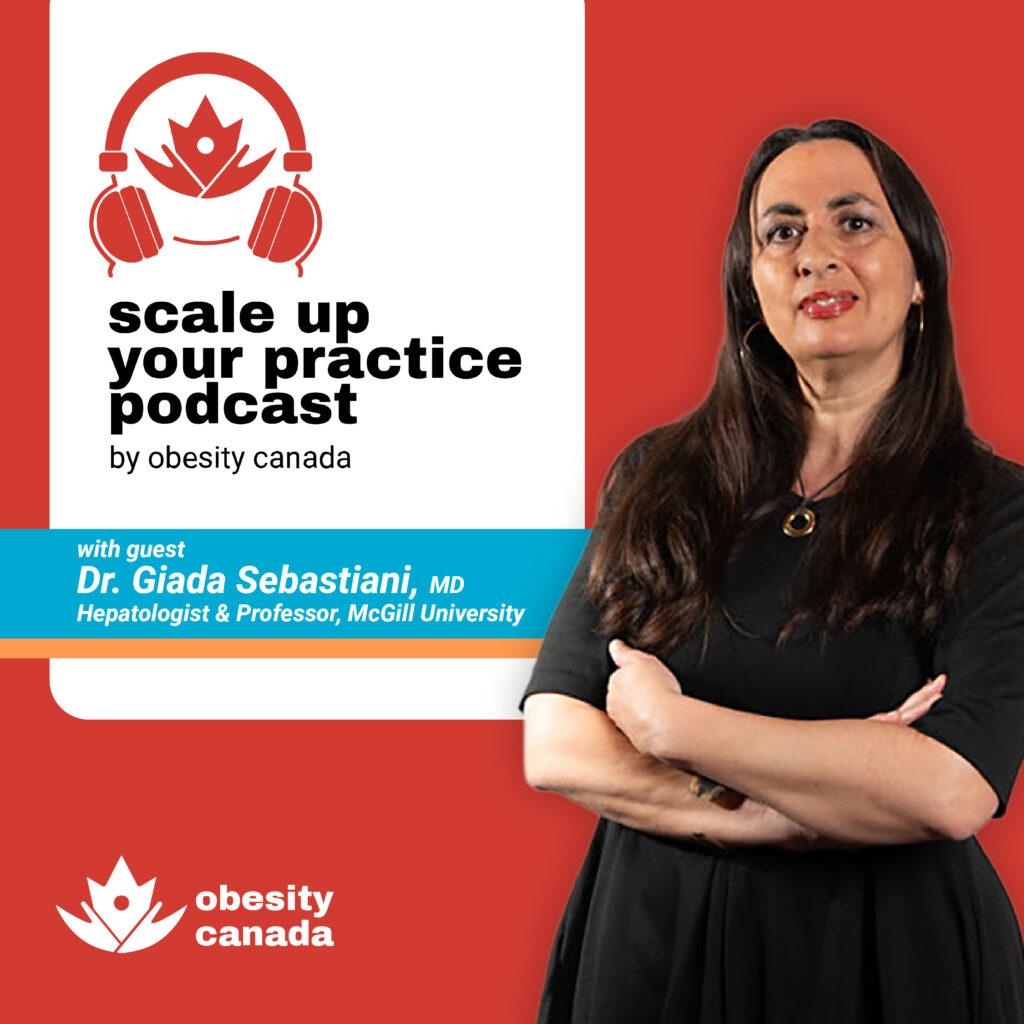


Metabolic dysfunction–associated steatotic liver disease (MASLD) affects an estimated 38% of adults in North America — yet many patients have never heard the term before receiving a diagnosis. Confusion, stigma, outdated language, and misconceptions often contribute to delayed recognition and missed opportunities for early intervention.
We’re joined by Dr. Giada Sebastiani, hepatologist and Professor of Medicine at McGill University, to explore the biological mechanisms behind MASLD, what early signs look like in clinical practice, and how to talk about liver disease in a way that reduces shame and strengthens the patient–provider alliance.
Dr. Sebastiani also shares practical guidance for screening, counselling, and helping patients understand the path forward.

Dr. Giada Sebastiani is a hepatologist and clinician–scientist at McGill University.
Her work focuses on metabolic dysfunction–associated steatotic liver disease (MASLD), liver fibrosis, and improving non-invasive screening for people at risk, including those living with obesity.
The metabolic link between obesity and MASLD:
How insulin resistance, adipose tissue dysfunction, and cardiometabolic risk factors drive steatosis, fibrosis, and progression to advanced liver disease.
Patient communication that reduces stigma:
Strategies for explaining MASLD, abnormal liver tests, and imaging findings in clear, non-blaming language that supports trust, understanding, and patient engagement.
Screening and early detection essentials:
Practical guidance on who to screen, how to interpret mild enzyme elevations, and when to use tools like FIB-4, transient elastography, and non-invasive biomarkers.
Management that supports long-term liver and metabolic health:
How lifestyle interventions, obesity pharmacotherapy, and multidisciplinary care can improve liver outcomes—and how to tailor these approaches to individual patient needs.
Obesity Canada’s flagship scientific congress returns March 25–29, 2026 in Montréal. Join researchers, healthcare professionals, policy leaders, and people with lived experience for five days of learning, collaboration, and community.
Registration is open now and tickets are already selling fast.
Email us at scaleuppod@obesitycanada.ca
– Welcome back to “Scale Up Your Practice,” the podcast from Obesity Canada. I’m Dr. Roshan Abraham, a family physician and associate professor at the University of Alberta.
– And I’m Michelle McMillan, a lived experience advocate with Obesity Canada. This is the podcast where we bring together research, clinical expertise, and lived experience to explore how obesity care can be more compassionate and evidence-based.
– Today’s episode is supported by an unrestricted educational grant from Eli Lilly Canada. When you’re seeing patients living with obesity, you might also notice early signs of liver dysfunction, things like mildly elevated liver enzymes, evidence of hepatic steatosis on imaging or other signs of metabolic dysregulation. So excess adiposity and metabolic dysfunction can contribute to a whole spectrum of liver related complications. Now grouped up to the term metabolic dysfunction-associated steatotic liver disease or M-A-S-L-D or MASLD, covers the full con continuum from simple steatosis to steatohepatitis to fibrosis and even cirrhosis. And the risk of progression depends a lot on the metabolic risk factors a person is living with.
– And recent estimates suggest that about 38% of adults live with MASLD in North America. Many patients may not even have heard of this term, I know I hadn’t, until they receive a diagnosis. Misunderstanding, a lack of awareness combined with obesity stigma can prevent early recognition and effective intervention of liver conditions.
– To help us better understand the intersection of obesity and liver related complications, we’re joined today by Dr. Giada Sebastiani, a hepatologist and professor of medicine at McGill University, whose research and clinical work focuses on MASLD, liver fibrosis and the links between obesity, diabetes, and liver outcomes. Dr. Sebastiani, thank you so much for joining us. Welcome to the podcast.
– Thank you so much for having me, Michelle and Roshan. It’s always a pleasure actually to work with you and with Obesity Canada. So, I think this is very important to us, this kind of events. And I’m really pleased to have this discussion with you and with our guests.
– So, let’s start with the foundations. For clinicians who may not specialize in hepatology, could you walk us through the underlying pathophysiology, again, what’s happening at that biological level when excess adiposity and metabolic dysfunction begin to impact the liver?
– Absolutely, Roshan. So, the main underlying pathophysiological pathway in MASLD is actually insulin resistance. So we know that ans insulin resistance is the main risk factor for MASLD and also associated the hepatitis, which is the inflammatory component of MASLD and also liver fibrosis. However, we can say that MASLD is a classical multifactorial disease where we have for sure health factors, for example, we can have the contribution of lack of physical activity, for example, or some food that are not good enough, nutritionally. But also, there is some genetic predisposition that it’s also important to underline because genetics we can’t change, right? We know for example, that there are some mutations in specific genes that are more frequenting people of Hispanic ethnicity. So, because of that people with Hispanic ethnicity may have higher risk of MASH, so steatohepatitis, and also, liver fibrosis. However, as we said initially, insulin resistance is the most important driver of this condition. That’s why people who live with some metabolic dysfunction like pre-diabetes, diabetes, or overweight obesity may have at higher risk for this condition. What happens biologically is that the hepatocytes, the cells of the liver may start accumulate something that are called fat droplets, little bit of steatosis as you said. And I really like that we’re using the term MASLD because in the past it was NAFLD, nonalcoholic fatty liver disease, which we don’t use anymore because it’s stigmatizing. And also, don’t put the accent on the main risk factors or the conditions that are metabolic factors.
– So, when people are told they have something like MASLD, which they may have never heard of, other, like some conditions, like hypertension or diabetes, you know, it’s kind of in the lexicon of general society. I don’t think MASLD is quite there yet. So, it can feel overwhelming. Especially if you know the medical professional that you’re seeing doesn’t explain it clearly to you. I’m sure many patients feel confused, even blamed when learning about the changes in their liver. How do you, as an expert in this field, explain this condition in a way that helps people without a medical background understand what’s happening in their body without adding any shame or blame around the diagnosis?
– Absolutely, Michelle. Thank you for this very important question. So the first and most important thing, I usually spend a significant amount of time on the first visit, when we discuss MASLD and steatohepatitis and fibrosis, to explain, number one, that this is usually a silent disease. So, the patient doesn’t feel anything. There is really no, not many specific symptoms for this condition. However, without any symptom, this condition can indeed progress towards scarring. I call it scarring in the liver fibrosis or even cirrhosis, which is like an extra amount of scarring into the liver. How to explain to a patient. So first of all, as we said, there is for sure a metabolic background. So I mentioned usually the metabolic, you know, drivers of these conditions without using, of course, the wording fat, it’s not even in the definition anymore of the disease. And this is something that we are very proud that the definition was changed two years ago. Second, a very important point that I always underline for the patients to give always hope to towards this condition is that the liver is a very forgiving organ. So, if we act together, and I always say this is a teamwork, the patient and the physician, we act together, we acknowledge this condition and we try to find solution together, actually liver can reverse the steatosis, can even reverse fibrosis, even scarring can be reversed. The liver is a forgiving organ and it’s regenerative organ. So I always try to put the accent, yes, you have this condition, steatotic liver disease associated with metabolic dysfunction with some metabolic condition. However, if we work together, we are actually able to improve the steatosis and even the fibrosis. And usually this is something that really creates a very strong alliance between me and the patient. So, we work towards a common goal and it’s a very, actually, very strong alliance and very good for both, in terms of satisfaction, in terms of medical satisfaction, personal satisfaction, and as you said, no judgment. This is something that can happen to everyone. Actually, as you said, 38% of the general population in North American has this condition.
– I am so glad we are doing this episode and that you are our guest. I have never heard it described so well. I tried to do that summary and you’ve tied in so many important points about bias, about patient physician communication, about systems level changes, all in a short summary. That was so well done and I hope our listeners take that away with them, I’m sure other things too, at the very least, that description because that is a perfect summary and for somebody who works in general practice who sees this all the time and has to tell patients about it and have to give them hope as well as we’re seeing more and more advanced cases. In the last few years, I’ve been noticing more and more advanced cases of MASLD. I think it is incredibly important for us to show the teamwork and the potential that’s there to actually treat this. So I am so thankful that you’re here to actually go through this with our listeners and that more people will be thinking about this and how they explain it to patients. ‘Cause I think that’s a key component is how we communicate this to patients.
– Thank you, Roshan. I totally agree with you.
– Yeah. For clinicians in general Practice, like myself, when you’re assessing a patient living with obesity who may also be at risk for liver disease, what are the most useful early steps clinicians can take?
– Absolutely. This is an essential and very more important evaluation in people living with obesity or overweight or even with diabetes. So, the first thing, because steatotic liver disease is still a diagnosis of exclusion. So the first thing we have to rule out, other liver disease that may be associated with steatosis and it may also not be all metabolic dysfunction. We know, for example, that some viral hepatitis, chronic hepatitis C or B can actually be associated with steatosis, hepatic steatosis. So, the first thing is to rule out really other causes of steatosis. The next step, it’s, of course, to do a very detailed conversation with the patient about the potential risks, but also, as we mentioned just earlier about the good things that can be done together and giving a positive message that this is a condition that can be reversed. Number three, at that point, we are not really interested on steatosis. As we said, as Michelle said very nicely, 38% of people in general population North American live with this condition. So, we can’t really screen or we can’t really do a very thorough evaluation for steatosis. We have to look for fibrosis, for scaring. This is the most important thing. And very clearly underlined by guidelines. So, we do a diagnostic pathway for fibrosis. How do we do this? So, in, let’s say in family medicine practice, of course not everyone has access to ultrasonograph noninvasive tools. So with the blood test which use liver transaminases and platelets, we can actually have a pretty good idea if a patient has a low risk of having fibrosis. So a simple blood test which is computed on liver transaminase platelets, and the age of the patient, it’s called FIB-4. It’s a very simple test. Then, if this test does not exclude the presence of fibrosis, then we go into more specialized tests, which are non-invasive. Liver biopsy is rarely used nowadays to stage or to diagnose MASLD. So I think this is also very important message for our patients, right? And for, like our people living with obesity or with diabetes, it’s not that the moment you walk in the clinics, you will undergo an invasive test biopsy, but, it’s going to be a blood test and possibly an imaging. So these are all friendly tests that will help us tell a lot about the condition of the liver and the liver health. And then next steps, of course, we will start some interventions. Mostly it will be a referral, for example, a conversation with a nutritionist, for example, in our practice, because, of course, the most recommended, for example, diet regimen, nutritional support is Mediterranean diet, but, it has to be, of course, adapted to the personal need of the patient. I always tell the person the good food, of course, this is the good food, generally good food, but, the good regimen is the one that is good for you. So, again, patient-centered, really personalized, individualized care, like I like to call individualized hepatology.
– So, on the podcast here, we kind of often talk about the patient and the practitioner being a team working together. So, I’d be interested, you know, for people living with obesity, they may not know about liver disease as something they should be concerned about or screened for. So, I’d be interested in your thoughts about what are the key things patients should know or should be bringing up maybe with their family physician when they’re in their office. Do you have any suggestions?
– Absolutely, Michelle. That’s an excellent point. As we mentioned, patient driven healthcare is more and more interesting, you know, like really empowerment of the patient. It’s not even anymore, you know, involvement of the patient, but empowerment of the patient. Actually I’m working a lot, also my research in MASLD, in empowered programs for screening for MASLD in people with type two diabetes or living with obesity. I think this is an essential component because the informed patient is also someone that will help his healthcare professional and actually will create, even from the beginning, stronger alliance. So, I believe that informing people will help them. For example, asking for a simple blood test screening, what do you think I heard there is this condition. They, of course, you do regular annual evaluation, it’s just question of calculate that biomarker. According to the guidelines nowadays, every person, for example, living with pre-diabetes or type two diabetes should undergo screening for fibrosis related to MASLD, every one, two years. And it’s quite similar for people living with obesity, especially if there is another metabolic condition. For example, you know, it could be some cholesterol or some hypertension. According to guidelines, these people should actually undergo a screening for liver fibrosis due to MASLD. As I told you before in this nice conversation together, it’s a simple blood test, let’s do it together, see what it brings us and we move from there. So, I’m very happy that you pose this question because I find it’s the first step for a very strong alliance that we can build together.
– So, you’ve talked about coming in and having a discussion and going for some lab work. Obviously, if it comes back and it’s flagged that the enzyme on the result is high, obviously, there’s going to be a lot of worry in the patient, right? Because, you know, we’re like, I need my liver, I need it to function. I’m very scared because, now I’m scared that my liver’s not going to function and I’m going to need a liver, you know, people spiral into things. So, maybe for the healthcare practitioners who are listening to this podcast, do you have any recommendations on them speaking with the patient once they’ve got a lab result which may show elevated results, and helping the patient not panic and spiral? Do you have any suggestions?
– Absolutely, Michelle. That’s another excellent point. The first thing I would like to underline also for my colleagues, health care professionals, is that we don’t really base a diagnosis of MASLD and MASH fibrosis just on the liver transaminases because, actually, they could be normal and persistently normal in a significant number of people who have MASLD and liver transaminases and even fibrosis, about 20% of the per person who have already fibrosis and the liver may have normal liver transaminases. So, it’s very important because of that to calculate that simple test that I mentioned before, based also on platelets and age. However, if in our evaluation we find elevated liver transaminases, of course, this is something that should be going in deep understanding together, again, the healthcare practitioner and the the patient. Because if the tests are indeed elevated, the enzymes as we go together, this could be a sign once we exclude other causes of liver disease, that indeed there is MASLD, indeed there could be a little bit of inflammation, even some steatohepatitis inflammation. So how do we approach that? The first thing is that, as we mentioned before, that liver is a regenerative organ, it’s a forgiving organ. So, even if that enzymes now are normal, I can sure you I follow so many patients with MASLD, the moment we start some, you know, intervention and we go together through this intervention, we can see in a significant proportion of patients the enzymes going down and it’s very actually reassuring and satisfactory for the patient, you know? See it works. There is a number that is going better, this is the liver is going back there. And the second message that I would like to communicate to my patients is that MASLD and liver disease in general, it’s a very long disease. So, you know, we can have elevation of the enzymes, but if the patient with elevation of enzymes, the biomarker, the test I mentioned before, this FIB-4 is called, tells us that there is not fibrosis. The time to develop fibrosis is very long, okay? Actually it’s 20, 30 years, okay? So it’s not something, you know, that will happen tomorrow, it’ll not even happen in one year. Of course, we don’t want it to happen. But, I think it’s very important for the patient to feel reassured. First, if we start doing something together, the liver will improve. Two, it takes a long time actually to develop liver cirrhosis, this very scary word, the liver cirrhosis. Of course, I have to be honest, there will be some patients that we do the screening, also, Dr. Abraham here knows very well that we do the test and unfortunately we find few patients who have already cirrhosis, but this is the minority, okay? The minority. So I think these two messages give some reassurance to our patients.
– I think it’s so great that you’re talking about this, we see this so commonly. Of all the episodes we’ve had on this podcast, I don’t think we’ve talked about a condition that is nearly as frequently seen in general practice as MASLD. And increasingly so. I’m finding over, like I’ve been in practice for eight years and definitely over the last few years I’ve been noticing it increasingly so actually pop up. We’re still talking about a minority with patients that move on to liver cirrhosis obviously. And I think a lot of the language that you’re using that you’ve already talked about, the team-based approach, that the fact that this is more of a long game when we think about fibrosis or even cirrhosis and that there is that collaborative approach between you and the patient to make sure that you can actually work together on this. I think that in and of itself is quite de-stigmatizing. Instead of just sort of slapping on this diagnosis and saying, you know, let’s work on a plan, but I’m going to tell you what to do. It’s going to be this, it’s going to, and they don’t feel like they’re really part of it. When they know the long game, they know that they can be part of the plan. I think that that in and of itself helps with reducing that, those feelings of blame and really focusing on collaboration, I really think so.
– I totally agree with you actually, Roshan, and also Michelle.
– Yeah. And also, you know, that leads to the patient feeling empowered. Like, we have a time, it’s a metabolic condition, right? And here are some steps. And you even spoke to it about we do the test again, and, oh look, the numbers are coming down. Like those changes you are making are making a difference. Like nothing is more empowering than, as a patient, than making changes to your life and seeing that there’s actually a result to it. So that’s so important and I’m so glad that you raised that ’cause I think it’s really important. It’s time now for our bias break, a moment to pause and reflect on how bias even unintentional, and I have to say most of the time I think it is actually unintentional can shape the way we talk about and treat obesity and liver disease. Outdated terms for liver conditions associated with obesity, like implied alcohol use or poor personal responsibility can lead to real harm. Many people feel blamed or dismissed before they even understand their diagnosis.
– From your perspective as a hepatologist, where do you see bias show up in the care of people living with obesity and liver related conditions, whether that’s in language, assumptions, or clinical pathways offered to patients?
– I think this is one of the most important part actually of our conversation today. Because often, unfortunately, we forget, and I put we, a general week, we, that about 20-30% of people living with obesity have actually an eating disorder for example. So, there is a psychological, actually, issue there. It’s not that the person is choosing that. And this proportion rises to 50% in those who also have MASLD. So really, I think we have to go beyond the idea of the food. We have to go to a holistic concept of the person in terms of the overall health of the person, psychological health, mental health, also, barriers to access. How much there is food insecurity out there in our country and even beyond the country? So, we are telling sometimes to my patient coming from remote communities, this is what you should eat. And they tell me, I don’t have access to this. So, there are many structural barriers. There are psychological barriers. And I think we should also provide mental health resources, access to psychologists, to specialists in eating disorders. Otherwise, if we just go start speaking all about blame, about, even about, you know, the fact that there is not enough physical exercise, there is, yes, but we need to understand the person in a holistic fashion. It’s really, all the pillars of mental health, access, and, of course, lifestyle modifications, so on. But, only focusing on one will be a limitation and will not provide the person to feel understood. So, I really think this is the most important conversation that I always have with my patient every time I’m starting a therapeutical alliance and the team alliance in this diseases, in this field.
– I’m curious ’cause you work in this field and obviously deal with patients a lot, is there a specific patient story or a moment that stands out to you in regards to bias that you’d be willing to share with us and our listeners?
– Absolutely. Actually, Michelle, I have several of these, of course, in this profession, but, one I think of the most touching also for me, and it was almost moving, I have to say. I think we are human beings, so. There are a few moments in my clinical practice where I also get moved. Was with a relative, a young lady actually who is struggling with binge eating disorder, that’s why I feel very passionate about that, was living with obesity and, of course, living with MASLD. And she, the first time she came to see me, she was really scared. So, I was really touched actually by her fear. I felt this, her fear, I felt her fear to be blamed because she mentioned to me that it happened in the past. So I sit down with her, I remember I hold her hand and I said, here you are in a safe space, if you want, we talk about your weight, but every time you’re going to walk through this door, I will first discuss anything else. And if you wish, you tell me today, I would like to talk about my weight. If you don’t want to wish to talk about your weight, we’re going to talk about your lab test, how is it going with your, she’s in university. We’re going to go speak about, a little bit about your exercise, of course, if you please. But from today we are going to speak about your weight only when you tell me, you know, what Dr. Sebastiani? Today I feel like we can speak a little bit about the weight. And from that moment, our alliance is now four years. And I just remember once her mother came and she said, you know, that’s amazing. So I feel small things, small things can make huge difference for a person. So, I think these are, this is a story that I wanted to share with you.
– That’s so heartwarming and touching. And not, like I, in family medicine and especially with the work that I’ve done over the last few years with Obesity Canada, that ends up being my go-to line. But, I don’t necessarily know if I hear that from patients when they speak with specialists, right? And I know everyone’s a little bit different in their approach and how they view obesity and overweight, but, I do think it’s really powerful when you do that. We try to emphasize that at our clinic as much as possible. But, I think be, I can totally just picture that. That patient going to see you, seeing a specialist being, sort of handed this diagnosis potentially already or being afraid of that coming down and then you just sort of bringing the temperature down with the language that you’re using, I think is really powerful. And I think it applies to everyone and it really highlights the importance of language.
– Yeah, I think it also highlights that there is particular scars of people who have lived with obesity. And one of those is that no matter what’s wrong with you, it’s because you weigh too much, right? So, it’s that. So, as someone who, the first thing and the only thing that many specialists want to talk about is weight. You know, how much you’ve lost, what have you done? Like, just your willingness to open that up to, you know, is this a day that you want to talk about weight or maybe today is the day we want to talk about exercise or what you’ve done in other aspects of your life. It just, as a patient, it would make my shoulders go from like really tight to, oh, okay, all right. I feel like this is someone that I can work with and communicate with. So, thank you. I think that’s amazing example. Yeah.
– We’ll get back to our conversation in a moment, but first we want to tell you, our listeners, about something big coming up next year. The Canadian Obesity Summit 2026 is happening March 25th to 29th in Montreal. This is Obesity Canada’s flagship scientific congress on obesity. Bringing together researchers, healthcare professionals, and policy leaders from across the country and around the world. It’s five days of learning, collaboration, and community, all centered on this year’s theme, obesity across the lifespan. Connecting research to real world care. Registration is open and tickets are already selling fast. Learn more and secure your spot at the link in the show notes or by scanning the QR code on screen if you’re watching on YouTube.
– So, we talked a little bit about, you know, that first diagnosis and you walking them through what it is. And, you know, helping them to understand and not panic. Now, I’d like to maybe shift a little into what happens after there’s a diagnosis like MASLD or liver fibrosis, you know, once it’s been identified. For a lot of people with that diagnosis, I’m sure it feels overwhelming, especially if they’re already navigating other disorders like obesity related stigma, maybe diabetes, maybe hypertension, like, you know, people living with obesity can be complex patients on the best of days, right? So, where do you usually begin that conversation about management and then next steps?
– That’s an excellent question actually, Michelle. The first point really is to understand at which stage of the disease we are. Because if there is no fibrosis, usually the patient doesn’t need, you know, a follow up with specialist and then it’s the family physician are actually fantastic in order to, Dr. Abraham here is much more experienced than me in the, in treating, you know, all this constellation as you said of, sometimes constellation of metabolic, some metabolic comorbidities, also some other little problems. So, this could be managed in primary care. When it comes to fibrosis and more, so fibrosis and cirrhosis. Let’s first start with fibrosis. As we said, fibrosis can be reversed. So, the first approach, usually I see a patient we discuss in detail, you know, the lifestyle, do they like to do some exercise? Do they do some exercise? And I really stress the fact that even a little exercise is better than nothing because beyond the liver, some exercise can improve cardiovascular actually fitness and reduce cardiovascular risk, which is also a concern, let’s say in patients who have MASLD, so, it’s something that usually I discuss. Then, of course, I discuss also a little bit about, about the dietary regimen. We go into the details little by little, you know, about what they like to eat, which kind of food if they want, I always ask if they want to have a conversation with a nutritionist, you know? So to have more time to discuss in specific, and I always mention the coffee because it’s very refreshing for the patient. It gives down, it puts down a little bit to the pressure. I always say by the way, you can drink coffee, coffee is good for liver. So it’s way, you know, while we discuss about, you know, lifestyle and exercise, by the way, coffee’s good. So, according to guidelines, actually for MASLD, we recommend to drink three black coffee a day. If, of course, someone can tolerate, you know?
– I was just going to say, it’s not something we can all tolerate.
– Yes. Not everyone can tolerate. You know, someone can have a little bit, you know, of palpitation or feel some, you know, some discomfort on the stomach. But, according to the guidelines, if a patient, person is living with MASLD, he can drink, he should drink, let’s say, three black coffee day, of course, no sugar. So this is something that puts the pressure down and the tension, you know, of all this information and that. So the coffee, oh, coffee, okay, coffee’s good. So, it’s also information that I share with the patients. Then we move, usually I see them after a few months I do imaging test, which is called the FibroScan to check, you know, yeah, to confirm if there is fibrosis or not. And then the nutritional support, as we said, evaluation. Then I see them after six months to see how they are doing. Then sometimes there may be a need, of course, to refer for an endocrinologist if they’re not followed already to consider pharmacotherapy. We know that there is significant pharmacotherapy now, you know, that can help and, with the weight loss. And importantly, this pharmacotherapy also has positive effects on the liver. So, that’s why, first I start with the lifestyle interventions and where the patient really feels empowered, you know? Then if this is, may not be enough or they may need, may be a need for a better control overall metabolic, I refer to my endocrinology specialists, colleagues where there is an aware, or even, of course, family physicians are very, very well awares and very, very experienced in the use of these medications. Of note, what I think is very interesting, I always tell my patients is that usually hypertension, dyslipidemia, diabetes, obesity, and MASLD, they’re all correlated. So if we improve one, you’ll improve all of them. This is a very strong motivation as well, you know? Improve this, you will see we’ll also improve that. So, you know, it’s very, it’s very empowering also this, you know. I act on one maybe, I focus on this, but, then I know that this will have a positive effect, like a positive wave on all the other parts of my body, you know? Then finally, for those who have a cirrhosis diagnosis, you know, so more advanced scarring on the liver. At that point, usually we see these patients every six months also with an ultrasound and the specific test to check that there is, for example, no cancer in the liver, which may be a complication, unfortunately, of liver cirrhosis. So, this is something that we have to do every six months, an ultrasound with a blood test to check that there is no development of cancer. However, of note, even cirrhosis can be reversed if we follow this pathway. So, this is also very motivating for the patient. Unless there is a decompensated cirrhosis, it’s called, so, something that it’s advanced, an advanced cirrhosis, even early cirrhosis can be reversed. So, again, liver is forgiving, liver can regenerate.
– I think you’ve highlighted so many important really points to take home for our listeners, especially if they are general practitioners in, again, in general practice and just the generalist in me really rejoices when you say, and how you describe how you communicate to patients, the importance of looking at all of these conditions as being interconnected. I think oftentimes in medicine it ends up being an, and this is just, this is human, the human condition is that we end up sort of focusing on very specific conditions, assuming that there isn’t a lot of interconnectivity when there is, and we know there is. And when we can tell patients that often treating one of these conditions can help with another. And this is again where the GLP-1s are incredibly useful for the first time. Because I’m having these conversations when before I never used to have these conversations about how these medications can actually help with multiple conditions. With hypertension, with heart disease, with weight, with liver disease. And so I think it’s really powerful and almost de-stigmatizing to know that this isn’t sort of on its own anymore. This fits into the broader picture of managing chronic disease as a whole, which is what we want to try to do, not only within our medical community, but also in the public is to de-stigmatize this primarily by stating this is just like hypertension, this is just like diabetes. We may not look at it that way because of stigma, but we treat it in a lot of the same ways, we need to look at it in a lot of the same ways in that holistic approach. So I really love how you, you as a specialist, speak to that sort of general approach. I think that’s really powerful.
– I totally agree with you, Roshan. I think we shouldn’t, in fact, as you underlined very nicely and clearly, we shouldn’t actually speak about obesity treatment, but metabolic health treatments. These are really treatments for metabolic health.
– Yes.
– We just want to achieve metabolic health. They don’t treat only, you know, they don’t treat obesity, they treat a metabolic dysfunction. So, I think this is a fantastic point that you raised. We have always to consider these conditions MASLD, obesity, type two diabetes, hypertension, dyslipidemia is a part of a metabolic dysfunction, so it’s a dysfunction. So, a dysfunction, a condition that should be treated. And when we try target the metabolic dysfunction, we’ll actually resolve so many issues, at least five we just mentioned together, you know? So, this is very reassuring for the patient. And, of course, de-stigmatizing, I totally agree. It’s metabolic health.
– Yeah. And I think with that, hopefully with that shift happening a bit sooner, I think we can hopefully encourage that within our conversations, not just within our clinical community, but also out in the public. That this is about chronic disease, metabolic dysfunction. And that’s, and then lastly approaching it in a holistic peace. ‘Cause you can still have metabolic disease, chronic disease, and still treat it sort of only with medications and stigma can still creep in. When we look at the holistic approach to metabolic disease, I think, that’s where a lot of strides can be made. As we wrap up the conversation, we’d love to leave our audience with a few clear takeaways. To start, we’d love to know what’s one myth about obesity and liver related complications that you wish we could retire today?
– I think that the most important thing is that liver disease, when you have a, when a patient has a diagnosis of MASLD or even a fibrosis, liver cirrhosis and is living with obesity, this is not a final condition. It’s something that can be reversed, that can be healed. So, that’s very important for me. Because many patients come and say, someone told me I have fibrosis, someone tell me I have cirrhosis, I’m so scared. This means I will, you know, have a very bad prognosis very soon. So, that’s the most important. Let’s demystify the fact that a person living with obesity is diagnosed with fibrosis and cirrhosis. And this is really something that is not possible to reverse, irreversible because it is reversible. So, it is something that can be fixed, that can be healed. And, as we mentioned, Roshan and Michelle today, the most important thing is, one, holistic approach. Two, empower empowerment of the patients. And three, metabolic health. I think with this three words takeaway of today are good enough to demystify anything that is out there.
– Yeah, that’s amazing takeaways.
– Yeah.
– Thank you Dr. Sebastiani for sharing your expertise with us today.
– Thank you, Michelle.
– And for helping us see liver health as a core part of metabolic health.
– Yeah.
– Thank you so much for having me. A pleasure.
– If you found this conversation helpful, share it with a colleague or team member and don’t forget to follow or subscribe so you’re notified when new episodes go live.
– Until next time, stay curious, stay kind, and keep scaling up your practice.
– This podcast is intended for informational and educational purposes only and does not constitute medical advice. The content shared in this podcast should never be used as a substitute for professional medical advice, diagnosis, or treatment. Always seek the guidance of a qualified healthcare professional with any questions you may have regarding your health or a medical condition. The information and treatments discussed in this podcast are based on Canadian guidelines and approved practices as of the time of recording. If you’re listening from outside of Canada, please consult your local healthcare professional to ensure compliance with your region’s medical standards, guidelines, and recommendations. The creators of this podcast disclaim all liability for any decisions or actions taken based on the content discussed. Listen to this podcast does not establish a professional or patient client relationship.
Be the first to know about new education and resources for healthcare professionals from Obesity Canada.