Call for Authors: Contribute to the Canadian Adult Obesity Clinical Practice Guideline. Learn more

Home • Scale Up Your Practice podcast • Metabolic Bariatric Surgery, Stigma, and its Role in Obesity Care with Dr. Boris Zevin

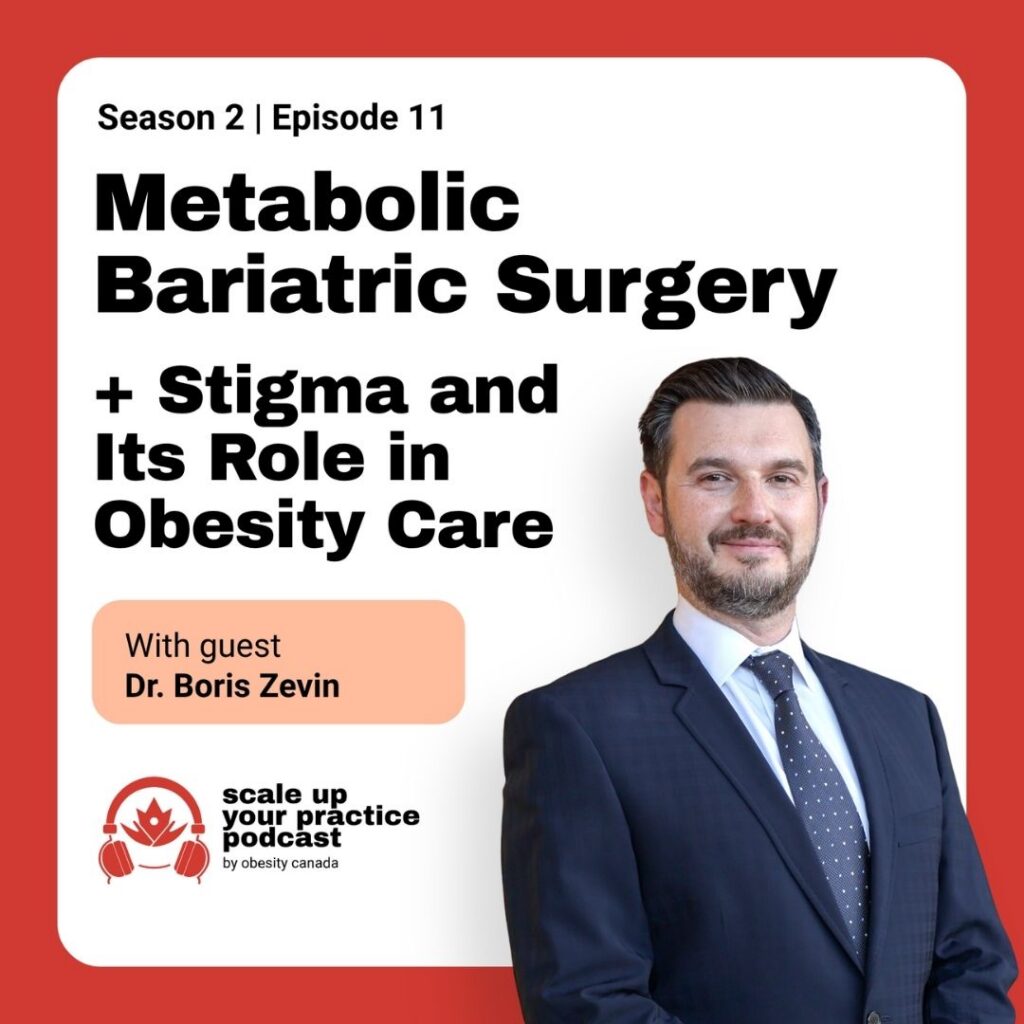


Metabolic bariatric surgery is often misunderstood as a last resort, or dismissed as “the easy way out.” In this episode, Dr. Boris Zevin joins Dr. Roshan Abraham and Michelle McMillan to discuss where surgery fits in obesity care, how it affects the biology of obesity, and how clinicians can talk about it with less stigma and more clarity.

Dr. Boris Zevin is a professor of surgery at Queen’s University and Medical Director of the Kingston Bariatric Centre of Excellence at Kingston Health Sciences Centre.
He specializes in minimally invasive metabolic bariatric surgery and the surgical management of conditions affecting the stomach and esophagus, including gastroesophageal reflux disease and hiatal hernia.
Dr. Zevin is also an experienced medical educator, with a PhD in Medical and Surgical Education and a focus on improving how surgeons are trained in minimally invasive procedures. In this episode, he brings both clinical expertise and a thoughtful teaching lens to the conversation about metabolic bariatric surgery, stigma and long-term obesity care.
Additional resources
If this episode leaves you thinking about how to strengthen your own approach to obesity care, Obesity Canada’s Calibre course is designed to help.
Calibre is an accredited course for healthcare professionals who want practical, evidence-based tools they can apply in real clinical settings. The course combines self-paced learning with live, interactive sessions, helping learners build confidence in obesity assessment, treatment, communication, and patient-centred care.
The next cohort runs September 3 through October .
Support Scale Up Your Practice by:
Email us at scaleuppod@obesitycanada.ca
This episode script was developed using NotebookLM to synthesize complex source materials into a structured educational format. The tool was used to analyze the Canadian Obesity Education Competencies (COECs), the Obesity Canada Strategic Plan, and guest-specific research. Specific prompts were utilized to extract relevant learning objectives, map them to CanMEDS roles, and generate competency-based interview questions.
While NotebookLM assisted in drafting the narrative arc and educational framework, all content has been reviewed, fact-checked, and refined by the podcast hosts and Obesity Canada’s clinical experts. This ensures the script aligns with current Clinical Practice Guidelines and authentically represents the lived experience perspective.
00:00:00:01 – 00:00:18:18
Dr. Boris Zevin
This is in many ways also in part responsible to some of the medications that we’re actually seeing now, because the hormonal changes that happen with surgery is what we’re trying to mimic with the medications and pharmacotherapy, which is actually great to see.
00:00:18:20 – 00:00:28:16
Dr. Roshan Abraham
Hello, and welcome to the Scale Up Your Practice podcast, brought to you by Obesity Canada. I’m Doctor Roshan Abraham, family physician and associate professor at the University of Alberta.
00:00:28:19 – 00:00:33:07
Michelle McMillan
And I’m Michelle McMillan, a lived experience advocate with Obesity Canada.
00:00:33:09 – 00:01:07:00
Dr. Roshan Abraham
When we talk about surgery for chronic diseases like osteoarthritis, most people understand it as life changing. When we talk about metabolic bariatric surgery for obesity, the conversation changes. Society, and often the health care system itself, views it as a drastic last resort. Today, we’re breaking down that stigma and talking about what the science says about metabolic bariatric surgery, how it fundamentally alters the biology behind obesity, and how clinicians can talk about it with more compassion and clarity to patients when considering this highly effective treatment.
00:01:07:00 – 00:01:35:01
Michelle McMillan
Today’s episode is supported by an unrestricted educational grant from Eli Lilly, Canada. We thank them for helping us bring this podcast to clinicians across the country. Today, we’re talking about how clinicians can have more thoughtful, informed, and collaborative conversations about metabolic bariatric surgery, including when surgery may be appropriate, what patients need to understand, and how to support patients long after surgery.
00:01:35:02 – 00:01:46:01
Dr. Roshan Abraham
To help us unpack the evidence and the realities of this treatment, we’re joined by Doctor Boris Zevin, an expert metabolic bariatric surgeon and professor of surgery at Queen’s University. Welcome to the show.
00:01:46:06 – 00:01:48:06
Dr. Boris Zevin
Thank you very much for having me on the show.
00:01:48:12 – 00:01:58:01
Dr. Roshan Abraham
We wanted to get started with this question. How should clinicians be thinking about the role of surgery in twenty twenty six for the care of patients living with obesity?
00:01:58:03 – 00:02:24:12
Dr. Boris Zevin
This is a great question, and I really want clinicians to think about the spectrum of treatments that we currently can offer patients who are living with obesity. And metabolic bariatric surgery is really one of the, now thankfully, many options that patients have. So I think you guys have outlined in previous podcasts the other options, including behavioral therapy, lifestyle modifications, pharmacotherapy options.
00:02:24:12 – 00:02:34:23
Dr. Boris Zevin
But metabolic bariatric surgery remains one of the most effective and long term successful treatments for patients who are living with obesity. And hopefully, we’ll have an opportunity to highlight that today.
00:02:35:00 – 00:02:56:13
Michelle McMillan
So I like to start at the beginning with our guests. We often joke around here that obesity medicine is not always the sexiest form of medicine, right? It takes a special person to have that compassion and care. So I’m wondering what brought you into metabolic bariatric surgery and what kept you here?
00:02:56:15 – 00:03:29:15
Dr. Boris Zevin
Yeah. So this is an excellent question. And Michelle, I agree with you wholeheartedly that this may be not the sexiest field from a medicine perspective, but it’s a very rewarding and gratifying field to be in. So my journey towards metabolic bariatric surgery started actually when I was a resident at the University of Toronto. So I finished medical school in two thousand and eight, and in two thousand and nine was the year where the Ontario bariatric network was created.
00:03:29:16 – 00:03:58:13
Dr. Boris Zevin
So prior to two thousand and nine, patients who were living with obesity, at least in Ontario, actually could not access minimally invasive metabolic bariatric surgery within the province. And they had to be referred out predominantly to the United States. So northern parts of New York state, for example, or Michigan, where they would go and have surgery there, and then they would come back and have their follow up care and complications dealt with in Ontario.
00:03:58:14 – 00:04:24:16
Dr. Boris Zevin
So after a lot of advocacy and financial considerations, the Ministry of Health and Long-Term care decided that this should be a funded procedure within Ontario. And then this is when the Ontario bariatric network was established. So I was in my second year of residency, and around that time, there was also evidence coming out that was demonstrating that surgical technique actually has an effect on patient outcomes.
00:04:24:16 – 00:04:57:22
Dr. Boris Zevin
So there are a number of studies, including from metabolic bariatric surgery, that was showing that the better the operation from a technical perspective, the fewer the complications the patients will have. And this was the time when I was taking time off from my residency training to do a graduate degree, and I was interested in surgical education. And one of the things that I was interested in looking at was, well, how do we actually assess someone’s technical performance in laparoscopic roux en y gastric bypass, which was the predominant operation at that time in Ontario?
00:04:58:00 – 00:05:26:02
Dr. Boris Zevin
So it was the right place and the right time. So from a research perspective, we developed ways of assessing technical performance. And we could also then figure out ways of teaching the surgeons in training in residency, how to prepare for these operations. And then the complexity of the operations that I get to observe during my research years when I was doing my PhD, actually got me interested in this as a career.
00:05:26:04 – 00:05:54:03
Dr. Boris Zevin
So after my residency training, I did one year of advanced GI and bariatric surgery training at the Ohio State University in Columbus, Ohio. And then I was recruited to Kingston to actually start their metabolic bariatric surgery program here in twenty sixteen. And then the question is, what keeps me in this non-sexy, as you guys have said, medical and surgical specialty really is the fact that we’re prolonging patients’ lives.
00:05:54:03 – 00:06:12:00
Dr. Boris Zevin
But not only are we prolonging their lives through these interventions, but we’re also really improving the quality of their life. And I think this is extremely important and valuable. Although the duration of time that it takes to see the effects may actually be a lot longer than some of the other surgical interventions that we do.
00:06:12:01 – 00:06:44:07
Dr. Roshan Abraham
Thank you so much for going through that. We don’t always get a deeper dive of the background from our guests, but it really ties into, I’d say, the rest of our conversation today. So I do appreciate that. Many people still refer to metabolic bariatric surgery as quote unquote weight loss surgery. When you’re talking with patients, how do you explain the way surgery affects the biology of obesity beyond the common idea that it just changes the size of the stomach, and that’s why people lose weight?
00:06:44:09 – 00:07:02:06
Dr. Boris Zevin
So I think this is a really important topic, and there’s still a lot of misconceptions that we see in the general public in terms of how do these operations work. So historically, what the narrative was is we make your stomach smaller. So instead of a size of a football, we make it into a size of an egg or a size of a small banana,
00:07:02:06 – 00:07:24:00
Dr. Boris Zevin
and therefore patients consume fewer calories. And also, if we do reroute their intestines by adding a hyper absorptive component, then you’re not absorbing all of the nutrients that you’re eating. But actually it is a lot more complex. And surgeons for a number of years have been trying to understand what happens to the patients when we do an operation for them, like a gastric bypass.
00:07:24:00 – 00:07:53:06
Dr. Boris Zevin
Why does their diabetes control improve dramatically even before the weight loss? So with a lot of the emerging evidence of endogenous incretins and the hormones that our gastrointestinal tract secretes, what I tell now to the patients is the surgery actually results in changes in the incretin levels. So for example, GLP one, which is endogenous, which we now see as a pharmacotherapy option for our patients.
00:07:53:08 – 00:08:15:11
Dr. Boris Zevin
There is a lot of changes in the signaling of the gut, liver and brain axis. And all of these changes and changes to the ghrelin, for example, which is what we call as a hunger hormone, which is secreted in the stomach. So all of these metabolic changes and the hormonal changes is what actually results in the metabolic effects that we see with these operations.
00:08:15:11 – 00:08:37:07
Dr. Boris Zevin
And the weight loss, improvements are really more of a byproduct of all of these hormonal and metabolic changes. So I think we’re really trying to reframe the conversation from eating less and absorbing less to actually dramatic changes in how the hormones within our body are changing as part of this operation and the effects that we’re seeing with these surgeries.
00:08:37:09 – 00:08:58:19
Michelle McMillan
Yeah, I find that fascinating from a layman’s perspective. Right. We started with the surgery thinking, well, it’s a simple solution. We’ll just make their stomach smaller, make their small intestine shorter, they’ll absorb less, they’ll eat more, they’ll eat less, and they’ll lose weight. And now we’re finding out just how complex the system is.
00:08:58:19 – 00:09:09:03
Michelle McMillan
And I love the fact that researchers are still continuing to look at this. And there’s still so much more to learn about it. So yeah. Fascinating.
00:09:09:05 – 00:09:32:06
Dr. Boris Zevin
Yeah. And I think the other Michelle, the other important part about this is if we look back at the knowledge that came from looking at the surgical patients. This is in many ways also in part responsible to some of the medications that we’re actually seeing now, because the hormonal changes that happen with surgery is what we’re trying to mimic with the medications and pharmacotherapy, which is actually great to see.
00:09:32:10 – 00:09:57:11
Dr. Roshan Abraham
I think, as a family doctor, a big step forward in addressing weight bias and stigma is actually explaining this background to patients in as best of a way as we can. Because if people come in assuming that either surgery or medications are just there to cut calories or try to eat less, we’re not actually addressing some of the drivers that actually cause and prolong obesity as a chronic disease.
00:09:57:11 – 00:10:22:10
Dr. Roshan Abraham
And so having that conversation with patients and educating them, and I think the advances in surgery have actually as, as Doctor Zevin mentioned, led to a lot of the advances that we have in pharmacotherapy that then allow us on the front lines to not only address weight bias and stigma, but also give patients and the public a little bit more information that they can take home with regards to obesity.
00:10:22:12 – 00:10:48:22
Dr. Boris Zevin
And just one more point on this is I think if we present the surgery in these terms, then the patients are much more understanding of the fact why certain people respond better to surgery and other people respond to a lesser degree. And that’s because of all of the actual hormonal and incretin changes. It’s not like we do the same operation for most people in terms of the technical components.
00:10:48:22 – 00:10:58:19
Dr. Boris Zevin
But the response to surgery is dramatically different sometimes. And it’s not in any way a patient’s fault. Right? So they just have different responses to treatment like we see with medications as well.
00:10:58:20 – 00:11:18:15
Dr. Roshan Abraham
Exactly. And I think that’s slowly coming to the forefront. Or I hope we can bring that to the forefront, just like it is the case with diabetes, just like it is the case with hypertension. Some people respond to certain treatments and others don’t. And it does have to do with the background physiology and metabolic changes that are happening within our body.
00:11:18:15 – 00:11:37:14
Dr. Roshan Abraham
In addition to long wait times, a major systemic barrier is that surgery is often seen as an absolute last resort, sometimes delayed until a patient’s complications are severe, which increases the risk of major surgery. What does the current evidence tell us that challenges this wait until it’s worse approach?
00:11:37:14 – 00:12:24:15
Dr. Boris Zevin
So thank you for raising this point. And I want to say that this is still a problem in twenty twenty six. Sometimes locally we’ll do, we’ll get invited to various continuing professional development sessions sometimes with primary care providers. And it’s not uncommon that I get the usual response is we’ll reserve surgery for when nothing else is working. And I think we really need to try and break down some of those barriers, because what the evidence tells us is that by doing the operation before the complications of chronic disease of obesity develop and the comorbidities develop, you’re actually doing preventative surgery rather than operating when the complications have already developed.
00:12:24:15 – 00:12:57:07
Dr. Boris Zevin
So, for example, if we were to do surgery on someone who has pre-diabetes, then you’re actually delaying the onset of diabetes for that individual versus if you’re going to operate on them once they have developed diabetes already as a disease. Similarly, if the duration of diabetes is shorter, the patients will have a higher likelihood of actually having diabetes remission, as opposed to simply decreasing the number of pharmacotherapy agents that they’re on for their diabetes.
00:12:57:07 – 00:13:32:04
Dr. Boris Zevin
So we know that the shorter duration of diabetes, when they have their operation actually results in a better rate of resolution of diabetes. So think of it as a preventative operation. In addition to we’ve developed all of these obesity related comorbidities. And now let’s try and address the hypertension and the sleep apnea and the gastroesophageal reflux. So I think from that perspective, I really want my colleagues to think about this as, let’s not wait until, everything else is not working. For certain people,
00:13:32:04 – 00:13:57:11
Dr. Boris Zevin
this is actually probably a reasonable, early treatment, right? If you have a younger individual in their twenties who’s struggled with obesity for a large proportion of their young life, and they’re coming in with a pretty high BMI and insulin dependent diabetes, then probably an operation for that person is the right thing to do. And then pharmacotherapy potentially can come later.
00:13:57:11 – 00:14:12:01
Dr. Boris Zevin
So I think it’s really we need to start thinking about how do we individualize treatment for patients. And not necessarily saying surgery is the last resort because it doesn’t work as well once we’ve developed all the comorbidities. And it works better sometimes as a preventative treatment. Yeah,
00:14:12:01 – 00:14:32:17
Michelle McMillan
I love the fact that, we’re getting ahead of it, that the thinking is changing, right? That let’s prevent things rather than let’s wait till things are absolutely terrible and then try to deal with them. Now we just have to convince the system to have the resources to do this.
00:14:32:19 – 00:14:58:07
Michelle McMillan
So I think our listeners know, but I will share that I have had the surgery. And I know that patients frequently face stigma, that the surgery is a failure of willpower, right? Or it’s the easy way out, if you just worked harder, ate less, moved more, you wouldn’t need surgery. I know we’ve now talked about that’s not how the surgery works.
00:14:58:07 – 00:15:26:14
Michelle McMillan
So you’re not fixing that problem. But I do know that when I first had surgery, I was reluctant to tell anyone but my closest friends and family for fear of really being judged and criticized. And I’m curious, what do you see in how weight bias and weight stigma, shapes a patient’s willingness to even consider surgery?
00:15:26:14 – 00:15:33:17
Michelle McMillan
And how do you help them make that conversation safer and easier?
00:15:33:19 – 00:16:00:06
Dr. Boris Zevin
Yeah. Michelle, thank you for sharing your personal experience. I think that’s really important. And it’s oftentimes not easy to do for our patients. So we know that obesity is a multifactorial chronic disease that’s driven by a combination of genetic, biologic, environmental and behavioral factors. We know that it’s not a failure of willpower. And metabolic bariatric surgery is not what people term as the easy way out.
00:16:00:08 – 00:16:32:00
Dr. Boris Zevin
So in our bariatric clinic, we educate patients on the etiology of obesity. Right, so really highlighting that this is not a failure of willpower, the multifactorial nature of the disease. And we strive to provide them with a psychologically safe space to learn about various treatment options for this chronic disease. And I do think that through leadership, advocacy and ongoing scientific discovery that we’re slowly changing the narrative, and the bias and the stigma around the chronic disease of obesity.
00:16:32:00 – 00:16:42:23
Dr. Boris Zevin
And I do want to applaud and congratulate Obesity Canada on doing a wonderful job in that regard. And in terms of really addressing the bias and the stigma around this disease.
00:16:43:03 – 00:17:11:12
Michelle McMillan
And we thank you for working in this area. Right. If there weren’t surgeons like you, we could advocate all we want, it wouldn’t do any good to move the needle and help patients that need help. So we’ve talked about this being preventative, but currently at the moment it really isn’t. That’s not, there isn’t capacity in the system for that. So for some patients, myself would be an example of that.
00:17:11:14 – 00:17:38:01
Michelle McMillan
Even losing thirty percent of their initial body weight will not put them in a normal body size. So how do you help your patients accept that? Well, this surgery will absolutely probably improve their health. It may not give them the body they want. It may not give them the body that will entirely remove them from the weight bias and stigma that exists in our society.
00:17:38:01 – 00:17:45:06
Michelle McMillan
So how do you help them balance healthier, but maybe not as small as they’d like their body to be.
00:17:45:11 – 00:18:07:16
Dr. Boris Zevin
Yeah. So this is a very challenging concept to think around. Right. So what we strive to do is to really think about this idea of shared decision making between the surgeons and the patients and the importance of setting realistic expectations. And we really try to get away from the idea of the weight as a number.
00:18:07:16 – 00:18:33:08
Dr. Boris Zevin
And we really try to emphasize the concept of what we call best weight that you’ve probably heard of before. So this is defined as whatever weight the patient reaches when they’re living their healthiest life that they can actually enjoy, right? Because if you have tremendous weight loss and you’re maybe in that body that you’ve desired, but actually you have no quality of life, that’s not what we want to strive for.
00:18:33:08 – 00:18:54:10
Dr. Boris Zevin
And we know that different metabolic bariatric operations will have different effects both on the obesity related comorbidities in terms of efficacy, and also in terms of how much weight people will lose. So when we’re having these discussions with patients, we look at what age is the patient? What is the disease burden that they have?
00:18:54:16 – 00:19:31:11
Dr. Boris Zevin
What is the stage of obesity that they have? And think about what operation would be a better fit for that person. So for example, as we said, you have a younger person who’s coming in with a high BMI, high weight, high disease burden, then probably the operation that they should consider is more of the metabolically aggressive operation, something like do a single anastomosis duodeno-ileostomy, or maybe even a traditional duodenal switch for someone who’s very compliant because they have their entire life to live with the chronic disease of obesity. Right.
00:19:31:12 – 00:20:04:23
Dr. Boris Zevin
So, and then other people may prefer the staged approach, right, where they have a less metabolically active operation, which is a sleeve gastrectomy, for example, knowing that down the road they may need to have further surgery or further pharmacotherapy because again, this is a chronic disease that will need multiple interventions along the patient’s lifespan. So I really do think it’s important to have the goal setting and expectations conversation with the patients in terms of what is important for them versus what the surgeons and the health care providers think is important for the patients.
00:20:04:23 – 00:20:33:15
Dr. Boris Zevin
Because I think we need to make sure that we align in our goals, and we need to educate the patients in terms of what is realistic and what’s not realistic, right? So as Michelle, you mentioned, if you’re starting out with a lot of excess adiposity and weight, even after an excellent operation of sleeve gastrectomy or gastric bypass, patients are still going to be living with class maybe two or three obesity if we look at the BMI category.
00:20:33:15 – 00:20:58:20
Dr. Boris Zevin
But how does that affect their quality of life? And are they actually getting to those goals that they wanted in terms of their physical abilities, their health overall? And I think as long as we’re aligned with our expectations and goals, generally, people will be quite successful and happy. And the other thing I wanted to mention is this idea that we used to, when we started the program here ten years ago, we used to always tell patients that, remember, surgery is just a tool, right?
00:20:58:21 – 00:21:31:09
Dr. Boris Zevin
And in isolation, this tool will likely not be as effective. Whereas if it’s a part of a comprehensive change, including those important things in terms of stress management and good sleeping hygiene and behavioral modification and healthy eating choices, all of those things are equally important. And the success that people have with metabolic bariatric surgery is very much linked to all of those other things that patients who are living with obesity will need to do in terms of improving their quality of life.
00:21:31:09 – 00:21:55:02
Michelle McMillan
I love that approach. I had my first surgery a long while ago and at the time we did, when you know better, you do better, right? So at the time, we truly didn’t entirely understand what was happening. I think when I had mine, it was still we were a little bit in the realm of, we’re just going to make the stomach smaller, you’ll eat less, you’ll lose weight.
00:21:55:03 – 00:22:17:10
Michelle McMillan
Right? So I think as we develop the knowledge, and I think as society starts to accept the knowledge that people do not have as much control over their body size as society generally believes that they do, I think a combination of that too, will make those conversations with your future patients hopefully much, much easier. So to the future.
00:22:17:13 – 00:22:18:12
Dr. Boris Zevin
Absolutely.
00:22:18:12 – 00:22:39:13
Dr. Roshan Abraham
So I love hearing about the concept of shared decision making in primary care. We need to guide patients through shared decision making for everything. Specifically around obesity. If we are using shared decision making to determine if surgery is appropriate for them. What are some of the key things you’re listening for when you discuss surgery with them?
00:22:39:15 – 00:23:24:08
Dr. Boris Zevin
I think it’s helpful for the patients to know and reemphasize what are some of the recommendations for surgery in terms of metabolic bariatric surgery for patients. So the current guidelines, which were changed several years ago, really would advocate for considering surgery for individuals who are living with class two obesity. So BMI over thirty five kilograms per meter squared, regardless of the presence or absence of obesity related comorbidities, which you will recall as a change because it used to be for a BMI over forty in the past. And surgery should also be considered for patients who are living with type two diabetes and class one obesity, which is BMI over thirty, especially if their diabetes is quite difficult to control medically. And
00:23:24:10 – 00:23:53:01
Dr. Boris Zevin
surgery should also be considered in individuals with class one obesity who do not achieve substantial or durable weight loss or comorbidity improvement using non-surgical methods. And the definitions of obesity using BMI we know are not very good, right? Because it doesn’t really apply to all populations. Similarly, it was a population based index when it was designed. So we really have to be careful when we’re looking at eligibility criteria using just the BMI cutoffs.
00:23:53:02 – 00:24:21:11
Dr. Boris Zevin
Unfortunately, most of the guidelines advocate for measuring BMI, but we know that a BMI of forty for one person means something very different in terms of their health versus another person. We no longer have the upper limits of age. We used to have this cutoff of sixty five, but now it’s very much of a shared decision making with the patients, whether or not surgery will achieve the outcomes that they want and what those outcomes are. And
00:24:21:13 – 00:24:45:19
Dr. Boris Zevin
sometimes we can even talk about metabolic bariatric surgery for patients who need to have other operations. Right. So sometimes we’ll see people who have abdominal wall hernias that cannot be repaired because of the fact that they’re living with obesity, and they may have to have metabolic bariatric surgery as a bridge. So I think all of those are important things to think about in terms of contraindications for patients.
00:24:45:20 – 00:25:12:05
Dr. Boris Zevin
When we’re talking about surgery, there’s actually very few. The most important ones is active substance use disorder or a problem with substance use. If they’ve had a major life threatening cancer within the last two years, and it really needs to be life threatening cancer, or if they have untreated or inadequately treated psychiatric illnesses, or there’s impaired cognitive function where we think they’re not going to do well with all of the changes that are required after these operations.
00:25:12:07 – 00:25:34:04
Dr. Boris Zevin
And also if you have any concerns of long term compliance with vitamin and mineral supplementation, that’s where this impaired cognitive function plays in. So what I’m interested in hearing from patients really is about their weight loss journey to date. Not because, if they’ve lost weight since in some way predictive that they’re going to be successful because that’s really not the case.
00:25:34:04 – 00:25:53:03
Dr. Boris Zevin
We know that the evidence tells us that making people lose weight before surgery is really not something that is evidence based. Historically, it’s what, especially south of the border in the US, they used to say that, oh, you need to have medical weight loss before you’re actually eligible for surgery. That’s really not in any way based on scientific evidence.
00:25:53:03 – 00:26:15:01
Dr. Boris Zevin
But what I’m interested in is what have people done before? What have they tried, what worked for them, what didn’t work for them, and what results were they able to achieve? And I want to understand the severity of their metabolic disease and their obesity related comorbidities. So how bad? If we think about the Edmonton obesity staging system, how bad is their disease?
00:26:15:01 – 00:26:32:00
Dr. Boris Zevin
And I want to understand how this disease is affecting their life in terms of living with obesity and their quality of life as a result. And lastly, I also want to understand their goals and what are they hoping to achieve. So going back to our previous discussion, right, what is going to make them happy at the end of the day?
00:26:32:00 – 00:26:52:02
Dr. Boris Zevin
And how do we get there together? Right. Because different people have different goals. And if the goals are misaligned, we’re usually not successful. So I think all of those things is what I’m interested in. But the key is there’s very few contraindications to surgery. We just want to make sure that the shared decision making is at the forefront of the conversation.
00:26:52:07 – 00:27:16:18
Michelle McMillan
Yeah, I’d love to hear that. Some of the barriers that were there before are no longer there. So it’s opening it up, again, we have to get the system to open up too. Right. We need more doctors who do what you do. We need more facilities, all of those things. I mean, you can open the gate, but if you only have so many surgeons and so many operating rooms, you can only do so many surgeries.
00:27:16:19 – 00:27:36:10
Michelle McMillan
I see Roshan nodding because he’s a family physician. Right. So he is in somewhat the gatekeeper to these things and trying to get he may see patients that he thinks, wow, this is someone who could benefit. But getting them through the doors maybe a bit of a challenge. I don’t know if you could speak to that.
00:27:36:12 – 00:27:59:21
Dr. Roshan Abraham
I definitely can. In fact, and I didn’t want to necessarily bring this up because we are moving from a time standpoint, but there’s just so much to cover here. And I’m so great that we have Doctor Zevin here. A lot of the cutoffs, if you will, that you’re mentioning still, or the changes to those cutoffs haven’t necessarily moved to other provinces.
00:27:59:23 – 00:28:41:14
Dr. Roshan Abraham
I am still seeing some of the things that you are talking about that are based off of older recommendations and guidelines that still exist in my province. Right. And so advocating for your patients. Some of my worst patients fall outside of those cutoffs. Right. And I think the advocacy piece is one that I think is essential. So even if it’s as simple as questioning the clinic or questioning the process or, and same as what we’re trying to do with pharmaceutical companies as well as our insurance companies, when they say that this drug isn’t necessarily covered, it’s not indicated under our plan.
00:28:41:16 – 00:29:10:20
Dr. Roshan Abraham
I think there is something to be said for evolving and informing our clinical population, especially our primary care providers, of what the latest evidence says and at the very least, to try to get a response or a good discussion, because we are the people seeing these patients and we are essentially struggling with them when we know that surgery is a very reasonable option and they just can’t access it. Yeah.
00:29:10:20 – 00:29:40:02
Michelle McMillan
Maybe that’s a podcast for another day, right? So Doctor Zevin, you touched on this briefly before about, after surgery is almost as important as the surgery itself. I’m curious, maybe you could elaborate a little bit more on what good long term collaborative care looks like after someone has had the surgery. How do you support them specifically?
00:29:40:03 – 00:29:56:19
Michelle McMillan
Of course, their GI tract is greatly changed, right? So around nutrition and of course, there’s a lot of psychological stuff that comes from your body changing so dramatically, right? So yeah, I’d love to hear your thoughts about that.
00:29:56:21 – 00:30:33:22
Dr. Boris Zevin
Yeah. Michelle, thank you. I think this is really important because the success of surgery is very much linked to both the preoperative optimization, but also the post-operative follow up. The structure of that post-operative follow up will be dependent probably province to province, depending on how the infrastructure was set up. So for example, in Ontario, because we have a centralized referral portal for the entire province and we have the Ontario Bariatric Network, generally, the post-operative follow up structure for the first year is pretty standardized.
00:30:34:00 – 00:30:55:04
Dr. Boris Zevin
So when I operate on someone, then they’re going to continue to be with our bariatric Center of Excellence for the year after surgery in terms of their follow up. So we’ll see them at ten days. They’ll follow up visit at one month, and where they both get to see the surgeon or a nurse practitioner,
00:30:55:04 – 00:31:27:02
Dr. Boris Zevin
they will see our registered dietitian. Then they’ll have some group classes at three months. Then there’s a six month follow up in a year. At one year, we generally will discharge them back to their primary care provider if they have one, which is a different conversation in terms of accessing primary care in our province. But, so if they do have a primary care provider and they’re doing well, they’ll be discharged to their primary care provider with the option of sending them back to our clinic with no formal referral within the first five years.
00:31:27:02 – 00:32:04:10
Dr. Boris Zevin
And that’s just the way that it was set up. And patients have access to a registered dietitian and a social worker within our clinic for the five years after surgery. The biggest challenge we have is what happens to them after five years. And that’s where we really rely on our primary care providers in terms of trying to follow these patients over time, because they do need annual blood work to make sure that their micro and macronutrients are appropriately replaced if required and optimized.
00:32:04:12 – 00:32:22:01
Dr. Boris Zevin
But the challenge is sometimes that they will no longer have access to, for example, a registered dietitian, at least in our province, right? So they can’t come back to our clinic because of the way the funding works. And we have to try and figure out a way of actually sending them up in the community with a dietitian who can guide them through some of the things.
00:32:22:01 – 00:32:47:12
Dr. Boris Zevin
And the longer the patients are from surgery. And Michelle, you may remember this, right? The things that you learned preoperatively over time, we all forget that stuff that we learned, right? And different operations are going to have different effects, right? So someone who’s had a sleeve gastrectomy is probably not as high of a risk for developing vitamin and mineral deficiencies. As for someone who has had a duodenal switch, which requires lifelong follow up,
00:32:47:13 – 00:33:04:16
Dr. Boris Zevin
right. So I think the structure of the follow up is going to vary province to province, but we do need to have very good communication with our primary care providers. And what we do at our clinic is at the one year mark, when the patients are being discharged back to their primary care, we actually provide them with a
00:33:04:17 – 00:33:29:12
Dr. Boris Zevin
what is an annual blood work look like, right? So that hopefully you’re not thinking, oh, what am I supposed to order? You just have a template that you can order for these patients. And having those easy access resources and the educational component, which we’re doing across the province, is also very important. So the biggest challenge we have really is longer than five years out.
00:33:29:13 – 00:33:50:15
Dr. Boris Zevin
Or those patients that I remember that I told you about that had surgery in the United States. They’re the ones that are really difficult to figure out. How do we help them? Because they’re not part of the Ontario Bariatric Network, for example. Right. And they’re the ones that sometimes can be orphaned because we’ll generally see them as metabolic bariatric surgeons,
00:33:50:15 – 00:33:57:00
Dr. Boris Zevin
but outside of our bariatric centers of excellence, because of the way the funding works, which is not ideal.
00:33:57:01 – 00:34:19:15
Dr. Roshan Abraham
We definitely need a part two. There’s so much about primary care here and the handoff, the coordination, how primary care can support patients with not just obesity, but chronic disease in general and how much it varies from province to province. But hopefully, hopefully we can look at a part two at some point because it’s always great to talk with you.
00:34:19:17 – 00:34:43:10
Dr. Roshan Abraham
Before we do get into the next part of our conversation, I want to pause on something we’ve been talking about throughout this season. Obesity care takes skills, confidence and ongoing learning. If you’re looking to strengthen your approach to obesity care, I’d encourage you to check out Obesity Canada’s Calibre course. It’s an accredited course designed for health care professionals who want practical, evidence based tools they can apply right away.
00:34:43:13 – 00:34:59:12
Dr. Roshan Abraham
Calibre includes a mix of self-paced learning and live interactive sessions, and the next cohort runs September third through October seventh. You’ll find the link in the show notes, and if you’re watching on YouTube, you can scan the QR code on screen to learn more and register.
00:34:59:17 – 00:35:21:21
Michelle McMillan
So as we move on in our conversation, I’m going to share a little bit about my own lived experience here. For our listeners, doctor Zevin was not my surgeon. We live in separate provinces. But seeing them have him here, I want to hear his advice, not for me personally, but for our listeners.
00:35:21:21 – 00:35:49:18
Michelle McMillan
So initially I had a very successful gastric sleeve. It worked great, lost the amount of weight that you would expect given the surgery and the things, years later, unfortunately, I developed some silent Gerd, so it didn’t really bug me, but it did concern my doctors. And so the decision was made to do a revision to a roux en y.
00:35:49:20 – 00:36:22:07
Michelle McMillan
So for me, unfortunately it was not so successful. I, unfortunately I live with daily GI issues. And as a consequence of that, I’ve had a lot of weight gain because I can no longer eat the things, the low calorie things that I used to eat. I can no longer participate in the activities that I used to participate in. Now this isn’t really about me. But what I would like your advice about for our listeners is, this is major surgery and it is major life changing, right?
00:36:22:07 – 00:36:41:00
Michelle McMillan
You have to change your lifestyle a great deal after these surgeries. So how do you talk with your patients to manage their expectations and, without scaring them off because the vast majority of people do fantastically well, but also make them well informed that, there are some risks involved.
00:36:41:01 – 00:37:05:12
Dr. Boris Zevin
Yeah. Michelle, once again, thank you for sharing your personal experience with metabolic bariatric surgery. And, and when we talk about, for example, your situation of people having what we call conversion operations, so when we take, for example, a sleeve gastric construct and change it to a gastric bypass, I think as surgeons, we have to be pretty thoughtful about why we’re doing this.
00:37:05:14 – 00:37:32:14
Dr. Boris Zevin
So for example, for symptoms of gastroesophageal reflux or heartburn that you described, they’re actually pretty common to have after the sleeve gastrectomy. So some of the literature says about fifty percent of patients at five years will have those symptoms. But the interesting thing and then objective. And then when we look at this concept that you said of silent reflux, where the patients actually have no symptoms, but they actually, if you do endoscopy, they will have esophagitis.
00:37:32:14 – 00:37:57:02
Dr. Boris Zevin
Or if you do some additional studies, they actually have abnormal amount of acid coming up in their esophagus. So that will be seen in about twenty five to fifty percent of patients, but they may not be the same patient. So there are some people who have symptoms of reflux, but they actually don’t have gastroesophageal reflux disease. And there are those people who will have no symptoms, but they may have changes in their esophagus, which are worrisome for some surgeons.
00:37:57:04 – 00:38:25:04
Dr. Boris Zevin
So there’s this marked discordance between symptoms and objective evidence of pathology in patients after sleeve gastrectomy. So from a surgeon perspective, what’s really important and being ten years into my surgical career is you really have to be careful about saying that the next operation is going to fix certain symptoms, because you want to be sure that the symptoms that you’re trying to address are actually, as a result of a certain abnormality.
00:38:25:07 – 00:38:47:00
Dr. Boris Zevin
And part of the challenge is if, for example, if you have a patient who has reflux symptoms, but they don’t actually have abnormal amount of acid coming up in their esophagus, right? They don’t have any changes on endoscopy. So by converting their sleeve to a gastric bypass, they’re still probably going to have similar symptoms. Because the issue wasn’t that they had abnormal amount of acid coming up.
00:38:47:02 – 00:39:14:09
Dr. Boris Zevin
So we want to be careful when we offer further surgery in terms of not making patient’s symptoms worse, but offering surgery when we know that symptoms are going to get better. We also know when you talked about this idea of the second operation wasn’t as successful as the first. We know that from a weight loss perspective, for example, a second metabolic bariatric operation is generally much less effective than the first.
00:39:14:09 – 00:39:45:05
Dr. Boris Zevin
And the reason for that is when you think back to what we talked about as the endogenous hormone changes in the incretins. Those things have already happened, right? So when you layer a different type of operation on top of that, there is not as much change that happens from the hormonal perspective. So we know that when a person goes, for example, from a sleeve to a gastric bypass, and if they’re doing it for what we call weight recurrence or suboptimal clinical response to surgery, then their response is actually not going to be as dramatic as after the first operation.
00:39:45:05 – 00:40:13:22
Dr. Boris Zevin
So I think educating patients on that is really important in terms of expectations. And then the last thing that I want to mention is, I would say ninety five percent overall of people are extremely happy with their operation. Five percent have various issues roughly. Sometimes we cannot figure out what those issues are. And part of it is not for the lack of trying is we do all kinds of investigations and we still don’t know.
00:40:13:23 – 00:40:34:15
Dr. Boris Zevin
Right. So there are some people who have, there’s a small number of patients who have this chronic nausea after surgery. And when you talk to the surgeons about this, there’s really not a good understanding as to why this happens. Part of, there’s some literature that says maybe we get this chronic nausea because of the upregulation of GLP one, right?
00:40:34:16 – 00:41:06:22
Dr. Boris Zevin
So when you think of the subcutaneous injections of GLP one receptor agonists, one of the side effects is nausea that people get right. So when we have surgery and we have endogenous GLP one upregulation, the response to that may be this chronic nausea that people are experiencing. So all of that to say is that despite metabolic bariatric surgery being around for, forty years, probably there’s still sometimes patients come in with symptoms that are very debilitating for a small number of people,
00:41:07:01 – 00:41:31:20
Dr. Boris Zevin
but we don’t actually understand as to why this is happening. So that requires further research and investigations and exploring. Because there is a very small subset of patients who are struggling with symptoms that we can’t explain or can’t really help sometimes. So majority of people are very happy. I think it’s important for people to know what the risks are, when they’re going to have an operation
00:41:31:20 – 00:41:39:05
Dr. Boris Zevin
and what is a small subset of people in terms of having those complications, what those complications are. So they’re aware of it.
00:41:39:09 – 00:42:04:18
Dr. Roshan Abraham
So we’ll end on, bias and stigma, because I, and I do appreciate you taking the time in this episode. And for our listeners, for really taking in all this information, building on Michelle’s experience when someone does face significant complications or experiences weight regain after surgery, how do we maintain a collaborative stigma free environment so they understand that it is not a personal failure.
00:42:04:19 – 00:42:33:10
Dr. Boris Zevin
Yeah. So I think this is really important in our practice. And we’ll maybe separate the weight regain piece from the complication piece because I think they’re a little bit different. So from a weight regain perspective, what we’ve tried to do is one is change the language that we use. So we’ve tried to avoid the idea of regain because regain somehow places blame on the patient that maybe you did something incorrectly and therefore you regained weight.
00:42:33:10 – 00:42:48:05
Dr. Boris Zevin
So we’ve tried, at least in our clinic, we try to use the term weight recurrence, just like you have any other chronic disease, right? You can have if you’ve had cancer, the cancer can come back and you can have recurrence. You’re living with a chronic disease of obesity. You’ve had a treatment and you can have weight recurrence as a result,
00:42:48:06 – 00:43:08:08
Dr. Boris Zevin
right? So then it changes the conversation. It’s not that the patient did something wrong. It’s the fact that they have a chronic disease that is coming back, or we call it suboptimal clinical response to surgery, which again then takes the idea that the patient compliance was an issue, which is oftentimes not the case. Right, is that people have different response to surgery.
00:43:08:08 – 00:43:43:16
Dr. Boris Zevin
So one is we change the language that we use to try and avoid placing any type of blame for the patient on the outcome that they’ve received, because oftentimes it’s the biology that drives the response to surgery. We know that obesity is a chronic disease that requires multiple interventions along the individual’s lifespan. And, when someone comes back with weight recurrence, right, we think about all of the other possible interventions to help them along the way, including behavioral modification, pharmacotherapy, possibly further surgery, maybe some endoscopic interventions and treatments.
00:43:43:18 – 00:44:10:20
Dr. Boris Zevin
So I think really trying to create that psychologically safe environment for patients to one is hopefully they will come back if they have complications or weight recurrence or suboptimal clinical response and actually tell us that that’s the case because some of the patients, if we create an environment where there’s bias and stigma, the patient may actually feel like their personal failure and therefore they’re ashamed to come back, which is not what we want.
00:44:10:22 – 00:44:35:00
Dr. Boris Zevin
So I think, there’s, when we think of patients who are living with obesity and we hear this sometimes at national meetings, there’s different phenotypes that people will have, right? So it’s not a person with a certain BMI and a certain weight. There’ll be different phenotypes where some have a lot of metabolic disease, others are living in a larger body but are otherwise healthy,
00:44:35:03 – 00:44:55:13
Dr. Boris Zevin
right? How people will respond to surgery and pharmacotherapy. We’re still not able to predict with a great degree of certainty that if I do this for you, you’re going to have this result. Right. We say that for an average number of people, if we do this, this is what you can expect. But how you’re going to respond as an individual, we don’t know.
00:44:55:13 – 00:45:10:01
Dr. Boris Zevin
So I think that’s where being honest about the fact that, even though we have a lot of evidence, we’re still not doing personalized medicine. With regards to obesity, treatment is important. And there’s definitely lots of work to be done in that regard as well. Yeah,
00:45:10:01 – 00:45:27:08
Michelle McMillan
I love the reframing. It just, not only is it going to make your patients want to come back and talk to you, because obviously, if I think it’s my fault that I did something wrong and it’s all about me, I’m going to go away and try to fix it myself, which probably isn’t going to be helpful.
00:45:27:08 – 00:45:41:14
Michelle McMillan
So I love the reframing and the rewording is lovely. As a lived, experienced person, it just struck me as, oh, I wish someone had said that to me rather than weight regain, I would have felt so much different.
00:45:41:18 – 00:46:01:15
Dr. Boris Zevin
Yeah. And I think we still have a lot of work to do because Roshan, I don’t know if you experience that with your colleagues, but within healthcare, I still at least probably a couple of times a month. I have to correct some of my colleagues because they’re using the language that’s not patient centered.
00:46:01:17 – 00:46:12:18
Dr. Boris Zevin
And because partly because they were trained in a system that did not even think about this. But I think it’s important to bring it out and highlight it to people because we really want to decrease the bias and stigma. Right? It’s
00:46:12:19 – 00:46:15:09
Dr. Roshan Abraham
a work in progress. Yeah.
00:46:15:11 – 00:46:32:14
Michelle McMillan
And we’ve made so much progress. Right. So we have we know the progress is possible. Absolutely. All right. So today we covered how to apply evidence based criteria to collaborate with patients when assessing metabolic surgery as a treatment option.
00:46:32:19 – 00:46:45:00
Dr. Roshan Abraham
We discussed the profound physiological and hormonal changes that occur post-surgery, and how dismantling the stigma of the easy way out is crucial for removing systemic barriers to care.
00:46:45:02 – 00:47:01:03
Michelle McMillan
You can find direct links to education courses and the Canadian Adult Obesity Clinical Practice guidelines, including the specific chapters on metabolic bariatric surgery in our show notes. Please visit them to dig deeper into the evidence.
00:47:01:05 – 00:47:09:15
Dr. Roshan Abraham
As a reminder, new episodes of Scale Up Your Practice drop every second Thursday, so make sure you are subscribed so you never miss an episode.
00:47:09:17 – 00:47:20:12
Michelle McMillan
If you found value in today’s conversation, please take a moment to rate and review us on your favorite podcast platform. It helps other clinicians find this podcast.
00:47:20:14 – 00:47:31:18
Dr. Roshan Abraham
Once again, thank you to Doctor Boris Zevin, for being our guest today. And thank you for our listeners for engaging with this conversation. Hopefully, most of you, if not all of you found this extremely helpful.
00:47:31:22 – 00:47:33:02
Dr. Boris Zevin
Thank you very much.
00:47:33:04 – 00:47:44:05
Dr. Roshan Abraham
Until next time, stay curious, stay kind and keep Scaling Up Your Practice.
00:47:44:07 – 00:48:15:04
Dr. Roshan Abraham
This podcast is intended for informational and educational purposes only and does not constitute medical advice. The content shared in this podcast should never be used as a substitute for professional medical advice, diagnosis or treatment. Always seek the guidance of a qualified health care professional with any questions you may have regarding your health or a medical condition. The information and treatment discussed in this podcast are based on Canadian guidelines and approved practices as of the time of recording.
00:48:15:06 – 00:48:37:06
Dr. Roshan Abraham
If you are listening from outside of Canada, please consult your local healthcare professional to ensure compliance with your region’s medical standards, guidelines and recommendations. The creators of this podcast disclaim all liability for any decisions or actions taken based on the content discussed. Listening to this podcast does not establish a professional or patient client relationship.
Be the first to know about new education and resources for healthcare professionals from Obesity Canada.
Applications are open for clinicians, researchers and other experts from across Canada to join the author group for the Canadian Adult Obesity Clinical Practice Guideline.