New report: Five gaps are holding back better obesity care in Canada. Learn more

Home • Scale Up Your Practice podcast • Navigating obesity pharmacotherapy in clinical practice with Dr. Sean Wharton

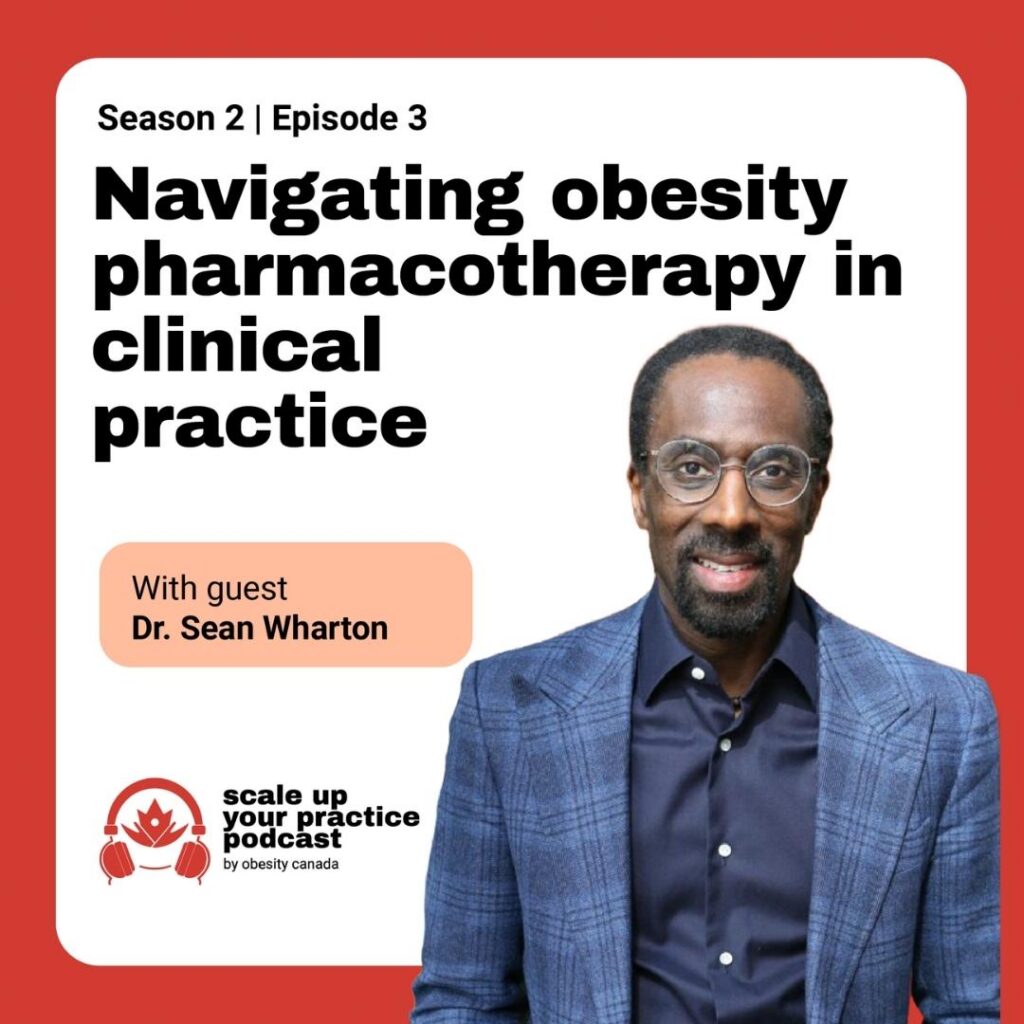


What changes when obesity care stops being about willpower and starts with biology? In this episode, Dr. Roshan Abraham speaks with Dr. Sean Wharton about how pharmacotherapy is reshaping obesity care, why “food noise” matters, and how clinicians can support patients with more empathy, less stigma, and a better understanding of obesity as a chronic disease.

Dr. Sean Wharton holds doctorates in both Pharmacy and Medicine from the University of Toronto. He is the medical director of the Wharton Medical Clinic, a community-based internal medicine clinic specializing in weight management and diabetes care. Dr. Wharton is also an assistant professor at the University of Toronto, and an adjunct professor at both McMaster University in Hamilton and York University in Toronto.
A respected researcher, Dr. Wharton is the lead author of the 2020 Canadian Obesity Clinical Practice Guidelines and has published numerous peer-reviewed articles in international medical journals.
In addition to his clinical and academic work, Dr. Wharton is an advocate for health equity in Canada. In 2000, he founded the Black Medical Students Association (BMSA) at the University of Toronto—a group that has since grown into a nationally recognized mentorship organization.
Support Scale Up Your Practice by:
Email us at scaleuppod@obesitycanada.ca
This episode script was developed using NotebookLM to synthesize complex source materials into a structured educational format. The tool was used to analyze the Canadian Obesity Education Competencies (COECs), the Obesity Canada Strategic Plan, and guest-specific research. Specific prompts were utilized to extract relevant learning objectives, map them to CanMEDS roles, and generate competency-based interview questions.
While NotebookLM assisted in drafting the narrative arc and educational framework, all content has been reviewed, fact-checked, and refined by the podcast hosts and Obesity Canada’s clinical experts. This ensures the script aligns with current Clinical Practice Guidelines and authentically represents the lived experience perspective.
00:00:00:02 – 00:00:13:12
Dr. Sean Wharton
Those medications failed you. You didn’t fail the medications. Let’s move on to something new. Even if it’s in a clinical trial, we can give this a shot.
00:00:13:14 – 00:00:39:21
Dr. Roshan Abraham
Hello, and welcome to the Scale Up Your Practice podcast, brought to you by Obesity Canada. I’m Dr. Roshan Abraham, family physician and associate professor at the University of Alberta for obesity. Historically, people have been told to just eat less and move more. There were few therapeutic options that addressed the comprehensive approach needed for this disease; between 2021 and 2026, though, the science of pharmacotherapy has shattered that paradigm,
00:00:39:23 – 00:01:03:03
Dr. Roshan Abraham
addressing the underlying biology of weight regulation. We’re no longer just looking at modest weight loss; we’re looking at medications like triple agonists and oral molecules that normalize neurobiology and fundamentally alter the trajectory of this chronic disease. It is time for our clinical practices to catch up to science. So today, we are diving into the current obesity pharmacotherapy landscape.
00:01:03:05 – 00:01:31:10
Dr. Roshan Abraham
Specifically, we want to help you master the skills needed to confidently collaborate with your patients to assess and prescribe these rapidly evolving medications. To help us navigate this, we are joined by a globally recognized researcher, internal medicine specialist, and the co-lead of the 2020 Canadian Adult Obesity Clinical Practice Guidelines Lead author, Dr. Sean Wharton. Dr. Wharton, welcome back to the show.
00:01:31:12 – 00:01:54:03
Dr. Sean Wharton
Thank you very much. I’m really excited to be here because, you know, we’re going to talk a little bit about all the new emerging research. I’m literally in my clinical trials division right now. So, I’m not in—I’m in the clinic. I’m in the clinical trials area where we work on clinical trials every single day. I’m seeing patients getting new medications, new therapies, new advances.
00:01:54:05 – 00:01:57:08
Dr. Sean Wharton
So, we can dig right into that.
00:01:57:10 – 00:02:18:22
Dr. Roshan Abraham
This is truly an exciting time for the field and for medicine overall. And I am grateful that you’ve taken the time today to be our guest once again, this time in season two. So, Dr. Wharton, the pharmacotherapy landscape has dramatically changed over the last few years. Emerging therapies are moving from single pathway GLP-1s to non-peptide oral pills and triple agonists.
00:02:19:00 – 00:02:29:19
Dr. Roshan Abraham
For the busy clinician listening, what do these therapies change about how we can support more comprehensive care for patients living with obesity?
00:02:29:21 – 00:02:52:16
Dr. Sean Wharton
I love that question because it digs right into immediately, like, what is the unmet need? Where exactly are we? So, where we are is that there are essentially four medications in Canada right now. They’re working relatively well. They’re doing pretty good, particularly if we look at semaglutide 2.4 mg, which is approved in Canada, and tirzepatide 5, 10, and 15 mg.
00:02:52:22 – 00:03:19:03
Dr. Sean Wharton
So, those two molecules give you anywhere from 15 to 22% weight change. Pretty darn good. Now, and the unfortunate thing is that some people just don’t do well on it. We have this thing called a waterfall plot where we rank every person’s weight loss. And on an average, then, if you’re looking at the tirzepatide molecule, on average, you’re going to get an average of about 21%.
00:03:19:03 – 00:03:38:04
Dr. Sean Wharton
But that 21% is made up of people at 5% weight loss and so on, that 30% weight loss, and a couple of people with weight gain. So, who are these people? What are they doing gaining weight? Are they injecting it, or are they injecting it into the air? If they’re really injecting it, how could they possibly gain weight?
00:03:38:06 – 00:03:59:19
Dr. Sean Wharton
But there’s that group.ne, there’s a group that is gaining weight. Two, there’s a small group that didn’t get significant enough weight change on the highest dose. So, those people are missing out. They’re missing out on their visceral adiposity decreasing, their comorbidities getting better. How can we help them? Well, we’re not going to help them with just a higher dose of the medication because it’s just not working for them.
00:03:59:22 – 00:04:21:02
Dr. Sean Wharton
What frequently works is a new medication, a different medication, a different twist, hitting a different hormone, a different receptor. And that’s what some of these newer molecules are going to do. They’re going to get to that problem area that we don’t quite understand. We don’t understand why it’s problematic, but we understand we may be able to get to it with different molecules with a little bit different target.
00:04:21:04 – 00:04:51:05
Dr. Roshan Abraham
And I think that mentality of going in it just as a primary care physician, that’s actually how I’ve been describing some of the, I guess, evolution of treatment to my patients because a lot of them are actually getting frustrated. Right, because they feel that they’ve sort of maxed out these doses. We’ve been doing it from a multidisciplinary standpoint and sort of being able to tell them about how the body, and we might not quite know it yet, biologically defends that weight, right.
00:04:51:05 – 00:05:04:07
Dr. Roshan Abraham
And that metabolic adaptation, and how we need to start looking at different approaches and to not necessarily add on to that internalized weight bias and stigma, because they feel like this is one other thing that they’ve actually missed out on.
00:05:04:12 – 00:05:26:18
Dr. Sean Wharton
Right, exactly. That’s 100% right. And that’s why in some cases, what we didn’t do was we didn’t maximize the dose in the research. So, for instance, in semaglutide 2.4, when we did that big trial in 2020, now what we’ve discovered is that maybe 2.4 wasn’t the highest dose and maybe we could go higher. So, what they’ve done is triple the dose to 7.2 mg.
00:05:26:18 – 00:05:49:00
Dr. Sean Wharton
So, a nice trial in the Lancet,I was lead author of that, at triple the dose from 2.4 to 7.2 milligrams gave us 3% more weight loss. It’s not a lot more weight loss. And it probably is not going to impact the people who had no impact from this medication— they are not doing well with the molecule–
00:05:49:06 – 00:06:09:13
Dr. Sean Wharton
But for those who wanted to go up a little further and were doing okay, they could crank up to 7.2 mg. So, that’s going up in dose. Next, let’s switch the molecule totally. And I believe that we’ll see the people who didn’t respond possibly respond to these newer targets.
00:06:09:15 – 00:06:36:22
Dr. Roshan Abraham
Again, Dr. Wharton, you’ve been a strong advocate for changing how we communicate the mechanisms of these medications to patients, which I find incredibly valuable as a generalist and as a medical educator. You often talk also about the neurobiology of food noise. How do you explain food noise in clinic, and what do you notice shifts for patients when they realize this is about regulating biology and not necessarily about willpower?
00:06:37:00 – 00:07:01:07
Dr. Sean Wharton
Food noise has been a new term over the past five years or so, but we’ve always had it. We just call it something different. We call it hunger, cravings, intensity, and getting hangry. So hangry is food noise, if that hunger and angriness lasts for a long time or dictates your day. And that is what we’re talking about.
00:07:01:07 – 00:07:23:00
Dr. Sean Wharton
We’re not talking about simple hunger. We’re talking about addictive type of behaviours even when you try to stop it. And nobody wants to live with that food noise because it stops their functioning with their partners, with their relationships, when they’re trying to listen to somebody, yet they’re thinking about food. Or they’re thinking about getting away from them.
00:07:23:00 – 00:07:43:03
Dr. Sean Wharton
How quickly can I get out of this conversation so I can go eat on my own? How can I get home by myself so that no one else is there, so I can eat before anybody else makes it home? How can I hide food wrappers and things like that? How can I hide my drive-through? To throw away stuff before they get home,
00:07:43:03 – 00:08:02:00
Dr. Sean Wharton
so it’s not even in the car. And this isn’t binge eating, which is another disorder that comes close to this, but it’s not the same. And so if you could get rid of the food noise, you are a new person. Because everybody living with obesity wants to eat healthy, wants to eat healthier, wants to eat smaller portions, wants to eat regular.
00:08:02:00 – 00:08:26:12
Dr. Sean Wharton
They’re not doing this out of a sense of lack of character. And once you give them that ability to eat healthy, oh man, they’re the best. They’re the best healthy eaters. And they’re structured and organized and coordinated. And it’s, it’s a joy to actually see. So if medications can help to quiet that, the same way medications can help to quiet schizophrenia. A person with schizophrenia doesn’t want to hear the noises.
00:08:26:14 – 00:08:43:05
Dr. Sean Wharton
And the voices- Quiet it down. So they can focus on your conversation and go to school and be structured and be there. So you have more available “real estate” we call it “real estate” in your brain, to be able to function on a daily basis. That’s what these medications often do.
00:08:43:07 – 00:09:11:06
Dr. Roshan Abraham
That’s so well-put. And again, coming from a family physician primary care standpoint, I have now at least a handful of patients where one of the primary goals or even secondary goals is about reducing that intrusive, obsessive thought about food. And in fact, in some cases, we’ve actually not needed to increase or even start antidepressants as a result of that, because we’re actually stopping this noise.
00:09:11:07 – 00:09:50:18
Dr. Roshan Abraham
And it wasn’t until we actually started it that they realized, “Oh, I don’t—I don’t actually need to start an antidepressant because these intrusive, obsessive thoughts about food aren’t there.” It is really about having that holistic approach because everyone’s different in terms of how these obsessive thoughts come up with food, and then the self-blame that’s been there since you were a child. Whether you’re living in the same place that you were before or not, the locations that sort of bring about that food noise that maybe are attached to some childhood memories as well. Going through that holistic approach really increases long-term adherence to the medications and then also relieves that patient’s self-blame, which I find is really powerful.
00:09:50:18 – 00:10:20:00
Dr. Sean Wharton
100%. And there’s new emerging research showing that people living with depression and mental health disorders actually kind of have enhancements of their medication. They can feel better on the medications and take lower doses of their medication by treating their obesity first. So treating obesity first may be one of the better ways to do that. Back in the day, I’m talking ten years ago in my clinic, we set up a system of treating the mental health condition first and saying, “You don’t need weight management treatment.
00:10:20:00 – 00:10:48:07
Dr. Sean Wharton
We’re not going to give you weight management treatment because you need to get your mental health in order.” And we’re now learning that that may have been the wrong way to do it. Get their food noise and their obesity in order, and they can now do their mental health so much better. We’re fighting against a brick wall, when in fact, we could have been having a much easier management of their mental health if we just took control of their weight management and their food noise in their brain a little bit earlier.
00:10:48:07 – 00:11:21:09
Dr. Roshan Abraham
And recognizing that that’s a little bit of systemic bias and stigma that basically told us as clinicians that we should probably address the mental health issues first before actually addressing the weight side of things. So I think that that switch has also been powerful for a couple of those patients. For them to hear from us that this could actually be beneficial for their mental health and not to prioritize that first and sort of think of weight or obesity as a secondary illness or secondary disease.
00:11:21:09 – 00:11:51:06
Dr. Roshan Abraham
Before we get into the next part of our conversation: if you’re listening and thinking that you’d like to feel more confident prescribing obesity medications in your practice, Obesity Canada has a resource for you. Our latest accredited course, Pharmacotherapy in Obesity Management, is online, self-paced, and walks through the latest 2025 Pharmacotherapy Clinical Practice Guideline Update. Scan the QR code on screen to enroll today or click the link in the show notes.
00:11:51:08 – 00:12:22:22
Dr. Roshan Abraham
So, Dr. Wharton, despite these incredible advancements, there is still a massive amount of stigma around these medications. We see healthcare systems and even some providers framing these as, quote-unquote, “the easy way out” or just a, quote-unquote, “weight loss journey.” The new Canadian guidelines and ADA standards heavily emphasize eliminating this bias. How does this systemic bias actively harm patients, and how must we change our language to dismantle it?
00:12:23:00 – 00:12:53:14
Dr. Sean Wharton
And this is a great, great question. And it’s the reason why I think it’s such a great question: because I just finished a teaching session where I was part of that teaching session for a different country. During that, there was a lot of discussion around the table and, oh my goodness, was it biased. There were some comments about the fact that I will not let my patients be on these medications unless they tell me what they’re going to do for their exercise, what they’re going to eat, and, and, uh, they stick to it, and etc.
00:12:53:14 – 00:13:10:15
Dr. Sean Wharton
I—It blew my mind because there were,obviously were cardiologists in the room, and the cardiologist would say, “If you don’t eat the Mediterranean diet, you’re not—I’m not going on this cardiac medication. If you don’t go to the gym on a regular basis, if I don’t see your gym membership, you’re not getting this beta-blocker, ACE inhibitor,
00:13:10:17 – 00:13:32:02
Dr. Sean Wharton
aspirin. I am sorry. You’re not getting my medication. Not from me.” That was the discussion. You’re not getting the weight management medication from me if you’re not shamed and blamed into ensuring that you check in with me every week to show me that you went to the gym or show me your food diary. I had to breathe
00:13:32:04 – 00:13:55:01
Dr. Sean Wharton
and relax. Because those biased, stigmatizing viewpoints, which I mean some of our friends share, some of our family members share, my parents, like—no, it’s not going to be easy to change this. We are, we are a small number. So when we talk about bias, stigma, and discrimination, we can’t preach it loud enough. We keep, need to keep, on preaching, and we need to show.
00:13:55:02 – 00:14:19:12
Dr. Sean Wharton
And we need to give people actual examples of what we’re talking about. Because they can’t see it in themselves. So, like racism back in the 1930s and ’40s, they’re like, “We believe that, you know, Black people should, they’re just not right, they—they can stay with themselves. We’re not against them. They need to stay
00:14:19:12 – 00:14:41:19
Dr. Sean Wharton
in their own spot, with their own people; they’re happy. They’re not bright, they’re not really capable. So they are happy by themselves.” That’s why there’s all these jolly pictures of Black people hanging out in the South: because they’re not bright enough or capable enough to move forward. That’s very clear now that that’s racism. But it wasn’t clear to the person in the 1930s.
00:14:41:20 – 00:15:00:03
Dr. Sean Wharton
They were the kindest, nicest person ever. This is the same kindest, nicest person ever, yelling at their patient to exercise better. And, “What, didn’t you hear that I told you last week?” Nicest, greatest doctor, they think they’re terrific.
00:15:00:05 – 00:15:31:00
Dr. Roshan Abraham
You’ve spoken beautifully about the love pillar in obesity management. The idea that being heard and cared for is just as essential as the prescription pad. Stemming from what you’ve just said, when a patient sits in front of you and they’re either able to feel the relief of their biology being regulated for the first time, or you’re able to explain that with a lot of these emerging therapies or current therapies, that they can actually feel that relief.
00:15:31:01 – 00:15:44:22
Dr. Roshan Abraham
How is it so important for us to link that, again, the pharmacotherapy, that prescription pad, to also the piece that we love and care for our patients? And how can some of these emerging therapies actually help with that?
00:15:45:00 – 00:16:11:13
Dr. Sean Wharton
Patients sometimes coming in with a medical condition or problem want to be either hugged, heard, or helped. So you’re not going to physically hug them. The hug is listening to them, understanding and saying, “I appreciate how challenging that must have been.” And it sounds like a just a clichéd statement, but it was hard for them. They hear you saying that and they appreciate that empathy. nd give them a second, because it was hard,
00:16:11:13 – 00:16:31:08
Dr. Sean Wharton
whatever they happen to be talking about. Next, to be heard. Sometimes you just want to spew out a whole bunch of stuff and it’s like, get it off of their chest. And they—they’re not necessarily looking for help, they’re not looking for advice and not absolutely looking to be hugged. They’re just looking for somebody to hear the challenges that they had.
00:16:31:09 – 00:16:46:17
Dr. Sean Wharton
They know that you don’t have hours, but you can hear a little bit of what they need. And they may not need help, but you can ask them. That’s where the ask comes from. The ask is about the help. We’re in a position now where we understand much more about weight management. Would you like some help?
00:16:46:17 – 00:16:47:17
Dr. Roshan Abraham
Yes.
00:16:47:17 – 00:17:07:16
Dr. Sean Wharton
In regards to your weight management, we can move from things like you were on this dual agonist, which was our best thing that we had at the current time. But you still didn’t get the impact. Would you like some help to move forward with some of the newer medications? We’ve got a new trial with an agent that does, that adds an amylin.
00:17:07:16 – 00:17:31:03
Dr. Sean Wharton
This new molecule that sensitizes the brain to leptin and the weight management regulatory hormones that are good regulatory hormones; just amylin sensitizes it and It makes it stronger. We can give this a shot; I’m not absolutely sure it’s going to work, but we can move forward. If you would like to move forward on yet another treatment, because that’s what I’m here to actually do.
00:17:31:05 – 00:17:45:05
Dr. Sean Wharton
Those medications failed you. You didn’t fail the medications. Let’s move on to something new, even if it’s in a clinical trial. Because I work in clinical trials, we may be able to do that for you in a clinical trial.
00:17:45:10 – 00:18:08:15
Dr. Roshan Abraham
I’m drawing from so much in my own practice about similar words, maybe not the exact same phrases, and how that relates back to the compassionate chronic care relationship and what that actually looks like. I think it’s imperative for us, especially as primary care physicians, but all clinicians, honestly, to say this is what the roadmap looks like.here are options.
00:18:08:17 – 00:18:36:16
Dr. Roshan Abraham
And we’re here with you, guiding you, collaborating with you on this. And I think that’s such a powerful statement around compassionate chronic care because it’s relationship building and being able to communicate that in simple terms. And just as you’ve put it, too, it is so beautifully put. I’ll be taking that back for me as well, just in terms of how I might communicate some of these emerging therapies if it comes up in our discussions,
00:18:36:18 – 00:18:39:21
Dr. Roshan Abraham
as I think it’s a really powerful tool for our listeners.
00:18:39:23 – 00:19:02:16
Dr. Sean Wharton
Yes. And sometimes it’s not at that doctor’s center, that the clinician’s center, they don’t run a clinical trial division, but there are clinical trials divisions in their city. They are on the internet. You just search Google, “I’m interested in weight management clinical trials.” I’m interested… I’m interested in that.
00:19:02:16 – 00:19:25:17
Dr. Sean Wharton
I mean, I may not absolutely do it, but I’m interested. So, and then you start to walk down the road and then you start to see whether that’s something that works for that person who’s looking for the next step. They can always wait until the clinical trials are done and then have the medication once it is approved. But we do find people that want to help to answer the question of, “Does this work in this patient population?”
00:19:25:17 – 00:19:45:20
Dr. Sean Wharton
I’m always amazed at my clinical trial patients, like, “What are you doing here? Why do I hear you here?” I did this. they’re like, “I’m actually interested in helping to forward research. I’d like to, I know that this may be able to help me as well, so I’m super interested in that and super interested in helping the research field.”
00:19:45:23 – 00:20:00:06
Dr. Sean Wharton
I’m like, “This is terrific.” And so, not everybody that is out there is like that. So don’t think that all the people who are like that will move forward; they’ll be here. And those are the people that you want in the clinical trials. At least you’re offering them something.
00:20:00:08 – 00:20:23:00
Dr. Roshan Abraham
So, Dr. Wharton, one of our last questions today is: What is on the horizon? What are some of the new and emerging therapies that are getting you excited about, again, this chronic disease management and how we can better manage obesity care for patients and really tap into that compassion with chronic disease management in this condition?
00:20:23:03 – 00:20:41:09
Dr. Sean Wharton
So, one of the things that I’ve always worked on is access to care. And so I believe that the populations that have the highest rates of obesity and type 2 diabetes are the ones who get the least amount of care. So, that’s the Indigenous population here in Canada and African American women in the southern states.
00:20:41:14 – 00:20:59:07
Dr. Sean Wharton
They have the highest amount of obesity, the highest amount of type 2 diabetes and get the least amount of care. And access. And all the treatments we’ve talked about were previously injectable treatments, which means “cold chain.” Cold chain is that fancy terminology for “it’s got to stay cold in the fridge, but it’s got to be shipped cold.”
00:20:59:07 – 00:21:16:21
Dr. Sean Wharton
So it means it has to be in a cold plane, in a cold truck, getting over to the pharmacy, and then eventually going to be. So, think of the highest rate of obesity in the world: It is in the Polynesian islands. Are they getting cold-chain injectable medications all that easily? And they’re also poor; they have a lower socioeconomic status
00:21:16:21 – 00:21:42:05
Dr. Sean Wharton
and strata. They’re not getting these injectable agents. So can we flip the switch and give oral agents? Because oral agents may give us a chance to treat those populations that have not been previously treated. This is going to change a lot. Cardiologists don’t like giving injectable medications. Not because they can’t do injectable medications. They do PSK9 inhibitors, which is fine,
00:21:42:05 – 00:22:04:06
Dr. Sean Wharton
they do injectable medications. They don’t want to do this injectable medication because it means a refill of a script, patient coming back: “Ah, my partner changed their insurance. Can you switch it for me?” They don’t want to do that, but they will give a pill that is easy to give, easy to titrate, and is part of their pill regimen that they give with their patients.
00:22:04:06 – 00:22:27:20
Dr. Sean Wharton
So, cardiologists, GI doctors, specialists, family doctors, and patients are asking for it. So, there are two barriers. There’s the barrier sometimes with the patient. But the barrier with the patient isn’t nearly as big as the barrier with the provider. Providers don’t like prescribing things that cause them to have to do refills and challenges. This is going to change that.
00:22:28:01 – 00:22:47:15
Dr. Sean Wharton
When you change something that’s that critical to the operation chain, it changes everything. So, that’s why we are excited. It is so it’s important to explain: it is not just orals coming to the market. No. This is a big, big change.
00:22:47:17 – 00:23:14:03
Dr. Roshan Abraham
I’m excited about increased access and improvements in sort of how we address social accountability and equity. And I’m not even a dual-trained pharmacist and internal medicine specialist like you are. I can’t imagine what it’s like to be in your shoes and being in this world and being in this field. Again, I’m a generalist.
00:23:14:03 – 00:23:37:17
Dr. Roshan Abraham
I work in a generalist practice. Obviously, I see a lot of obesity as a chronic disease, and it’s slowly becoming more of an interest for me. But I still represent that primary care perspective. I can’t imagine what it’s like for you with your previous training that you get to now bring into the everyday work. I mean, you were doing it before, obviously, but now… Just hearing it from you is what’s making me excited.
00:23:37:21 – 00:23:39:12
Dr. Roshan Abraham
And I’m not even a pharmacist.
00:23:39:14 – 00:23:59:00
Dr. Sean Wharton
Yeah. And it’s really exciting because of that science side of it. The pharmacokinetics,how the kinetics of a drug being absorbed and going into the bloodstream, and then the dynamics, does it actually get to the receptor and work? So all of these we call geeky things, but the science things and the biological things really get us excited from a science standpoint.
00:23:59:02 – 00:24:13:07
Dr. Sean Wharton
But then to see it in operation, to see it for a patient that’s not concerned about all the kinetics and the pharmaco. They’re just like, “Does it work, and can I get access to it, and can I change my trajectory? Can I change the way I show up to work? Is it going to change how I show up with my family?
00:24:13:09 – 00:24:21:06
Dr. Sean Wharton
Can it allow me to walk up a flight of stairs without shortness of breath? Can I pick up my grandchild?” That’s what we’re talking about.
00:24:21:08 – 00:24:47:06
Dr. Roshan Abraham
Dr. Wharton, I am so glad you came back for another episode. And hopefully, we have you back many more times. For our listeners, in summary, we covered the rapidly evolving landscape of obesity pharmacotherapy. Some of the current therapies, as well as emerging therapies that we are obviously excited about. We discussed how treating the neurobiology of food noise is fundamentally changing the way that we practice medicine.
00:24:47:08 – 00:25:18:05
Dr. Roshan Abraham
We discussed how mastering this knowledge allows you to dismantle the stigma that calls these lifesaving treatments the, quote-unquote, “easy way out.” And when we understand the science, we can truly practice compassionate, person-centered care. You can find direct links to the 2025 update of the Canadian Adult Obesity Clinical Practice Guidelines, and a link to the Pharmacotherapy for Obesity Management course.
00:25:18:07 – 00:25:39:07
Dr. Roshan Abraham
Please visit them to dig deeper into the evidence. New episodes of Scale Up Your Practice drop every second Thursday, so make sure you are subscribed so you never miss an episode. If today’s conversation was helpful, please take a moment to rate and review us on your favourite podcast platform. It helps other clinicians find the show and bring this learning into their practice.
00:25:39:09 – 00:25:49:16
Dr. Roshan Abraham
Thank you again, Dr. Wharton, for guiding us through this. It was a pleasure, and I hope that our listeners also got a great opportunity to learn again from you.
00:25:49:18 – 00:25:52:06
Dr. Sean Wharton
Cheers. Thank you very much, Roshan.
00:25:52:08 – 00:26:04:03
Dr. Roshan Abraham
Until next time, listeners, stay curious, stay kind, and keep scaling up your practice.
00:26:04:05 – 00:26:35:07
Dr. Roshan Abraham
This podcast is intended for informational and educational purposes only and does not constitute medical advice. The content shared in this podcast should never be used as a substitute for professional medical advice, diagnosis, or treatment. Always seek the guidance of a qualified healthcare professional with any questions you may have regarding your health or a medical condition. The information and treatments discussed in this podcast are based on Canadian guidelines and approved practices as of the time of recording.
00:26:35:09 – 00:26:56:23
Dr. Roshan Abraham
If you are listening from outside of Canada, please consult your local healthcare professional to ensure compliance with your region’s medical standards, guidelines, and recommendations. The creators of this podcast disclaim all liability for any decisions or actions taken based on the content discussed. Listening to this podcast does not establish a professional or patient-client relationship.
Be the first to know about new education and resources for healthcare professionals from Obesity Canada.