New report: Five gaps are holding back better obesity care in Canada. Learn more

Home • Scale Up Your Practice podcast • The Science of Obesity as a Chronic Disease with Dr. Arya Sharma

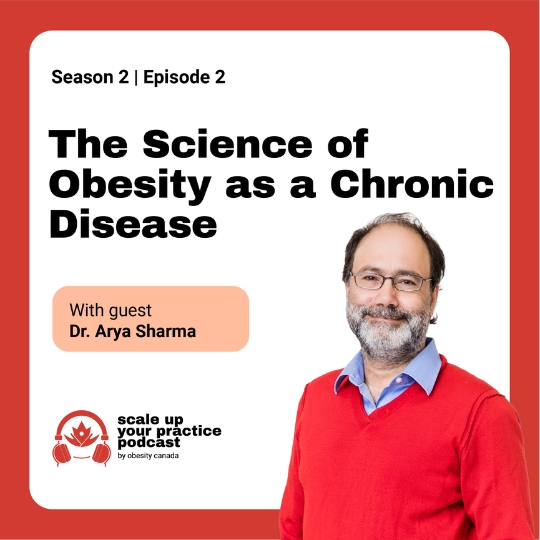


Why is obesity still treated differently from other chronic diseases? Dr. Arya Sharma, founder of Obesity Canada, joins Dr. Roshan Abraham to explore the biology of obesity, the limits of lifestyle advice alone, and the role of compassion, evidence, and better clinical tools in improving care.
Listen to their conversation to learn why lifestyle advice alone is often not enough, how the body defends against weight loss, and why obesity should be understood as an impairment of health rather than a number on a scale. They also discuss how stigma shows up in clinical practice, why the Edmonton Obesity Staging System helps shift the conversation, and what more equitable, evidence-based obesity care could look like in the years ahead.

Dr. Arya M. Sharma, MD, DSc (hon), FRCPC, is Professor Emeritus of Medicine and Past-Chair in Obesity Research and Management at the University of Alberta in Edmonton, Canada. He also served as Past-Clinical Co-Chair of the Alberta Health Services Obesity Program.
A founder and Past-Scientific Director of Obesity Canada, formerly the Canadian Obesity Network, Dr. Sharma is also a Fellow of the Canadian Academy of Health Sciences and Past-President of the Canadian Association of Bariatric Physicians and Surgeons.
His past academic appointments include Professor of Medicine and Canada Research Chair (Tier 1) at McMaster University, Professor of Medicine at the Franz-Volhard Klinik at Charité, Humboldt University Berlin, and Professor of Medicine at the Free University of Berlin. His research has focused on the evidence-based prevention and management of obesity and its complications.
Dr. Sharma has authored or co-authored more than 500 scientific articles, lectured extensively on obesity and related cardiovascular disorders, and is regularly featured as a medical expert in national and international media.
He currently lives in Berlin, where he works as an independent medical, research, and educational consultant for non-profit and for-profit organizations.
00:00:00:00 – 00:00:12:23
Dr. Arya Sharma
The problem is that anybody who tries to lose weight is actually fighting their biology. You know, it’s fair to say that that biology is actually there to protect us from weight loss.
00:00:13:01 – 00:00:36:14
Dr. Roshan Abraham
Hello, and welcome to the Scale Up Your Practice podcast, brought to you by Obesity Canada. I’m Doctor Roshan Abraham, a family physician and associate professor at the University of Alberta. In today’s episode, we are going to be talking about obesity as a chronic disease. We wouldn’t treat hypertension with willpower alone. We wouldn’t ask someone to prove they’ve tried hard enough before offering care.
00:00:36:15 – 00:01:07:10
Dr. Roshan Abraham
So why is obesity treated differently? Today we’re looking at the biology, neural hormones, the genetics, and the physiological defense of body weight, so care can match what we know. To do that, we are joined by the person who literally wrote the book, or at least the guidelines on this. He is the founder of Obesity Canada, the Canadian Association of Bariatric Physicians and Surgeons, the creator of the Edmonton Obesity Staging System and a global leader in obesity medicine with over 500 peer review publications.
00:01:07:12 – 00:01:22:10
Dr. Roshan Abraham
Known to so, so many in the community that is obesity care across the world and a driving force behind the landmark 2020 clinical practice guidelines. Doctor Arya Sharma. It is an honor and a privilege to have you on this podcast.
00:01:22:12 – 00:01:24:07
Dr. Arya Sharma
Hi Roshan. Good to see you.
00:01:24:09 – 00:01:57:01
Dr. Roshan Abraham
Just as a reminder, today’s episode is supported by an unrestricted educational grant from Eli Lilly Canada. We thank them for helping us bring this podcast to healthcare professionals across the country. So Doctor Sharma, you founded the Canadian Obesity Network, now Obesity Canada in 2006. Back then, calling obesity a disease was controversial. Even today, despite many obesity guidelines, we see our systems are ill equipped to treat obesity as a disease, leaving it up to individual clinicians, patients and the public to pick up the slack.
00:01:57:01 – 00:02:09:12
Dr. Roshan Abraham
Why does the concept of obesity as a chronic disease still feel like the point? We keep getting stuck on? Why is shifting our mindset from lifestyle to medicine the prerequisite for everything else?
00:02:09:18 – 00:02:38:02
Dr. Arya Sharma
Well, I think the biggest mistake that most people do when they think about obesity or try to tackle obesity is there’s an illusion of control. People think that weight is something you should be able to control. And, the solution to controlling your weight is, you know, controlling calories in, calories out. Which means that, you know, if you eat less and move more, you should you should potentially be able to be at whatever, you know, weight you choose to be.
00:02:38:04 – 00:02:54:05
Dr. Arya Sharma
The illusion is created largely because when people go on diets, they lose weight. And in fact, you know, when I look at my practice, you know, I don’t think I’ve ever met anybody, you know, who comes to a to an obesity clinic or bariatric clinic who has not already tried countless diets and they’ve tried over and over again to lose.
00:02:54:05 – 00:03:16:09
Dr. Arya Sharma
And in fact, we know that there’s a huge so-called weight loss industry out there that, you know, creates the illusion that, you know, if you try hard enough and if you follow the diet, whatever the diet is, you know, whatever the fad, the latest fad diet is, or if you join the gym and you get your personal trainer and you work out every day, you should be able to somehow conquer your obesity.
00:03:16:11 – 00:03:34:05
Dr. Arya Sharma
And there’s a lot of money to be made with that. And, and then so we have this huge industry that is giving you these messages. And in fact, you know, you keep meeting people who tell you that they’ve lost a significant amount of weight. You know, I’m there to tell you whatever they, you know, they follow. They’ll say, you know, this diet worked for me or this exercise program worked for me.
00:03:34:07 – 00:04:01:03
Dr. Arya Sharma
What they don’t often tell you is, or what you don’t often see is the fact that the vast majority of people who, you know, do these diets, do these exercise programs who successfully manage to lose weight, end up putting it all back on. And usually the excuse for that is that people are just not trying hard enough, that they’re not persistent enough, that they’re not really, you know, sticking with the with the diet that works.
00:04:01:05 – 00:04:19:12
Dr. Arya Sharma
When in reality, the problem is that anybody who tries to lose weight is actually fighting their biology. And so, you know, we have to have a, you know, the first step to understanding obesity is understanding the biology of how the body actually regulates its, its weight, or its energy stores, if you want to look at it that way.
00:04:19:14 – 00:04:38:10
Dr. Arya Sharma
And that is a very, very complex biology. And in fact, you know, it’s fair to say that that biology is actually there to protect us from weight loss. And so anytime anybody goes and tries to lose weight, no matter how they do it, ultimately they’re fighting their own biology. We’re just trying to do the exact opposite, and that is to keep them where they are.
00:04:38:12 – 00:05:00:07
Dr. Arya Sharma
And if they somehow manage to lose the weight that biology is actually there to make sure they put the weight back on, as you know, as soon as they stop doing whatever it is that they’re doing. And that brings us to this whole notion that once you’ve once you have obesity or someone who has obesity, it kind of becomes a lifelong struggle because any time you try to lose weight, you’re going to be fighting that biology.
00:05:00:07 – 00:05:17:19
Dr. Arya Sharma
And the biology, unfortunately, never gives up. So even if, you know, you’ve been successful over many, many years and keeping in losing weight and keeping the weight off, it doesn’t really take much to put all of that weight back on. And and I know that that is very frustrating. And this is not a this is not a happy message.
00:05:17:21 – 00:05:40:01
Dr. Arya Sharma
But it does explain why so many people are struggling to lose weight and keep it off, and then end up by blaming themselves. You know, we talk about internalized stigma so people are really beating up themselves or they get beaten down by other people, you know, for not keeping the weight off, when in fact, they are actually dealing with their own biology, which is hard to overcome.
00:05:40:01 – 00:05:45:11
Dr. Arya Sharma
In fact, actually, there is no way to overcome it at the end of the day, because it’s always going to be fighting you.
00:05:45:12 – 00:06:16:14
Dr. Roshan Abraham
I can’t tell you how many times as a family physician that does comprehensive family medicine, how many times I just had somebody yesterday who essentially said that if they just wanted it enough, they could change their weight. And some of the unlearning that we all have to do around weight starts, with addressing that internalized blame. But at the same time, which is what I’m trying to do, as well as a practitioner, is that the science can actually tell us something different.
00:06:16:14 – 00:06:43:07
Dr. Roshan Abraham
So actually breaking down that biomedical reality is essential for patients to reframe the way they think about it. So can you break that down for us and for our listeners? Because I do think that is essential for a lot of people to understand. So when a person cuts calories, what is happening physiologically in the brain and the gut that makes this long term sustainable weight loss unattainable for many patients using lifestyle interventions alone.
00:06:43:12 – 00:07:00:18
Dr. Arya Sharma
We’re talking about a very complex biology. But the concept is really very simple. Energy stores are vital for survival. And the reason we are here in the way the reason or answers to survive was because when there was food available, they were able to, you know, eat as much as they possibly could. Clearly they didn’t need all those calories.
00:07:00:18 – 00:07:19:08
Dr. Arya Sharma
I mean, this was way more calories than they needed. And those extra calories they get stored as fat. The idea is to eat as much as possible, because you never know when the next meal might come along. And so there’s a biology that kind of drives us to to consume food beyond what we actually need at a given moment.
00:07:19:12 – 00:07:38:03
Dr. Arya Sharma
Now, in the old days, I mean, you know, there’d be a famine or there’d be an illness or we have to go off, you know, on long treks and you’d use up some of those calories. And then, you know, next time you have food, you fill up those stores again. And so there is a complex biology that allows you to actually take up more calories than you need at at any given moment.
00:07:38:05 – 00:08:05:06
Dr. Arya Sharma
Then we have this amazing tissue, which is fat tissue, which then converts these calories into something and stores them off and, and and it stores them safely. So, you know, the adipose tissue or fat tissue can actually store those calories for years and years and years. And I sometimes joke about I said, you know what, you could be living off the pizza you had ten years ago because, you know, that pizza was converted to fat tissue and it went there and sits in your fat tissue till you need it.
00:08:05:08 – 00:08:29:03
Dr. Arya Sharma
And that’s that’s what it’s therefore. And so protecting those energy stores, is, is a vital function. You know, it’s, it’s as important to survival as, everything else, you know, that the body controls. And so although the, you know, we get fooled by the day to day fluctuations in body weight or I don’t eat for a few days and I lose weight and then the weight comes back.
00:08:29:03 – 00:08:50:10
Dr. Arya Sharma
And so we think this is something we can control. But actually there’s a very complex biology behind this. That really makes sure that, you know, our energy stores are protected. Unfortunately, the way the system works is that it? It is designed to continue moving up. And this is, I think, one of the biggest issues around the way that the biology works.
00:08:50:12 – 00:09:10:10
Dr. Arya Sharma
This happens pretty much, you know, starting, starting from infancy, the set point keeps moving up and, and kind of matches the highest weight that you’ve achieved. That then over time becomes your new set point. But there is no biology that allows the set point to move down. Because that was never and you never have to go back to, to six pounds, right?
00:09:10:10 – 00:09:32:21
Dr. Arya Sharma
I mean, you know, once you’re at 70, you know, or 80 pounds or 100 pounds, well, that’s not what you know, what it evolved for, right. And so unfortunately, what happens when you gain weight is that, you know, the set point keeps going and it keeps, you know, going higher. And usually it settles around your maximum weight, so it’s your lifetime maximum.
00:09:32:21 – 00:09:53:02
Dr. Arya Sharma
And so that’s one of also the important history questions, right. One of the questions you would ask your patients, is not counting pregnancies, what’s the maximum weight you’ve ever been? And for most people, that maximum weight is actually the weight that they’re fighting when they try to lose weight, no matter how hard you try it, you know, very often it’s very hard to get beyond that plateau.
00:09:53:04 – 00:10:09:06
Dr. Arya Sharma
And from a clinical perspective, that, of course, is extremely frustrating for the patient. But from a biological perspective, all it, you know, all that tells us is that while you’ve got a biology, you’ve got a normal working biology that is trying to defend you, against losing too much weight.
00:10:09:08 – 00:10:42:00
Dr. Roshan Abraham
I’m smiling throughout all of this as an educator, because the value of this explanation and understanding this biology is crucial. And I think having this, applied to what we do and how we teach in the exam room is essential. So how how does that change our responsibility in the exam room, if a patient comes in and we’re only offering lifestyle advice, are we really practicing evidence based medicine or are we falling short of our professional standards?
00:10:42:04 – 00:11:03:18
Dr. Arya Sharma
You know, lifestyle advice is important, right? Because there’s always things that that, that everybody can do to improve their lifestyle. Why don’t you know, whether it’s making healthier choices, whether it’s trying to be more active, but it’s reducing screen time, whether it’s reducing stress levels, they’re always important. And in fact, they’re important for everybody Right. And so, you know, if somebody came to me with diabetes, I’d probably give them the same advice, right?
00:11:03:18 – 00:11:19:00
Dr. Arya Sharma
You know, you’ve got to have a healthier diet. You need to be more physically active and do all of those things. If somebody came to me with hypertension, I’d probably give them the same advice. In fact, if somebody came to me with pains in their knees, I’d also give them the same advice, right? Because we know that, you know, physical activity is so important, right?
00:11:19:00 – 00:11:42:16
Dr. Arya Sharma
So, the question is, is it enough? Right? Is it enough to actually manage obesity in the long term? Right. Because what we’re looking for is, is not a short term solution. You know, when you lose 20 pounds in a couple of weeks and, you know, and that’s it. But if you’re talking about significant obesity, we’re talking about people who probably need to lose, you know, 20 pounds, 30 pounds, 40 pounds, 60 pounds, maybe 100 pounds.
00:11:42:18 – 00:12:02:17
Dr. Arya Sharma
That kind of weight loss is not something that you can sustainably achieve. You know, by walking your dog, you know, it’s going to take a lot more than that. And if people remember the Biggest Loser as a as an exercise, I mean, if you look at the amount of activity that was being done there, I mean, you know, people were exercising to the till, they threw up.
00:12:02:19 – 00:12:20:16
Dr. Arya Sharma
That’s a crazy amount of activity. On top of that, they were severely diet restricted, right? I mean, they’re reading 900 800 calories a day, if that’s all you’re going to eat. I mean, I can guarantee you that you’re going to end up with nutritional deficiencies, right? There’s no way that anybody can survive in the long term forever. If if all you’re eating is 1200 calories.
00:12:20:16 – 00:12:42:17
Dr. Arya Sharma
Right. That’s simply not going to work. So lifestyle, interventions alone are not going to be effective enough, for, for the vast majority of people who have a significant amount of weight to lose, right? I mean, you can get there. But that’s not what we’re looking for. We’re not looking for, you know, people to get there.
00:12:42:19 – 00:12:46:23
Dr. Arya Sharma
We are looking for people to stay there. And that’s a whole different story.
00:12:47:01 – 00:13:22:00
Dr. Roshan Abraham
We talk a lot about reshaping narratives as an organization just for strategic purposes for Obesity Canada. And, we hear a lot about diagnostic overshadowing where a doctor sees a large body and assumes unhealthy or noncompliance before asking appropriate questions about a patient’s health. So this stems exactly from what you were saying. How does understanding the definition of obesity as an impairment of health, not just appearance or size or BMI, help dismantle that bias and change the way we assess and talk about health risks?
00:13:22:01 – 00:13:26:12
Dr. Roshan Abraham
And how does EOSS help us do that more effectively?
00:13:26:14 – 00:13:47:13
Dr. Arya Sharma
Well, the Canadian obesity guidelines, of which we first the first version of which we published back in 2020, was really the first guideline, that defined obesity as being the presence of excess or abnormal body fat that impairs health. And it’s really the the health and payment part of it that makes this interesting for, you know, us medical folks, right?
00:13:47:13 – 00:14:06:11
Dr. Arya Sharma
I mean, if this was just a, you know, you know, a shape and size thing and, you know, that’s important, I mean, aesthetics is also important. But if it was just an aesthetic problem, then it’s not really a medical problem. They have to be affecting some aspect of health. And you can look at the potential effect of excess body fat on health, in three dimensions.
00:14:06:11 – 00:14:27:16
Dr. Arya Sharma
Right. We’ve we’ve got the medical complications and the medical complications would be, say, a high blood pressure or sleep apnea, type two diabetes, osteoarthritis, the list goes on. I’m just 200 conditions that, you know, are either directly, related to obesity or, get a lot worse if you also have obesity. Okay. So that’s that’s the medical side of things.
00:14:27:18 – 00:14:45:20
Dr. Arya Sharma
But then we also have the mental aspect of obesity so directly and you find people that, you know, their blood pressure’s normal, they don’t really have, any metabolic issues, but, they might have other problems, right? They might have poor body image. They might have emotional eating. They might have depression. They might have anxiety disorder.
00:14:45:20 – 00:15:08:11
Dr. Arya Sharma
There’s there’s all kinds of sort of emotional issues that can come with obesity or that can actually drive obesity. The mental health issues related to excess body weight are actually part of the problem. And then we have functional limitations. And these are people, you know, they may be metabolically healthy, they may feel great about themselves, but they’re simply not able to function the way that they would like to function.
00:15:08:11 – 00:15:24:02
Dr. Arya Sharma
There’s there’s things that they just cannot do because of the size or they find more difficult to do because of their size, you know, and that can impair your health. And that in turn then can lead to, you know, mental health issues. And that can in turn can ultimately also lead to to sort of metabolic issues or other health problems.
00:15:24:02 – 00:15:43:17
Dr. Arya Sharma
Right? So when you look at the three dimensions of health, your question is if obesity is impairing health, well, or which part which of these three dimensions is really affecting the most? Why are we talking about metabolic health or medical problems that the patient has? Are we talking about, you know, you know, mental health issues? Are we talking about functional issues?
00:15:43:21 – 00:16:04:06
Dr. Arya Sharma
The strange thing is that this is not really very size dependent. It’s not the amount of body fat that’s the problem. It’s the type of body fat and the location of the body fat. It’s a little bit like real estate, right? Obesity. Obesity. It’s all about location, location, location, right? So you could have a lot of body fat that’s just sticking underneath your skin.
00:16:04:08 – 00:16:27:12
Dr. Arya Sharma
That is usually not the problem when it comes to metabolic disease. Now, obviously, if you have a lot of that fat, that means that there’s a there’s a mechanical load, you know, on your knees and on your feet and maybe around your neck and, you know, so so you’re talking about mechanical complications of just, you know, having all of this fat, but it’s not really leading to any metabolic problems.
00:16:27:12 – 00:16:49:06
Dr. Arya Sharma
Right. And that’s subcutaneous fat, right? Then we have another, then we have what we call visceral fat. Now, that fat is a fat that’s located inside your abdomen and around certain organs. So, you know, this is fat that could be wrapped around your heart. So we talked about epi cardial fat. We talk about renal fat. And, and these are, these are natural fat deposits.
00:16:49:06 – 00:17:13:14
Dr. Arya Sharma
So we do have some fat there, naturally. But that’s, those fat depots, when they increase in size, dramatically, that can cause a lot of problems. So that’s visceral adiposity. And then we have, ectopic adiposity, or ectopic fat. And that’s when you start putting fat in organs where we’re, where it really doesn’t belong. And the best example for that is the liver.
00:17:13:20 – 00:17:42:21
Dr. Arya Sharma
Right. So when you start having a fatty liver, when you start having fatty skeletal muscle where you really don’t want a lot of fat, that’s that’s really when a lot of the metabolic problems start, right? Because that causes insulin resistance and local inflammation etc., etc.. Right. So one of the things that we’ve learned is that it’s not the total amount of body fat, but it’s the kind of body fat as the location of the body fat that ultimately determines whether or not you’re going to be having any of those health impairments, especially the medical, the health impairments.
00:17:42:23 – 00:18:06:12
Dr. Arya Sharma
So what that means is that if you’re trying to define obesity or look at the severity of obesity in terms of how severe are the medical problems that you’ve got because of excess body fat, body mass index, or in fact, even body composition measures don’t really give me the information on that. Right. And so we had to come up with another way of looking at this.
00:18:06:12 – 00:18:23:03
Dr. Arya Sharma
We said, okay, you know, we can make the diagnosis of obesity based on body mass index. That’s okay. right? But the clinical diagnosis really should be based on so what are the health impairments that this patient has? And for that we got to actually do some labs. You’ve got to take a history look at one of the problems.
00:18:23:03 – 00:18:47:03
Dr. Arya Sharma
And so we we came up with this staging system that was really based on these clinical indicators. And because I was in Edmonton at the time, but it became to be known as the Edmonton Obesity Staging System. And in fact, now it’s worldwide, pretty much the most popular system. I know that the clinicians love it. The researchers find it a little bit difficult because, you know, it’s but it wasn’t designed for research.
00:18:47:03 – 00:19:03:16
Dr. Arya Sharma
It wasn’t designed for science. It was designed for clinical decision making. That is a you know, I do the Edmonton obesity staging in my patient. I know how severe the obesity is. And that of course then guides my treatment decisions. So and that’s what it was we designed for. And and it works great for that.
00:19:03:21 – 00:19:32:11
Dr. Roshan Abraham
This is such an amazing conversation. I wish we had more time to go over EOSS in more detail as an educator, as someone who teaches medical students here, I speak on EOSS as much as I possibly can to explain the importance of. I sometimes actually talk about it like a disease-illness dichotomy, even though it’s not exactly the same, but the importance of recognizing of a lot of the functional impairments that we can see as a result of the disease.
00:19:32:11 – 00:19:52:07
Dr. Roshan Abraham
This is obviously more in line with the grading and staging that we see with a lot of other, diseases and, and looking at it that way, but really understanding the person more than just what you see in front of you, I think is also really powerful and really important. And we need to have this in our education system from day one when we talk about obesity.
00:19:52:09 – 00:19:55:17
Dr. Roshan Abraham
And I think that’s something that we’re we’re going to continue working on.
00:19:55:22 – 00:20:11:03
Dr. Arya Sharma
Yeah. And I think what we also have to understand from them, one is that that the whole blame shame strategy that we’ve, you know, that we’ve been using for, you know, simply does not work, right? And the only thing that’s going to guarantee is that they’re not that patient might never come back or feel even worse about themselves.
00:20:11:03 – 00:20:34:11
Dr. Arya Sharma
And in fact, we do have data showing that the more weight bias or discrimination or shame and blame that patients experience from their health care provider, the less likely they actually are to, to follow up and, and, you know, very often, you know, the, the notion is that, you know, if they sit in front of me and they leave my office with shame and blame, the next their next stop is going to be the the donut shop, right?
00:20:34:11 – 00:20:54:00
Dr. Arya Sharma
Because that’s the normal response to not feeling good about yourself. You know, if the result of anything I do in my practice is the patient leaving my practice, not feeling good about themselves. I haven’t really helped them much. Right. And in fact I’ve done the exact opposite. And so, so I think the first thing we need to do in this is, use compassion, understand?
00:20:54:00 – 00:21:13:14
Dr. Arya Sharma
This is a tough fight. This is not an easy fight. It’s a it’s it’s a it’s a cruel disease. I say, because it impacts every single aspect of your life. And so I think we do need to approach every patient with understanding, with love and compassion and say, you know, I don’t have a simple solution for this, but I’m here to work with you.
00:21:13:16 – 00:21:26:03
Dr. Arya Sharma
And that’s why when we look at the Five A’s of obesity management, the most important part of this is the advice and the agree part, because at the end of the day, you know, I can give you all the advice I want, but at the end, we going to have to agree on the course of action.
00:21:26:03 – 00:21:42:18
Dr. Arya Sharma
And that course of action, at the end of the day, has to lead to results that, that, that reduce the burden of obesity or whether it’s the health burden, whether it’s the mental health burden. But there’s the functional burden, because that’s that’s what managing this chronic disease ultimately is about.
00:21:42:20 – 00:22:05:04
Dr. Roshan Abraham
What does the future look like, Doctor Sharma, if we were to incorporate this knowledge into our practice from an early stage around bias, around stigma, around the biomedical basis of obesity as a chronic disease, how does the conversation in the clinic change? What’s the vision look like from your standpoint, from someone who has seen so much and contributed so much to this field?
00:22:05:06 – 00:22:35:05
Dr. Arya Sharma
Well, the vision for obesity has been from day one to make sure that people who have obesity as a chronic disease, get the same, respect and level of care, that, that anyone with any other chronic disease gets, you know, when, when people come to the clinic with diabetes, you know, there’s a standard of care, you know, it includes lifestyle advice, includes education is includes, you know, medication that includes, you know, but this is an insulin pump or whatever it is, right?
00:22:35:05 – 00:22:55:16
Dr. Arya Sharma
I mean, you know, there’s a the there are treatments you have access to, to diabetes treatments. You come to a clinic with hypertension while there’s hypertension treatments that you have access to, or you come to a clinic with heart disease while you have access to treatment for heart disease. These are all chronic diseases. And the vision is that that hopefully.
00:22:55:16 – 00:23:15:05
Dr. Arya Sharma
But in the next 4 or 5 years, anybody who comes to see a doctor or a health care professional with obesity, gets the same level of respect, the same level of understanding, and has access to the same level of treatments, whatever those treatments are, those treatments can be, you know, they could be psychological. They could be behavioral, they could be medical, they could be surgical.
00:23:15:05 – 00:23:31:11
Dr. Arya Sharma
Whatever the treatment is that would be best for this patient. They would have access to those those treatments. But because right now what we have is a completely unfair situation. So so if you have diabetes, you get all the care you need if you’ve got, you got, you know, you got heart, problems. You get all the care you need.
00:23:31:11 – 00:23:45:20
Dr. Arya Sharma
You know, you got sleep apnea, you get all the care you need. You have obesity. Now you’re on your own, right? With no access to any of the treatments that actually work and that are actually good for you. And even if you had the access, then, you know, you got to jump through all kinds of hoops.
00:23:46:02 – 00:24:08:02
Dr. Arya Sharma
If you look at bariatric surgery, I still being perhaps the most effective treatment for obesity, even today in most provinces, perhaps with the exception of Ontario and maybe, maybe Quebec, most people still have a hard time getting surgery. And, I don’t even get me started on access to medication. Right. Because that’s, that’s almost hopeless for me.
00:24:08:02 – 00:24:09:20
Dr. Roshan Abraham
Don’t get me started either, as a family doctor.
00:24:09:21 – 00:24:29:09
Dr. Arya Sharma
It’s unfair. Right. Because the science tells you that these medications and these treatments actually work, and they, you know, they improve the lives of our patients, they reduce the, the health burdens. And, I’m hoping that in five years, most patients or the vast majority of patients who are living with Obesity will actually have access to these treatments.
00:24:29:11 – 00:24:52:14
Dr. Roshan Abraham
Today, listeners, we unpack the biological reality of obesity. We defined it not as only as a behavior, but as a multifactorial, chronic disease defended by the brain. We also discussed how deep biomedical knowledge is actually your strongest tool against bias. When you understand the physiology, judgment gets replaced by curiosity. Doctor Sharma, thank you so much for being here.
00:24:52:20 – 00:25:19:08
Dr. Roshan Abraham
Listeners, if today’s conversation sparked questions and curiosity for your practice, check out the show notes for links to Doctor Sharma’s LinkedIn page. ICHOM Outcome Measures and the Edmonton Obesity Staging System, or EOSS, so you can dig deeper into the evidence. Again, thank you, Doctor Sharma, for being here. This was an incredible episode and I am so grateful I had the opportunity to talk with you today.
00:25:19:10 – 00:25:21:02
Dr. Arya Sharma
Great talking to you and thanks for having me.
00:25:21:07 – 00:25:40:12
Dr. Roshan Abraham
So remember, listeners, new episodes of Scale Up Your Practice drop every second Thursday. Make sure you are subscribed so you never miss an episode. If you found value in today’s discussion, please take a moment to rate and review the podcast or share it with a colleague. Until next time, stay curious, stay kind, and keep scaling up your practice.
Be the first to know about new education and resources for healthcare professionals from Obesity Canada.