Call for Authors: Contribute to the Canadian Adult Obesity Clinical Practice Guideline. Learn more

Home • Scale Up Your Practice podcast • Screening for Complications Related to Obesity with Dr. James Kim



What happens when a symptom is explained away too quickly?
For people living with obesity, concerns like fatigue, shortness of breath, poor sleep, or pain are too often viewed through the lens of weight first. That can delay the right questions, the right tests, and the right care.
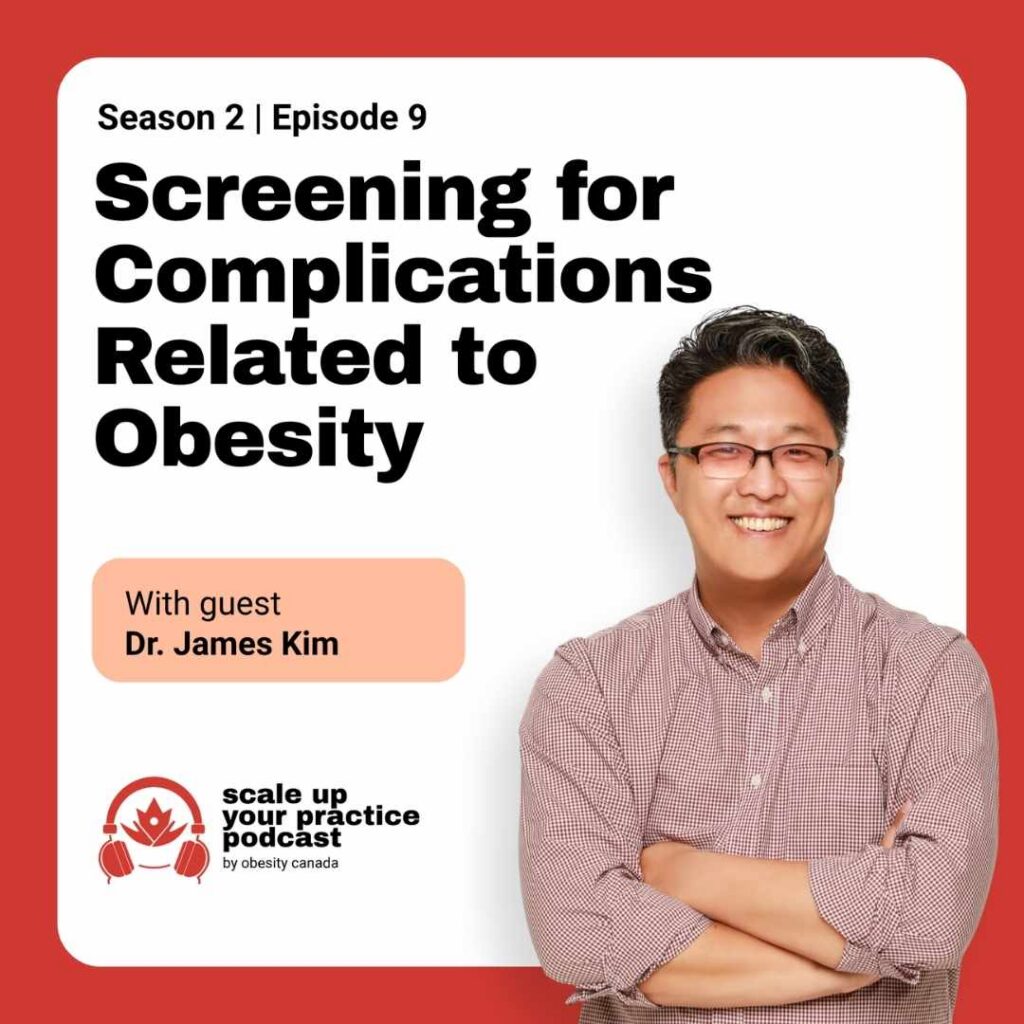
In this episode, Dr. James Kim joins the podcast for a practical conversation about screening for obesity-related complications without letting weight bias narrow the clinical picture. We explore how healthcare professionals can recognize diagnostic overshadowing, build more consistent screening workflows, and make care safer, more respectful, and more evidence-based for people living with obesity.

Dr. James Kim is a Clinical Assistant Professor in the Department of Family Medicine at the University of Calgary, with clinical interests in diabetes, MASLD, chronic migraine, and healthcare professional education.
He is a member of Diabetes Canada’s Clinical Practice Guidelines steering committee, co-chair of the Primary Care Special Interest Group, and lead author of the MASLD guidelines. He also serves as lead editor for the Primary Care section of the Canadian Journal of Diabetes, sits on Migraine Canada’s scientific committee, and was recently invited to join the Global NASH Council as one of its first Canadian members.
If this episode leaves you thinking about how to strengthen your own approach to obesity care, Obesity Canada’s Calibre course is designed to help.
Calibre is an accredited course for healthcare professionals who want practical, evidence-based tools they can apply in real clinical settings. The course combines self-paced learning with live, interactive sessions, helping learners build confidence in obesity assessment, treatment, communication, and patient-centred care.
The next cohort runs September 3 through October 7.
Support Scale Up Your Practice by:
Email us at scaleuppod@obesitycanada.ca
This episode script was developed using NotebookLM to synthesize complex source materials into a structured educational format. The tool was used to analyze the Canadian Obesity Education Competencies (COECs), the Obesity Canada Strategic Plan, and guest-specific research. Specific prompts were utilized to extract relevant learning objectives, map them to CanMEDS roles, and generate competency-based interview questions.
While NotebookLM assisted in drafting the narrative arc and educational framework, all content has been reviewed, fact-checked, and refined by the podcast hosts and Obesity Canada’s clinical experts. This ensures the script aligns with current Clinical Practice Guidelines and authentically represents the lived experience perspective.
00:00:00:01 – 00:00:05:18
Dr. James Kim
if these exact same symptoms were presented in a person living without obesity,
00:00:05:21 – 00:00:08:18
Dr. James Kim
What would I be ordering? And if the answer is different,
00:00:08:23 – 00:00:17:07
Dr. James Kim
that’s my flag to slow down and to look at things differently.
00:00:17:09 – 00:00:27:18
Dr. Roshan Abraham
Hello and welcome to the Scale Up Your Practice podcast, brought to you by Obesity Canada. I’m Doctor Roshan Abraham, family physician and associate professor at the University of Alberta.
00:00:27:22 – 00:00:32:06
Michelle McMillan
And I’m Michelle McMillan, a lived experience advocate with Obesity Canada.
00:00:32:08 – 00:01:04:23
Dr. Roshan Abraham
A patient living in a larger body presents with fatigue or shortness of breath. The immediate reflex in health care is often to attribute those symptoms entirely to their weight. But what are we missing? Diagnostic overshadowing means we frequently under-screen for the actual complications like sleep apnea, MASLD, or cardiovascular issues that we would actively investigate in other patients. Today, we’re talking about how to use evidence-based screening tests to identify obesity-related complications more accurately and confidently.
00:01:05:04 – 00:01:16:17
Michelle McMillan
Today’s episode is sponsored by an unrestricted educational grant from Eli Lilly Canada. We thank them for helping us bring this podcast to clinicians across the country.
00:01:16:22 – 00:01:30:23
Dr. Roshan Abraham
Today, we’re focusing on interpreting screening tests and integrating the best available evidence into clinical practice. Specifically, we want to help you address knowledge gaps when it comes to identifying obesity-related complications.
00:01:31:00 – 00:01:42:21
Michelle McMillan
To do that, we are joined by Doctor James Kim, a primary care physician with a dedicated focus on chronic disease management and clinical education. Welcome to the show.
00:01:42:22 – 00:01:47:20
Dr. James Kim
Well, thank you very much for having me, Michelle and Roshan. It’s a real pleasure to be here.
00:01:47:22 – 00:01:56:10
Michelle McMillan
So I guess the first question is, why is this such an important topic for clinicians right now?
00:01:56:12 – 00:02:27:11
Dr. James Kim
Yeah, a very good question. So this is probably one of the two biggest topics in medicine right now along with menopause. So I guess that also explains why obesity in menopause is a real hot topic right now as well. And I believe that it is because of three main reasons that I could think of. First of all, the science in obesity medicine has moved really fast, probably faster than how an amoeba changes its morphology and its shape.
00:02:27:16 – 00:02:57:05
Dr. James Kim
And that’s really fast. So much is happening in this space, and we have more tools than we used to have before, which used to be just lifestyle modification only. And I believe it is by far the most difficult management strategy that patients can adhere to. But we have more tools available. But also, more importantly, we now understand obesity as a complex, chronic relapsing disease, not a lifestyle choice that has failed.
00:02:57:05 – 00:03:23:21
Dr. James Kim
And it is not about how we look outside, but there are over 230 potential complications or health issues associated with obesity, and they definitely deserve the same rigorous screening that we give to other chronic diseases as well. But finally, and the most important reason, I believe, is that people living with obesity are advocating for themselves, which is probably one of the most important things that they can do.
00:03:23:22 – 00:03:29:04
Dr. James Kim
And huge kudos to them for changing the landscape of obesity medicine.
00:03:29:06 – 00:03:43:06
Michelle McMillan
So chronic disease management is a huge part of your clinical focus. What made you start noticing the gaps in how primary care physicians screen for complications in patients living with obesity?
00:03:43:07 – 00:04:10:17
Dr. James Kim
So it really started by reflecting on my own practice, which wasn’t very good at screening people with obesity complications. So when I graduated from medical school and residency and became a family doctor, I realized very quickly that cardiometabolic disease is everywhere and we cannot get away from it. And I was actually very bad at it, especially when it comes to diabetes.
00:04:10:18 – 00:04:38:06
Dr. James Kim
So then I took a two-year postgraduate diploma in diabetes, which really opened my eyes to what needs to be done to reduce the illness, the complications, while improving the health of my patients and improving their functions. So following that, I was fortunate enough to be part of the national guidelines in terms of writing the guidelines, leading them, and the dissemination and implementation of those guidelines for diabetes.
00:04:38:06 – 00:05:04:19
Dr. James Kim
So this experience really helped me to focus on ensuring that the complications need to be properly screened. So these moments were more like an ‘aha’ moment where the light bulb suddenly came on. And it’s almost like, you know how in The Matrix, when Morpheus gave the pill to Neo—I trust you all watched The Matrix—and when Neo took the pill, he began to see reality.
00:05:04:19 – 00:05:30:16
Dr. James Kim
And once you see the gap like this, you can never unsee it. Then I started implementing these proper screening algorithms for obesity and diabetes-related complications for my patients. Then I started noticing improvement in my own patients’ health and began to see more gaps in primary care in obesity-related complications screenings, or lack thereof. So it really came from examining my own deficiencies.
00:05:30:20 – 00:05:38:04
Dr. James Kim
I still have deficiencies; I’m improving them. But that’s how I came to know that there are some gaps in primary care, for sure.
00:05:38:04 – 00:05:58:02
Dr. Roshan Abraham
And I think that is amazing to hear, especially with the shift from earlier in your career to later in your career as a primary care provider myself. That self-reflection process and really ensuring that we’re staying up to date with the evidence, especially with chronic diseases that are changing so rapidly. And let me just say, your analogies are spot on.
00:05:58:02 – 00:06:09:02
Dr. Roshan Abraham
I don’t think we’ve had anyone on the podcast yet who has pulled out two analogies like that: amoebas and The Matrix. I have to say that that is quite impressive.
00:06:09:05 – 00:06:10:17
Dr. James Kim
There’s more coming.
00:06:10:19 – 00:06:42:06
Dr. Roshan Abraham
Okay. So let’s talk about the realities of limited time and resources in primary care. The guidelines recommend specific baseline tests like HbA1c, lipid panels, and ALT for MASLD, which was mentioned previously. But for those that are listening, metabolic dysfunction-associated steatotic liver disease. How do you use those recommendations to screen for metabolic complications in a way that’s practical in a busy clinic?
00:06:42:08 – 00:07:10:09
Dr. James Kim
That’s a great question. First of all, even as a person who wrote the guidelines and is still writing some guidelines from different medical fields, and also knowing that the guideline is very much based on science, I can tell you that the guideline is there to guide you. It’s not telling you that this is exactly what needs to be done, and it’s really up to the healthcare professionals to adapt the guidelines to their practice and their environment, and figure out what works best for their own place of work.
00:07:10:10 – 00:07:39:09
Dr. James Kim
And guidelines only help us if we can actually adopt it and operationalize them in our ten to fifteen minutes of the visit. So what I do is that I built standardized baseline panels that I order proactively at appropriate intervals. And I do really want to specify appropriate intervals, which means that we don’t have to do these tests every three months or one month or so.
00:07:39:11 – 00:08:02:01
Dr. James Kim
So anyway, by having this kind of standardized baseline panel in my EMR, it isn’t something that I have to remember all the time in the room because, as you know, sometimes it can get really hectic. And I don’t have time to actually use my other brain cells to try to get those complication screenings.
00:08:02:03 – 00:08:27:00
Dr. James Kim
So for adults living with obesity, the typical things that I look for will be the very common ones like pre-diabetes and diabetes by ordering an A1c. Now, I don’t really see the point of ordering fasting glucose for almost all of our patients, but the association between diabetes and obesity is very, very close. So I do screen for diabetes very closely.
00:08:27:02 – 00:08:55:04
Dr. James Kim
Full lipid panels, including ApoB, Lp(a), and hs-CRP, I do them for cardiovascular risk stratification. And as you know, Lp(a) and hs-CRP probably just need to be done just once in their lifetime, at least for now. Things may change down the road, but at least for now. Yeah, TSH, vitamin B12, and ferritin, because these deficiencies and thyroid disease can be quite common in our patients and be easily missed.
00:08:55:07 – 00:09:27:02
Dr. James Kim
Blood pressure measurement with an appropriate-sized cuff. Very important because otherwise we’re not going to get the right results. Now, I love Obesity Canada and I love Sean Wharton, who oversaw everything. But I do have one issue with using ALT, and I know that Obesity Canada is very well aware of the fact that using ALT to screen for MASLD is an old concept and we don’t do that anymore.
00:09:27:03 – 00:09:54:13
Dr. James Kim
And going back to the evidence, some studies are actually showing that even up to 80 to 90% of patients with MASLD actually have normal ALT. So we are going to miss it a lot. And I know Obesity Canada is aware of this and they’re looking to change it. So what we recommend is that we recommend using this calculation called the FIB-4 test to screen for MASLD-related liver fibrosis. So
00:09:54:13 – 00:10:24:02
Dr. James Kim
the first thing is, do we actually even have to screen for MASLD in people living with obesity? The answer is no. And we took a similar approach in Diabetes Canada as well, because 70% of people living with type 2 diabetes actually have it. So what’s the point of screening for those conditions that they probably have already? And besides, just having a fat deposition in the liver doesn’t really lead to any meaningful outcome because it’s not the actual amount of fat deposition in the liver.
00:10:24:03 – 00:10:51:12
Dr. James Kim
I mean, there’s some data that will say it is, but it’s actually liver fibrosis that determines the patient’s outcome, like increased risk of MI, stroke, cardiovascular disease, renal issues, and also liver-related complications. So it really has to do with liver fibrosis. So then we would use a FIB-4 test to determine the likelihood of the person having non-significant liver fibrosis
00:10:51:12 – 00:11:13:07
Dr. James Kim
or do they have significant fibrosis? So we came up with the guideline in Diabetes Canada for MASLD in people living with type 2 diabetes, which I was very fortunate to be the lead author for. And we have a whole guideline and algorithms on the FIB-4 test, and I believe it can be adapted in people living with obesity as well.
00:11:13:09 – 00:11:38:18
Dr. James Kim
Then there are some other conditions that I definitely screen for on a regular basis, at least once a year, that I think get missed in many parts of primary care when managing people living with obesity. So these things could be mood disorders such as depression, anxiety, PTSD, and eating disorders, especially binge eating disorder. This gets missed so many times.
00:11:38:18 – 00:12:05:13
Dr. James Kim
And if binge eating disorder is not managed, then good luck trying to manage their weight, too. Obstructive sleep apnea, obesity hypoventilation syndrome, which is far more common than we think, and sleep disorders because things like insomnia can really impact one’s weight, but also massively impact almost every single cardiometabolic condition that you can think of. Some of the vaccine-preventable diseases.
00:12:05:19 – 00:12:45:15
Dr. James Kim
So these are some of the things that are usually screened at least once a year, if not once every two years. It’s almost like a diabetes flow sheet approach that we have in Canada, but applied to obesity-related complications so that we can screen our patients in a systematic fashion and not just try to remember at the moment when I see the patient. And the Canadian Adult Obesity Clinical Practice Guideline is excellent and it gives us a really good framework. We just have to build a workflow around this whole guideline.
00:12:45:20 – 00:13:19:04
Michelle McMillan
So you mentioned the blood pressure cuff, right? So that speaks as a limitation. And we know that there can be limitations to equipment and access barriers for patients living with obesity. So in your opinion, how should clinicians think about screening when those limitations affect what testing is possible, maybe how reliable the test is? How do you recommend to our listeners to deal with that situation?
00:13:19:05 – 00:13:44:06
Dr. James Kim
I think that’s a really good point and a very, very important question, Michelle. And I think this is a topic that is often under-discussed because it’s not considered as sexy as talking about newer medications. And there’s also the real barrier from the cost perspective as well. I personally run a medical clinic, so I am privy to the equipment barriers and the costs associated as well.
00:13:44:08 – 00:14:11:13
Dr. James Kim
But we also have to remember that lots of our diagnostic tools were designed for people with lesser weight or a narrower body size range than the people that we actually see. So there are some practical things. For blood pressure cuffs, if it’s too small, then you’re likely to get more falsely elevated readings. So you can have an extra-large cuff in every single room.
00:14:11:15 – 00:14:40:22
Dr. James Kim
Or if they don’t have it, then at least if it’s very difficult to get the extra-large blood pressure cuff in every single room, then at least have one that can be detachable in the clinic and we should be using them without any problems. Now, imaging can be a bit tricky because the standardized ultrasound can reduce the sensitivity for detecting MASLD if we are actually going for the actual diagnosis of MASLD using an ultrasound. And
00:14:40:22 – 00:15:10:16
Dr. James Kim
it really depends on the body habitus as well. Now, sometimes some patients will need a FibroScan, which can be quite an expensive little toy because it costs in the region of $150,000 plus, and it can be very essential equipment to correctly analyze our patient’s liver health for MASLD. And we cannot even send our patients for a FibroScan because there are just not enough of them, and they’re not being covered by the provincial healthcare plan.
00:15:10:17 – 00:15:39:13
Dr. James Kim
So many patients end up paying like $100 to $150. So that is a problem. You just have to know which radiology companies or places near your areas are very good at interpreting the ultrasound in people with a larger body habitus. Scales and exam tables are something that I think are very, very important to know some of the barriers around.
00:15:39:13 – 00:16:01:21
Dr. James Kim
So knowing your clinic’s weight limit and being transparent with patients about where they can be safely accommodated is a part of respectful care. But also as a clinic owner, I do know that the scales and the exam tables that can accommodate some of our larger patients can be very expensive too, so that can be a limiting factor.
00:16:01:22 – 00:16:24:17
Dr. James Kim
Phlebotomy can be tricky because in some patients it can be a bit difficult to draw blood. So we have to be very mindful of sending our patients to the lab, because the last thing you want is to send your patients to the lab and get told that because of their body habitus, they cannot draw the blood. But yet, we do know that we have to do the test.
00:16:24:17 – 00:16:53:23
Dr. James Kim
So just be very mindful of this as well. And I always frame it that this is a technical issue; it has nothing to do with you at all. So then they don’t get body-shamed as well. I mean, there was a very interesting story out of Stanford in their sleep clinic where a person living with obesity, over 600 pounds, apparently broke their toilet seat. It
00:16:53:23 – 00:17:28:13
Dr. James Kim
is very unfortunate that that happened, but that was a good moment to realize that we may have to have a bigger toilet seat, or a toilet seat that can accommodate people with a larger body habitus. So that is something that I think all clinics should start considering if they don’t have that. So the bigger point is that when the test has limitations, we should say so in the chart and adjust our clinical reasoning, and not just accept the potential false-negative result and move on.
00:17:28:15 – 00:17:46:00
Dr. James Kim
But also, there is a barrier that it is not easy to convince clinic owners to purchase these expensive pieces of equipment, and understandably so because of the cost. But maybe purchasing one piece of equipment at a time could be an option, too.
00:17:46:01 – 00:18:09:18
Michelle McMillan
So if we talk a little bit about diagnostic overshadowing, because as a person who lives in a larger body, who lives with obesity and has friends and family who do as well, you know, we all unfortunately have a story about that, right? That obesity is the one, and our body weight is the one and only thing that causes all problems in your life, apparently. Which we know isn’t true;
00:18:09:19 – 00:18:34:03
Michelle McMillan
it just isn’t. So I’m wondering how you deal with that kind of thing and how you would recommend to our listeners to deal with it. How do you step back and go—because I know doctors, you know, you’re looking at the big picture and what’s the most common answer, right? You’re not looking for the zebra,
00:18:34:04 – 00:18:50:05
Michelle McMillan
right? So trying to deal with that, how would you recommend to our listeners that they just divide between the two? Not ignoring the zebra, but considering it.
00:18:50:09 – 00:19:19:13
Dr. James Kim
Yeah, I mean, it’s a very good point. Unfortunately, diagnostic shadowing, in my view, is one of the most consequential forms of weight bias in medicine. And mainly because it doesn’t feel like it’s a bias to us, right? And it feels like there’s clinical reasoning behind it as well. So for example, if a person comes in with shortness of breath, in a patient with a lower body habitus we would think, oh, it could be asthma, it could be anemia, cardiac deconditioning, anxiety—and
00:19:19:15 – 00:19:51:10
Dr. James Kim
we can go on with a list of all these potential diagnoses that we were supposed to regurgitate in medical school. And we do investigations accordingly and manage them accordingly. However, in people living with obesity, the shortcut often jumps straight to, oh, this is all about weight. It’s a weight issue. And once that anchor is set, we stop generating other hypotheses and differential diagnoses like we would do in people living without obesity.
00:19:51:10 – 00:20:13:21
Dr. James Kim
And we don’t order the appropriate investigations such as spirometry, echocardiograms, or whatever it may be. And because we don’t look into this and just blame everything on obesity, then we don’t often ask about the other issues as well. It’s like—I actually grew up in South Africa, as you can tell, I’m very African. I
00:20:13:22 – 00:20:45:09
Dr. James Kim
often say that I am a South African trapped in a Korean body that happened to have a Canadian passport. Anyway, in South Africa, the prevalence of HIV is so common. So anybody that comes with a cough, we thought it’s probably TB, tuberculosis, which is unfortunately not always the case. But I think it’s a kind of similar thing. The result is that patients living with larger bodies have heart failure diagnosed later, sleep apnea or asthma,
00:20:45:09 – 00:21:05:14
Dr. James Kim
COPD diagnosed later, cancer diagnosed later. And the literature on this is very clear. And it is not that the clinician doesn’t care; it’s that the differential diagnoses have been prematurely closed and decided without appropriate investigations when needed.
00:21:05:14 – 00:21:15:08
Dr. James Kim
So what I do is that I ask myself, if these exact same symptoms were presented in a person living without obesity, what would I be doing?
00:21:15:08 – 00:21:24:04
Dr. James Kim
What would I be ordering? And if the answer is different, then that’s my flag to slow down and to look at things differently.
00:21:24:06 – 00:21:38:06
Dr. James Kim
One of the best pieces of advice that I got when I was early in my career is that whenever you see a person coming in, always think of at least three differential diagnoses. So number one, what is the most likely diagnosis?
00:21:38:07 – 00:21:50:21
Dr. James Kim
Number two, what is the second most likely? And then the third one is, what is the likely diagnosis that can kill the person right away? And that really helped me so much, even to this day.
00:21:50:22 – 00:22:19:14
Dr. Roshan Abraham
Thank you for laying that out, especially for our primary care listeners who understand the challenges of generalist practice and undifferentiated patients, and how bias can influence our decision-making when we see those patients for the first time. For our listeners, if this episode is bringing up questions about how to strengthen your approach to obesity care, I’d encourage you to check out Obesity Canada’s Calibre course.
00:22:19:14 – 00:22:42:09
Dr. Roshan Abraham
It’s an accredited course built for healthcare professionals who want practical, evidence-based tools they can use right away. Calibre includes a mix of self-paced learning and live interactive sessions, and the next cohort runs September 3rd through to October 7th. You’ll find the link in the show notes, and if you’re watching on YouTube, you can scan the QR code on screen to learn more and register.
00:22:42:11 – 00:23:02:05
Dr. Roshan Abraham
Getting back to our conversation, for the busy clinician listening, Doctor Kim, what does this look like in a standard assessment? For example, how do you decide when to order an abdominal ultrasound, let’s say for liver disease in general, or a sleep study for apnea?
00:23:02:07 – 00:23:16:17
Dr. James Kim
Yes, a very good question. Because everyone’s busy—primary care is extremely busy, as you can tell, I was running late for this podcast. Oh, can you please remove that from the recording? I’m kidding.
00:23:16:19 – 00:23:20:12
Dr. Roshan Abraham
We’ll see. We’ll see if we can edit that in post. Yes.
00:23:20:14 – 00:23:43:16
Dr. James Kim
Yeah, so I have—for example, I have a standardized lab form that I go through once a year. But I just want to talk more about those two concrete pathways for the conditions that you just mentioned: MASLD and OSA, so obstructive sleep apnea. So for MASLD, as I mentioned, we don’t screen for MASLD anymore in people living with obesity;
00:23:43:17 – 00:24:06:22
Dr. James Kim
we assume that they have it. The question is, do they actually have liver fibrosis or not? And as mentioned, we don’t use the ALT anymore as a screening tool for MASLD. We use a FIB-4 test to see if they actually have liver fibrosis or not. As you know, the FIB-4 test requires four data points, including ALT, AST, platelets, and the patient’s age.
00:24:06:22 – 00:24:37:19
Dr. James Kim
And if you have a low FIB-4 score—so that’s less than 1.3—that reassures me that there’s a 95% likelihood that your patient who has a FIB-4 less than 1.3 does not have significant liver fibrosis. So we can just manage them from the cardiometabolic perspective in our clinic. Now, if the FIB-4 is too high—in other words, 2.67—then the person requires a referral to GI or a hepatologist, and we probably will have to do some tests in between as well.
00:24:37:19 – 00:24:58:04
Dr. James Kim
And if the score is in between, so between 1.3 and 2.67, then they should get an additional test done, such as an ELF test or shear-wave elastography. So now I just want to give you a bit of a tip on remembering this FIB-4 number. The only number that you have to remember is actually 1.3.
00:24:58:10 – 00:25:20:04
Dr. James Kim
So if it’s less than 1.3, don’t worry about liver fibrosis; just manage the cardiometabolic issues as you see them in front of you. Now, if it’s too high, then it’s 2.67. So, what I said you have to remember is just the number 1.3. All you have to do is take 1.3 times two, then what do you get?
00:25:20:04 – 00:25:32:09
Dr. James Kim
You get 2.6, but then it’s actually 2.67, right? So then what I do is say, okay, so what do teenagers say when they hear the number
00:25:32:11 – 00:25:33:16
Dr. James Kim
6-7, right?
00:25:33:19 – 00:25:35:22
Dr. James Kim
So annoying, but it is such
00:25:35:22 – 00:25:57:20
Dr. James Kim
an easy way to remember. So if you think of it as a high number, you’ll remember this forever, right? Whether you like it or not, you will remember it. It’s one of those things you hear it and you can never unhear it. So then you get a high number: 1.3 times two is 2.6, and it’s 2.67. And so that’s the number that you remember.
00:25:57:22 – 00:26:23:20
Dr. James Kim
So that’s what I would do. And also just something to remind you is that an abdominal ultrasound can determine how much steatosis there is and rule out other liver pathologies, but it does not stage liver fibrosis. So I wouldn’t rely on that alone to diagnose someone with liver fibrosis. Now for sleep apnea, I screen them with a STOP-Bang questionnaire.
00:26:23:20 – 00:26:53:09
Dr. James Kim
It’s a quick, validated questionnaire. And I also ask partners about witnessed apnea or loud snoring. By the way, did you know that snoring can even reach up to 72 decibels in many patients? Now, 72 decibels is really loud. It’s really loud. And unfortunately, your partner will have to listen to that on average about 50 minutes per night. So that’s a big problem.
00:26:53:09 – 00:27:20:15
Dr. James Kim
So your partner will probably know if you snore quite loudly and if you stop breathing as well. Then you can also ask them about next-day functions, so daytime sleepiness, morning headaches, and all the other things like uncontrolled hypertension, atrial fibrillation—all lower my threshold significantly. A STOP-Bang score of three or more can really raise a red flag and trigger a referral for a sleep study.
00:27:20:17 – 00:27:53:04
Dr. James Kim
But then we also have to think about insomnia, because insomnia is hugely associated with cardiometabolic issues. We know that if you don’t sleep well—that means either too little or too much—then your weight is likely to go up, but not just your weight. Diabetes is going to get worse. Cardiometabolic issues, development of atrial fibrillation, heart failure, stroke, kidney disease—they all tend to go up quite significantly.
00:27:53:04 – 00:28:14:10
Dr. James Kim
So I use a questionnaire called the Insomnia Severity Index questionnaire, which is a simple seven questions. And it’s a very well-validated questionnaire. Now, if you don’t have time to do the Insomnia Severity Index questionnaire, then I would ask patients two questions. First question is, “How is your sleep?” And second question is, “Are you still tired the next morning?”
00:28:14:12 – 00:28:25:08
Dr. James Kim
So these questions are looking at the quantity and quality of sleep. And these are easy questions to ask patients and just rule out if they have any sleep issues.
00:28:25:08 – 00:28:46:22
Michelle McMillan
So that kind of leads us to the next question. So you do this screening and it reveals a new complication. In a world where the three of us on the podcast know this, but I would say in society in general, people think that they have 100% control over their weight,
00:28:46:22 – 00:29:16:04
Michelle McMillan
right? It’s a myth that’s out there. So if you have a patient who is living in a larger body, they think it’s entirely under their control. And now you’ve presented a new complication or comorbidity or something like that. How do you talk to your patient without making them feel stigmatized or biased, or experiencing a lot of guilt about, “I did this all to myself” kind of thing?
00:29:16:05 – 00:29:45:03
Dr. James Kim
Yeah, no, a very good question. So first of all, I always tell patients why I am sending them for certain tests and what we are screening and what we’re looking for. And I really try to frame that this is a medical condition that we’re looking at. And therefore, when complications get picked up, it doesn’t come as a surprise to many of my patients. And I think words really do matter when these complications or comorbidities get found.
00:29:45:03 – 00:30:09:23
Dr. James Kim
So I once again try to frame the result as information about their body’s biology, not a verdict on their behavior. So instead of saying that your liver is fatty because of your weight and you really need to work on that, I would say something like, your blood work is showing that there are some changes in your liver that we see in a condition called MASLD.
00:30:09:23 – 00:30:33:16
Dr. James Kim
It’s a very common condition. It is treatable. And the good news is that we caught it early. So let’s talk about what we can do together to protect your liver going forward. So once again, really, really focusing on the fact that this is biology that we’re looking at and health that we’re after, not just talking about and being judgmental about their behaviors.
00:30:33:17 – 00:30:57:11
Dr. James Kim
Now, there are some other few principles that I apply when I talk about these comorbidities. First of all, I would name the condition, so it gives dignity by calling it what it is. Things like MASLD—by the way, I don’t use its old terminology, non-alcoholic fatty liver disease, anymore, or say, “Oh, it’s a fatty liver”.
00:30:57:11 – 00:31:22:23
Dr. James Kim
The terminology actually changed a couple of years ago. And it took like two and a half years, I think, over 200 experts around the world to change the word from non-alcoholic fatty liver disease to metabolic dysfunction-associated steatotic liver disease. And one of the reasons for that is to remove the word “fatty,” to really show that this is a metabolic condition of the liver.
00:31:22:23 – 00:31:56:17
Dr. James Kim
And that it has nothing to do with the patient’s weight. And also, we offer what we can do rather than, “Here’s what you need to do to fix the problem”—so more as a partnership, and also acknowledge the emotional weight of the new diagnosis as well. So I would pause and let them respond and give lots of time to ask questions as well, because I think we are very good at throwing out the names of medications.
00:31:56:17 – 00:32:14:22
Dr. James Kim
“Hey, this is your new diagnosis and these are the pills or these are the things you have to do,” without really giving them a chance to think about this. Or sometimes I give them an open invitation that if you have any questions, then please do not hesitate to reach out to us and we can talk more about these conditions.
00:32:14:22 – 00:32:39:05
Dr. James Kim
When I started out running a vascular risk reduction clinic in Calgary, patients would come in and we had lots of complex diagnoses. And in the beginning, I was like, you know what, I want to save the government some money by making sure that I can tell them everything about this disease on visit number one so they don’t have to come back and I save them time.
00:32:39:05 – 00:33:00:02
Dr. James Kim
And I think that would be really good. What I realized is that number one, there’s a bit of a cognitive overload when you do that, and patients will not get everything. And if they forget some of the things, then you blame them, “Oh, you’re not paying attention to what I was saying”. No, no. And there is also an emotional weight to a new diagnosis.
00:33:00:03 – 00:33:05:09
Dr. James Kim
We really have to appreciate this from the person on the other side’s perspective.
00:33:05:10 – 00:33:36:14
Dr. Roshan Abraham
I’m really, really glad to hear that. And I think there was recently a change just in the last few days of PCOS being changed to PMOS to represent the broader diagnostic criteria. It would ultimately fall a lot on the presence or absence of cysts that would rule in or rule out the diagnosis when there are actually several different criteria in which to diagnose PCOS.
00:33:36:14 – 00:34:04:01
Dr. Roshan Abraham
And yet I think that shift more broadly across the medical world is really important just in the language, especially when we see it established by organizations. I mean, The Lancet is where it was published, right? And so, this is really important, not just at the local level, but also at those larger levels, at that systemic level as well, for patients to understand that we’re trying to combat stigma wherever it actually resides.
00:34:04:01 – 00:34:33:20
Michelle McMillan
So, Doctor Kim, you’ve been really good at talking about your patients. And you talked about blood work and the anxiety it can cause, and the anxiety around diagnostic tests, especially if you’re worried that your weight is the reason this stuff is happening, right? And I’d like your thoughts about using evidence-based screening
00:34:33:21 – 00:35:00:06
Michelle McMillan
to validate symptoms without introducing that bias to patients. Because I think most practitioners aren’t interested in making their patients feel bad about things, but they don’t know quite how to breach this diagnostic testing in a way that will make their patients understand the reason and what the next steps are.
00:35:00:08 – 00:35:04:02
Michelle McMillan
So if you had some advice for our listeners, that’d be fantastic.
00:35:04:04 – 00:35:29:08
Dr. James Kim
Yeah. What I hear from patients almost universally is some version of, “It’s the first time that I felt like my doctor’s actually listening to my symptoms instead of just my body”. And they really do appreciate evidence-based screenings to validate symptoms because, like we said earlier, we don’t just say that this is all because of your weight.
00:35:29:09 – 00:35:49:13
Dr. James Kim
No, there are actually medical issues going on, and patients really do appreciate that. And I think sometimes we are a bit scared that patients will be offended when we talk about these issues. But I want to give you one example. It’s a real case of this one patient who was quite obese, and everybody could tell that he was obese.
00:35:49:13 – 00:36:10:15
Dr. James Kim
But not just that, he actually looked like a gangster, too, with hip-hop style jeans, a baseball cap, and a gold chain around his neck. Anyway, he has obesity. I followed my principle of how I manage people with obesity, screened him for all the complications, and some comorbidities were found.
00:36:10:16 – 00:36:30:02
Dr. James Kim
And then he looked at me while I was talking all about this with a very serious face. He’s the type of person that if he asked me for money in the middle of the night, I would give him that plus my car keys. So he’s that type of person.
00:36:30:04 – 00:36:55:04
Dr. James Kim
And then he came right up to my face and he said, “Thank you, Doctor Kim,” because he said I’m the first person that actually told him that he was obese. And by talking about his potential comorbidities and screening for these comorbidities, he actually felt like he was respected and treated like a human being, not because everything was about weight.
00:36:55:06 – 00:37:21:05
Dr. James Kim
Yeah, I’m sure they were related, but these are medical issues. So he knew that he was obese, obviously, but no healthcare providers actually talked to him about it. And he was very appreciative of that. And ever since then, I changed my attitude and I became a lot more confident when I was talking to patients about screenings and about obesity itself.
00:37:21:05 – 00:37:45:00
Dr. James Kim
Because if you’re fearful, if you’re so worried about talking about these things, believe me, patients will pick that up. They can sense that you are not confident and you’re scared and you don’t really want to talk about it, and the barrier can build up very quickly. So I would say just be confident and just say that these are the medical things that we are looking for.
00:37:45:02 – 00:38:21:10
Dr. James Kim
So it’s not how they look; it’s actually what’s happening. We really want to take care of their health overall, and I have patients tearing up in my room, not because of the diagnosis, but because someone finally took them seriously. So that tells you everything about how often the opposite happens in our medical community, unfortunately. But we can make lots of differences in these people by respecting them for who they are and treating them like any other human being, regardless of how they look.
00:38:21:16 – 00:38:47:20
Michelle McMillan
Wow, that is a great note to end our discussion today. I mean, one of our themes around here is compassionate care, right? And what you’ve described is compassionate care. And if we can pass that on to our listeners on how to communicate that to their patients, that is invaluable. And so thank you for giving us your time today and your wisdom.
00:38:47:20 – 00:38:52:12
Michelle McMillan
And the Matrix reference is really good, too.
00:38:52:14 – 00:38:54:07
Dr. Roshan Abraham
So many analogies.
00:38:54:09 – 00:38:56:03
Dr. James Kim
What about 6-7?
00:38:56:03 – 00:38:57:21
Michelle McMillan
And 6-7. Okay.
00:38:57:22 – 00:38:59:12
Michelle McMillan
True.
00:38:59:14 – 00:39:00:03
Dr. Roshan Abraham
Endless.
00:39:00:05 – 00:39:08:17
Michelle McMillan
I know even I’m going to remember that. And that has no value in my professional career whatsoever. But thank you so much.
00:39:08:19 – 00:39:11:05
Dr. James Kim
You’re welcome. Well, thank you very much for having me.
00:39:11:06 – 00:39:25:07
Michelle McMillan
So today we covered how to apply evidence-based resources from the Canadian Adult Obesity Clinical Practice guideline to accurately select and interpret screening tests for conditions associated with obesity.
00:39:25:10 – 00:39:38:04
Dr. Roshan Abraham
We also discussed how analyzing these results allows us to address knowledge gaps, and how avoiding diagnostic overshadowing actively reduces weight bias in our clinical assessments.
00:39:38:05 – 00:39:54:03
Michelle McMillan
You can find direct links to the assessment of people living with obesity chapter of the guidelines, including the specific laboratory and diagnostic testing tables mentioned by Doctor Kim. So we don’t have to remember the numbers; they’re there.
00:39:54:05 – 00:39:59:15
Michelle McMillan
In our show notes. Please visit them to dig deeper into the evidence.
00:39:59:17 – 00:40:07:18
Dr. Roshan Abraham
As a reminder, new episodes of Scale Up Your Practice drop every second Thursday. So make sure you are subscribed so you never miss an episode.
00:40:07:19 – 00:40:19:01
Michelle McMillan
If you found value in today’s conversation, please take a moment to rate and review us on your favorite podcast platform. It helps other clinicians find this podcast and join the movement.
00:40:19:01 – 00:40:30:06
Dr. Roshan Abraham
And until next time, stay curious, stay kind, and keep scaling up your practice.
00:40:30:08 – 00:41:01:03
Dr. Roshan Abraham
This podcast is intended for informational and educational purposes only and does not constitute medical advice. The content shared in this podcast should never be used as a substitute for professional medical advice, diagnosis, or treatment. Always seek the guidance of a qualified healthcare professional with any questions you may have regarding your health or a medical condition. The information and treatment discussed in this podcast are based on Canadian guidelines and approved practices as of the time of recording.
00:41:01:06 – 00:41:23:06
Dr. Roshan Abraham
If you are listening from outside of Canada, please consult your local healthcare professional to ensure compliance with your region’s medical standards, guidelines, and recommendations. The creators of this podcast disclaim all liability for any decisions or actions taken based on the content discussed. Listening to this podcast does not establish a professional or patient-client relationship.
Be the first to know about new education and resources for healthcare professionals from Obesity Canada.
Applications are open for clinicians, researchers and other experts from across Canada to join the author group for the Canadian Adult Obesity Clinical Practice Guideline.