New report: Five gaps are holding back better obesity care in Canada. Learn more

Home • Scale Up Your Practice podcast • The State of Obesity Care in Canada Report

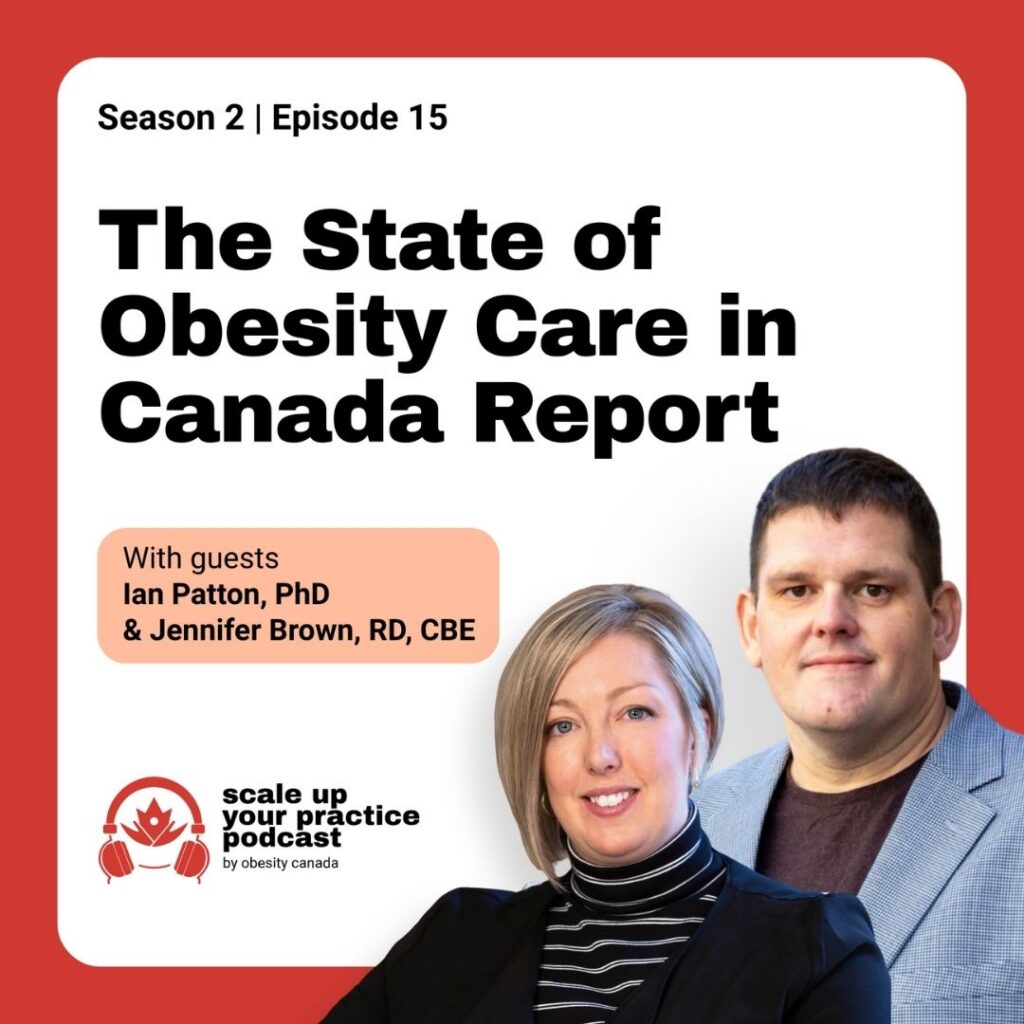


What happens when healthcare professionals know what evidence-informed obesity care should look like, but the system makes that care difficult to deliver?
Ian Patton and Jennifer Brown join us on the podcast to unpack findings from The State of Obesity Care in Canada report and connect them to what clinicians and patients experience every day: limited referral pathways, uneven treatment coverage, gaps in psychological support, inconsistent access to metabolic bariatric surgery and the effects of weight bias at the system level.
Ian Patton is the Director of Advocacy and Public Engagement at Obesity Canada, combining his academic expertise and lived experience to drive change in obesity care.
He holds a PhD in Kinesiology from Western University and completed a Postdoctoral Fellowship at the University of Toronto, with research focused on BMI, obesity, and childhood physical activity. As a bariatric surgery patient and national advocate, Ian works to eliminate weight bias and improve access to care for individuals living with obesity.
Jennifer Brown is a registered dietitian with 18 years of experience and a passion for advancing compassionate, evidence-based obesity care. She wass the lead author of the Medical Nutrition Therapy chapter in the 2020 Canadian Adult Obesity Clinical Practice Guidelines and now serves as Obesity Canada’s Director of Program Innovation. Jennifer is also a Certified Bariatric Educator and a long-time advocate for weight-inclusive, person-centred care.
Support Scale Up Your Practice by:
Email us at scaleuppod@obesitycanada.ca
This episode script was developed using NotebookLM to synthesize complex source materials into a structured educational format. The tool was used to analyze the Canadian Obesity Education Competencies (COECs), the Obesity Canada Strategic Plan, and guest-specific research. Specific prompts were utilized to extract relevant learning objectives, map them to CanMEDS roles, and generate competency-based interview questions.
While NotebookLM assisted in drafting the narrative arc and educational framework, all content has been reviewed, fact-checked, and refined by the podcast hosts and Obesity Canada’s clinical experts. This ensures the script aligns with current Clinical Practice Guidelines and authentically represents the lived experience perspective.
00:00:00:02 – 00:00:11:13
Ian Patton
At this point in time, with everything we know about effective obesity management, weight bias is the foundation upon which obesity care is organized, funded, and prioritized, and that’s a sad truth.
00:00:16:15 – 00:00:25:00
Michelle McMillan
Hello, and welcome to Scale Up Your Practice, brought to you by Obesity Canada. I’m Michelle McMillan, a lived experience advocate with Obesity Canada.
00:00:25:18 – 00:00:30:12
Dr. Roshan Abraham
And I’m Dr. Roshan Abraham, family physician and associate professor at the University of Alberta.
00:00:31:09 – 00:00:39:14
Michelle McMillan
Today, Roshan, I’d like to start with something that I think patients like myself don’t always see. It’s stuff that happens in the background.
00:00:40:16 – 00:00:55:20
Michelle McMillan
So I’m curious, when you as a family doc know what care you want to provide, but the system around you doesn’t make that easy, what does it actually look like in your workday?
00:00:57:04 – 00:01:21:06
Dr. Roshan Abraham
It can look like a lot of things, but I just want to say first that it’s incredibly challenging to feel that way, and I’m sure a lot of listeners feel that way as well, so not just patients, but providers. Sometimes I know there’s a treatment that may help someone, but limited availability or insurance coverage becomes the barrier. Sometimes there are forms, approvals, appeals, or follow-up requirements that take time away from actually seeing patients.
00:01:21:19 – 00:01:31:20
Dr. Roshan Abraham
And I think that’s really frustrating because as clinicians, we’re trying to provide evidence-based care, but knowing what good care should look like and being able to deliver it are not always the same thing.
00:01:33:03 – 00:01:51:17
Michelle McMillan
Yeah. And patients like myself, we experience the other side of that, right? So you’re a patient. You have an incredibly smart and caring doc or other healthcare practitioner who informs you that obesity is a chronic disease and that there are evidence-based treatments.
00:01:52:14 – 00:02:10:02
Michelle McMillan
But then you find out that some of those treatments aren’t covered by private or even provincial health plans, or the service you need isn’t even available where you live. After a while, I’ll be honest, it starts to feel a little bit personal.
00:02:10:17 – 00:02:30:15
Dr. Roshan Abraham
Absolutely. And that’s an important distinction for today’s conversation because many of these barriers are much bigger than one patient or one clinician. Obesity Canada’s new report released earlier this week, The State of Obesity Care in Canada, looks at how obesity care is recognized, measured, funded, and delivered across the country.
00:02:31:09 – 00:02:56:07
Dr. Roshan Abraham
Today, we want to understand what the report’s findings mean in practice and what healthcare professionals can do with that information. Joining us today are two people who are closely involved in this work. Dr. Ian Patton is Obesity Canada’s Director of Advocacy and Public Engagement, and Jennifer Brown is a registered dietitian, certified bariatric educator, and Obesity Canada’s Director of Program Innovation.
00:02:56:23 – 00:02:59:13
Dr. Roshan Abraham
Ian and Jennifer, welcome back to the podcast.
00:03:00:08 – 00:03:01:08
Ian Patton
Thanks. Happy to be here.
00:03:02:17 – 00:03:03:01
Jennifer Brown
Thanks.
00:03:03:01 – 00:03:21:15
Michelle McMillan
All right. We’re just gonna jump right in ’cause there’s so much great information in this report. But before we get into the nitty-gritty details, Ian, maybe you can give us what the big picture is. What does this report tell us about obesity care in Canada today?
00:03:22:05 – 00:03:49:03
Ian Patton
Yeah. I think the big picture that came out of this report was that there were five identified important and connected gaps that are holding back effective evidence-based obesity care in Canada. And each of these gaps affects whether obesity is recognized as a chronic disease, whether we’re planning for it appropriately, whether we’re funding it appropriately, and that trickles down into how care is being delivered as a chronic disease.
00:03:49:13 – 00:04:11:15
Ian Patton
So those five gaps are the first one being that Canada does not measure what matters when it comes to obesity. Access to primary care does not mean access to obesity care, which is an important one. Access to surgery depends too much on where you live, and there’s a huge amount of variance across those different jurisdictions.
00:04:12:10 – 00:04:24:23
Ian Patton
Obesity medication use is rising, but the coverage is not. And then finally, psychological care is essential but often invisible. So those are the five kindof overarching gaps that we identified in this work.
00:04:25:20 – 00:04:44:00
Dr. Roshan Abraham
Thank you, Ian, for that bigger picture on what the report entails. Jennifer, when you look at those findings through a clinical lens, where do you see the biggest disconnect between what evidence-informed obesity care asks healthcare professionals to do and what the system actually enables them to do?
00:04:44:20 – 00:05:06:18
Jennifer Brown
Yeah. Thanks, Roshan. I think the biggest disconnect is that we actually have really good obesity care. We know what it looks like, but we haven’t built the system around it. And the evidence asks us to provide individualized, comprehensive, long-term care for any chronic disease, including obesity.
00:05:08:05 – 00:05:39:16
Jennifer Brown
We should be looking at physical health and mental health, social health, someone’s spiritual health, their function, their quality of life, their nutrition, their movement, medication, psychology, whether there are surgical interventions available. But then as a clinician, and my background being a dietitian, you end up asking really practical kindof questions as well as if you’re a family doctor, like “Where can I refer this person, or is there a dietitian available?
00:05:40:02 – 00:06:07:08
Jennifer Brown
Are clinicians even trained in obesity care? Is there psychological support, or is there medication coverage?” And when, more importantly, like “what happens if someone leaves that specialty care? So bariatric centres, for example, what happens after that?” So very quickly, we end up having an evidence care plan, but we are often navigating a broken system or running into almost like a scavenger hunt.
00:06:08:03 – 00:06:26:14
Jennifer Brown
I saw this in my clinical background, working in both, in a tertiary obesity and bariatric centre of excellence, where you’d be able to provide comprehensive care for people with, I think, really exceptional care of like assessment, support.
00:06:26:20 – 00:06:46:16
Jennifer Brown
There’d be nutrition, psychology, social work, nursing, exercise physiology, all the follow-up. But somebody in the exact same province but in a different region might end up getting a completely different experience. Their assessment might be completely different, the standards might be different.
00:06:47:08 – 00:07:12:18
Jennifer Brown
And then even more frustrating, I think, in clinical practice is that when people move back into primary care, that’s a whole other kinda area that they have to navigate. So for me, the disconnect isn’t so much that clinicians don’t care or that we just don’t have the evidence. We do. It’s that the evidence asks us to care for the whole person, but yet the system that we’re working in just doesn’t fund.
00:07:13:02 – 00:07:22:05
Jennifer Brown
It often funds individual pieces of that person. So we end up working in silos rather than kindof funding in a comprehensive model.
00:07:23:08 – 00:07:43:02
Dr. Roshan Abraham
I think that’s put so well for our listeners, and really that last point about people really don’t live in silos even if our funding models do. And so let’s focus on the second gap because that’s near and dear to my heart: access to primary care doesn’t equal access to obesity care. So what does that look like in practice?
00:07:44:08 – 00:08:14:20
Jennifer Brown
Yeah. I mean, obviously, having access to a primary care provider is really important, but like you said, it doesn’t automatically mean that someone has access to actually evidence-informed obesity care. So somebody might have excellent support or treatment or management for blood pressure or diabetes or sleep apnea or joint diseases, but they may often never be assessed or diagnosed or even treated for obesity.
00:08:15:06 – 00:08:34:21
Jennifer Brown
And I don’t think that should be entirely put on the provider. As I kinda mentioned earlier, I think it’s the system. We noticed that in this report, it often found clinicians themselves were telling us that there’s a lack of time, there’s a lack of compensation and resources.
00:08:35:03 – 00:08:42:18
Jennifer Brown
Training is a big gap. Yet we have resources to help support those gaps. It’s just a lot of times
00:08:44:11 – 00:09:02:03
Jennifer Brown
People just don’t have the time. So again, we’re telling folks, “Hey, provide this comprehensive obesity care,” but yet the system is only allowing people 10, 15 minutes for an appointment. And oftentimes, depending on where people practice or where people are seeing their provider,
00:09:03:11 – 00:09:24:05
Jennifer Brown
Where do you send them? The biggest example that we kindof saw in the report was that diabetes gives us a really good comparison. Across Canada, we’ve spent decades building diabetes infrastructures. We have diabetes education programs. We’ve got trained nurses and dietitians, certified diabetes educators, endocrinology pathways.
00:09:24:16 – 00:09:46:03
Jennifer Brown
We’ve got monitoring systems. We’ve got provincial funding. And I know that those who work in diabetes would argue and say it’s not perfect at all, but yet we don’t have anything comparable when it comes to obesity. And so I’ve always found that this was kindof strange that you could be someone who lives with obesity and develops type 2 diabetes, and suddenly there’s access available.
00:09:46:04 – 00:10:11:06
Jennifer Brown
There’s a funded program. You now have access to an interdisciplinary team. But before you developed diabetes, there could have been an opportunity to, say, intervene earlier, and those supports really weren’t there for people. And so I find that’s kindof this part we’re stuck in, is that people don’t suddenly become more deserving of care because they’ve developed another disease.
00:10:11:09 – 00:10:28:19
Jennifer Brown
It’s just that the funding system has just recognized them. And we need to do that with obesity, is we need to recognize it as a chronic disease, and we need to support people. And I think we have a lot of those resources available. It’s just a matter of, again, identifying it and putting supports there.
00:10:29:22 – 00:10:49:07
Michelle McMillan
So great points, Jennifer. It’s near and dear to my heart ’cause I know people who live with diabetes, and they have a lot of access to things that people living with other chronic diseases don’t. I think it’s great that we have a model, right? That we have somewhere to start, right? So we got a model.
00:10:49:13 – 00:10:50:13
Michelle McMillan
We can move from there.
00:10:51:16 – 00:11:02:04
Michelle McMillan
But it does speak to the disconnect, right? So Ian, what does the report tell us about all the disconnects that are happening in our system?
00:11:03:07 – 00:11:26:15
Ian Patton
Yeah. I mean, I think at the core of it, it all comes down to that recognition piece, recognition and understanding of obesity as a chronic disease. And if we’re not recognizing that at the systems level, at the policymaker level, at the healthcare system, the doctors themselves, we need to get that information through to everyone.
00:11:26:16 – 00:11:45:00
Ian Patton
But it really does come down to that this is a systems-level issue, and the gap that we’re seeing reflects a system that has not yet caught up to the advancements in our understanding of obesity and a system that doesn’t deliver obesity care consistent with how we would approach any other chronic disease.
00:11:45:13 – 00:12:19:04
Ian Patton
Canadian medical education shapes obesity care, and we know that medical students, even today with all this information that we know about obesity, are still learning about obesity as simply a risk factor, or potentially a lifestyle issue or part of another condition rather than a chronic disease in and of itself. So this kindof highlights the critical need to revamp training and education for our healthcare professionals to ensure that they are being trained with that current understanding of obesity and recognizing it as a chronic disease where the patients are accessing that care.
00:12:20:00 – 00:12:30:02
Michelle McMillan
Yeah. Just to follow up on that, Ian, I mean, yeah, I agree with you. This is probably the part of the report that many patients like myself have probably been most impacted by, right?
00:12:32:06 – 00:12:51:04
Michelle McMillan
The system tells people that obesity is a chronic disease and that there are evidence-based treatments, but important parts of the care, including obesity medications and psychological supports, are still largely outside the public system and the coverage that comes with the public system.
00:12:51:17 – 00:13:00:10
Michelle McMillan
So Ian, maybe you could speak to this disconnect between what’s covered, what we know, and the gaps in between.
00:13:01:06 – 00:13:14:17
Ian Patton
Yeah. I can tell you for our community, it’s for sure super frustrating that we keep saying the message “obesity is a chronic disease.” We keep saying that there’s the scientific understanding that obesity is a chronic disease,
00:13:16:00 – 00:13:34:19
Ian Patton
But the care that people are accessing and the access to the available treatments doesn’t align with that messaging. So it’s very frustrating, and I’ve been an advocate in this space for over a decade. When I was seeking bariatric surgery myself, there were no other options. Bariatric surgery was kindof the gold standard at the time.
00:13:35:16 – 00:14:04:00
Ian Patton
We didn’t have other treatments that would’ve had the clinical effectiveness that I needed. So the choice or the options for me were pretty straightforward. You fast-forward to now, when we have additional tools in the toolbox that can be really effective in the medications that have gotten a ton of attention over the last several years, but it’s very clear that approval of these treatment options by Health Canada does not mean access for the majority of individuals.
00:14:04:16 – 00:14:22:21
Ian Patton
So we can look at examples. None of the available obesity medications have been recommended for reimbursement in public drug plans, specifically for obesity management, even though that same molecule is being recommended for reimbursement for another chronic disease in diabetes, for example.
00:14:22:21 – 00:14:48:10
Ian Patton
Private coverage for the medications is also highly variable and full of unnecessary barriers. There are exclusion criteria that might be considered more about cost management rather than clinical need, and there’s administratively burdensome prior authorization and reauthorization that doesn’t really align with the clinical guideline recommendations and how we say obesity care should be.
00:14:48:20 – 00:14:56:04
Ian Patton
The lack of access means that we have community members right now who actually celebrate getting sicker, which I think is
00:14:57:08 – 00:15:18:21
Ian Patton
Shocking and mind-boggling and a terrible indictment of our healthcare system. So when they end up getting a diagnosis for diabetes, they’re actually excited about it and happy about it because now they can finally access the treatment that they’ve been trying to access previously because there’s coverage for it for diabetes, and that’s really, really sad.
00:15:19:08 – 00:15:41:16
Ian Patton
So when evidence-based care is out of reach, the market fills that gap. The high demand that we see for these treatments paired with the poor access has created a growing marketplace of online platforms, direct-to-consumer services, compounded products, unregulated supplements, and a whole bunch of misinformation, which can all be very, very scary for our community.
00:15:42:03 – 00:15:52:13
Ian Patton
When clinically appropriate treatments are not accessible, people don’t stop seeking a solution. They’re going to continue to look for help and try and find other ways to get that help.
00:15:53:06 – 00:16:12:01
Dr. Roshan Abraham
So very true, Ian, and thank you for highlighting that so succinctly, yet in a comprehensive manner. Another important component is psychological and behavioural support. We know that’s a part and a pillar of comprehensive obesity care and can be extremely difficult to access for a lot of patients.
00:16:12:17 – 00:16:22:15
Dr. Roshan Abraham
Jennifer, when that support isn’t available, what are primary care teams left to do to try to manage on their own, and how does that impact patient care and outcomes?
00:16:23:07 – 00:16:42:09
Jennifer Brown
Yeah. I mean, I think that’s a million-dollar question, is how do we support folks that need psychological care just in general, let alone in the obesity space? And I think in clinical practice, we know, like people are not arriving with just one concern or one barrier.
00:16:43:06 – 00:17:14:22
Jennifer Brown
Many people, we’re all managing stress, maybe depression or anxiety. There might be history or current disordered eating behaviours or patterns. There might be a history of trauma, internalized weight bias, complicated relationships with food, or maybe people are taking several medications that are really affecting their cognitive function and all, just major life things that sometimes these are all happening all at once for some people.
00:17:15:16 – 00:17:56:23
Jennifer Brown
I find even in like nutrition, for example, I often would use, like, an iceberg analogy, and I often would think of nutrition or certain things that I might be seeing in an assessment or what clients or patients might be telling me kindof as like that tip-of-the-iceberg idea. But underneath the surface and kindof all around the iceberg, there are so many barriers or stressors or maybe there are psychological gaps that are occurring that have just never been identified, supported, or people just maybe don’t have the skills yet on how to develop or how to cope with some of those pieces that might be impacting the tip of the iceberg.
00:17:57:11 – 00:18:22:12
Jennifer Brown
So I always found that when there weren’t psychological supports available, as a… Again, I’ll use my own experience as a clinician, as a dietitian. I always found that there is a fine line between kindof that scope of identifying where there might be some gaps from a psychological support piece to making sure that people have access to that.
00:18:22:13 – 00:18:44:16
Jennifer Brown
And it doesn’t disappear. Just because it’s not available doesn’t mean that someone may not, like, they of course need it. And I find that this ends up going back to either the family doctor or the nurse practitioner or, in my case, the dietitian. And we care. We care deeply, but not everybody has the training, the time.
00:18:45:00 – 00:19:10:08
Jennifer Brown
There might not be referral pathways to help support people. And I know that mental health and psychological interventions kindof are universal across all chronic conditions, and nowadays, like, everybody needs access to that. But it really puts the risk, I think, on the fact that we might provide evidence-informed treatment, but there isn’t wraparound support for someone.
00:19:10:20 – 00:19:30:08
Jennifer Brown
And there was a really good, or there was kindof a really impactful story that a person with lived experience had shared in the report that they had had… There was someone who had had metabolic bariatric surgery years ago, and they described very significant physical complications that happened
00:19:31:08 – 00:19:49:09
Jennifer Brown
After surgery and that there was a lot of psychological impact. There was the trauma of the complications. There was a lot of fear. There was grief. There was a lot of adjustment periods afterwards. And ultimately, this person expressed the biggest, like the hardest part for their care was the fact that
00:19:50:20 – 00:20:09:04
Jennifer Brown
Psychological supports or psychotherapy was just financially out of reach, or it just wasn’t available. So I do think that it should not be optional. It should be something that is standard care, and it should be part of everyone’s kindof whole treatment when we’re looking at the person.
00:20:10:15 – 00:20:36:03
Michelle McMillan
Yeah. I mean, that’s such a great point, that need for wraparound care, not to mention it’s one of the pillars, right? So it’s like we have this lovely three-legged table that we just rip one of the pillars out, and then we go, “Oh, I wonder why the table doesn’t work anymore,” right? So another one of those pillars, of course, is the metabolic and bariatric surgery, and that’s another place where the report found considerable variations across the country.
00:20:36:15 – 00:20:42:02
Michelle McMillan
Ian, what does that variation look like from one jurisdiction to another?
00:20:42:18 – 00:21:03:00
Ian Patton
Yeah. The reality is access to bariatric and metabolic surgery depends far too much on where you live, and from one jurisdiction to another, there are different pathways to care, different wait times. There are different levels of support, both pre and postoperatively.
00:21:03:13 – 00:21:25:13
Ian Patton
So someone like me, for example, who had about a year-and-a-half wait from the time that my doctor sent the referral in to the point that I had surgery, and I’m in Ontario, that one-and-a-half-year wait is gonna be a very different experience for someone, say, in Atlantic Canada, whose wait times could be multiple years longer.
00:21:26:04 – 00:21:45:00
Ian Patton
We could also have very different pathways, different people that we have to interact with along the way, different health professionals that we have to get assessments from while we’re going through that program. We could even have very different support postoperatively in how long we’re monitored by the bariatric programs and those sorts of things.
00:21:45:17 – 00:22:08:03
Ian Patton
We can even have different recommendations and guidelines on how to go through the program. So in support groups that I’ve been in for bariatric surgery, sometimes it’s a little bit crazy when we’re comparing notebooks on like what we’re being told to do postoperatively or preoperatively in preparation for the surgery.
00:22:08:03 – 00:22:39:03
Ian Patton
So there’s a lot of inconsistency in that way. The report also points out that the information that’s available on surgical wait times is difficult to interpret and compare. So many provinces use standardized surgical wait time measures, so that can include wait time number one, which is from the point of your referral going in to the point that you have your consultation, and then there’s wait time two, which is from the decision to proceed with the surgery to your actual surgery date.
00:22:39:16 – 00:22:41:18
Ian Patton
But with metabolic and bariatric surgery,
00:22:42:20 – 00:23:01:01
Ian Patton
It can be a little bit complicated because you have multiple assessments. There’s pre-surgical education and readiness steps that kindof complicate how these measures are applied along the way. And in some cases, when the clock starts ticking on the wait times is different from one jurisdiction to the other.
00:23:01:15 – 00:23:23:17
Ian Patton
So for example, wait time number one starts when the bariatric program accepts the referral. So for me in Ontario, my doctor sent it into the centralized bariatric network, and I got a call within a few weeks to schedule my orientation. That orientation was a couple months down the road, but at least I knew I was in the system.
00:23:23:19 – 00:23:45:04
Ian Patton
I had a date, I had that stuff. I knew that my referral had gone in. But there are other areas of the country where that referral can sit in a pile in a queue for years before it even gets accepted into the program, and they schedule that initial consultation, and that wait period isn’t accounted for there.
00:23:45:16 – 00:23:52:15
Ian Patton
So the wait time could be actually far more significant than what’s actually being reported in the numbers that we see publicly available.
00:23:53:07 – 00:24:14:21
Michelle McMillan
Yeah, I can back that up as well. We live in different parts of the country. We’ve both had bariatric surgery. I can tell you that my wait time was vastly different than your wait time, although I don’t know, but I could say maybe when the numbers are reported, just because the way the numbers are reported on the page, those numbers might look very similar.
00:24:14:23 – 00:24:36:16
Michelle McMillan
Even though I waited significantly longer than you, on the page, it looks like the Alberta numbers are equivalent to the Ontario numbers, right? We often talk about weight bias on the podcast here as something that happens between people, but of course, the system is made up of people, right?
00:24:37:05 – 00:24:56:12
Michelle McMillan
And one of the things about this report is it’s asked us to look at how the people within the system impact the system. From your experience putting together this report, Ian, where does weight bias show up in the way that obesity care is organized and funded or prioritized even?
00:24:57:03 – 00:25:27:14
Ian Patton
Yeah, I mean, we’ve been talking about weight bias for a really long time. And to be honest, at this point in time with everything we know about effective obesity management and the availability of that expanding toolbox that I talked about earlier of treatment options, when you pair that with the state of obesity care in Canada, as we outline in this report, I mean, weight bias is the foundation upon which obesity care is organized, funded, and prioritized, and that’s the sad truth.
00:25:28:00 – 00:25:48:18
Ian Patton
I think we have outdated and biased narratives about weight, obesity, and treatment, and that means that we don’t appropriately recognize and treat obesity as a chronic disease. And if it’s not being recognized as a disease, we don’t diagnose it or measure it appropriately. And without appropriate measures, the system is not able to appropriately plan for care.
00:25:49:00 – 00:26:02:23
Ian Patton
Without appropriate planning, we’re not gonna have the funding that is needed in order to deliver effective obesity management. So it’s a big snowball rolling downhill, and it all starts with weight bias at the beginning.
00:26:04:01 – 00:26:08:15
Dr. Roshan Abraham
Absolutely, and measurement is such a key, key component of all that.
00:26:10:05 – 00:26:16:07
Dr. Roshan Abraham
Jennifer, when those system-level gaps and assumptions reach primary care, what do clinicians experience?
00:26:17:22 – 00:26:25:21
Jennifer Brown
I mean, just like what Ian mentioned around those gaps and everything, I mean, from a clinician standpoint, I mean, I feel like
00:26:27:08 – 00:26:48:09
Jennifer Brown
It shows up in everyday practice. It shows up with like medications that are considered legitimate for diabetes, but then denied or questionable for obesity, and Ian mentioned that earlier. But it’s real. And how do you as a clinician be able to help support and justify that to someone?
00:26:49:00 – 00:27:10:20
Jennifer Brown
It shows up when our system asks clinicians to repeatedly prove that a patient is sick enough. Again, those stories are real. I mean, I know working in metabolic bariatric surgery, the number of times people would try to gain weight or they would try to specifically
00:27:12:23 – 00:27:19:00
Jennifer Brown
Get some sort of chronic condition that would qualify them to have surgery.
00:27:20:12 – 00:27:42:16
Jennifer Brown
That again, there’s something wrong with our system that is setting up those expectations. It shows up, I think, probably the most in how we actually define success. I think weight and BMI are far too often put at the pedestal of what obesity care is supposed to, or success is supposed to look like.
00:27:42:17 – 00:28:10:21
Jennifer Brown
And it doesn’t, that’s not what success is. It doesn’t ask or look at anybody’s overall health, their mobility, their function, their quality of life. And so I think it’s just inherently ingrained in what happens in our practice. So if you think about family physicians, and Roshan, I’m gonna use you as an example because there’s so much we hear again and again about you’re having to constantly
00:28:12:16 – 00:28:35:08
Jennifer Brown
Advocate for people having coverage for medications, or you’re having to complete all these pre-authorization forms. You’re having to write appeal letters. You’re having to really, like, chase insurance forms and filling out papers rather than actually caring for or seeing patients. And that was something that really kinda stood out really well in the report.
00:28:35:09 – 00:28:52:13
Jennifer Brown
And again, Roshan, you had some really, really good points. The fact is that you end up spending hours every week filling out forms and denials and having to chase care, like just so that your clients and patients can actually get the treatment and care that they deserve.
00:28:54:16 – 00:29:27:05
Dr. Roshan Abraham
Yeah. I’m grateful you brought it up, and I would actually like to qualify my response because hours, I would say, isn’t 100% of the time with the forms, but the almost unnecessary time, if it was compared to another chronic disease, that I have to spend with the patient trying to turn myself into a pretzel to try to figure out what to do instead that is either not as evidence-based, is a second or third-line treatment,
00:29:27:07 – 00:29:50:21
Dr. Roshan Abraham
And then trying to mix and match all these different options. Like, there’s so much that we have to do. Hours, I would agree, is what it takes for us as primary care doctors because of the lack of funding and because of the lack of coverage as opposed to diabetes, heart disease, whether it’s congestive heart failure, although again, that’s not as much of an issue when it comes to drug coverage, at least in our province.
00:29:51:08 – 00:29:52:17
Dr. Roshan Abraham
I don’t have to do that, right?
00:29:54:22 – 00:30:19:19
Dr. Roshan Abraham
The number just states it, whether it’s an HbA1c or it’s sometimes they’ll look at ejection fraction, let’s say, for the type of congestive heart failure that they have, and then that’s it. That’s all. It’s done. I can get that. I can work out a plan that is evidence-based. Instead, I have to take into account the denial, take into account what that means and feels like for the patient because that’s not insignificant, right?
00:30:19:20 – 00:30:39:21
Dr. Roshan Abraham
We’ve talked about this, Michelle, on other episodes about what that denial, right, represents. I actually get, like, my heart rate actually goes up every time I see another prescription, sorry, a pending approval because it shows up in our EMR as pending approval and then either approved or denied because it means I have…
00:30:39:22 – 00:30:58:00
Dr. Roshan Abraham
And it’s only obesity medications where that shows up, maybe asthma, a couple of ones, and it’s just because I didn’t follow the appropriate rules, and that actually follows evidence-based pathways, by the way, and it’s just because I haven’t necessarily followed evidence-based pathways because I’m forgetful or something happens. This is not me forgetting.
00:30:58:09 – 00:31:19:12
Dr. Roshan Abraham
This is about me following the evidence and me having to twist myself into a pretzel just for patients, and then what the patient feels is even worse, that they don’t matter. That again, it reinforces that internalized weight bias, that they don’t matter because the system is telling them that treatment for this condition isn’t justified.
00:31:20:09 – 00:31:27:14
Dr. Roshan Abraham
So hours is true with how much time we have to spend on the phone, in person, trying to navigate this. So I completely agree with that.
00:31:28:10 – 00:31:50:06
Jennifer Brown
Yeah, and that piece around you having to turn into a pretzel to be able to advocate for your patients and clients, I mean, we hear all the time from patients that they don’t have a family doctor who understands obesity, and they’re not going to go above and beyond to do those things. So yes, now all of a sudden you are perpetuating more of that bias because the system basically enables it.
00:31:50:18 – 00:32:16:00
Jennifer Brown
So I think, yeah, we really have to look harder at not just what are we doing individually as clinicians to mitigate that bias, but I think it really brings up the point of we have to change policies, we have to change insurance authorizations, these funding rules, these measures, everything that’s kindof the system baked around you as the clinician and you, Michelle, as the client or patient.
00:32:16:03 – 00:32:25:04
Jennifer Brown
I mean, this is a system that we can ultimately improve and fix, but it comes from both levels.
00:32:25:23 – 00:32:50:00
Dr. Roshan Abraham
Absolutely. Absolutely. We’ve had a great discussion so far about a lot of the barriers that exist, and personally as well as professionally, I wanna be careful. Health professionals are already quite stretched, and I never want the message to be, and I think all of us don’t want the message to be, “The system isn’t working well enough, and now it’s your job to fix that too.”
00:32:50:15 – 00:32:57:02
Dr. Roshan Abraham
Jennifer, what are realistic ways healthcare professionals can use this report within the work they’re already doing?
00:32:57:12 – 00:33:28:01
Jennifer Brown
Yeah. Yeah. Excellent point, and I just do wanna reinforce that we’re not telling people that they need to take on one more thing. Clinicians are already stretched. And I think a lot of times it’s just doing some reflection of, “What do you actually see in your practice?” Maybe you’re frustrated because you have nowhere to send patients for psychological support, or say there’s no dietitian in the community that has training in obesity care.
00:33:28:13 – 00:33:49:12
Jennifer Brown
Maybe, like you said, you’re spending hours or you’re spending a lot of extra time filling out paperwork or navigating a system just to be able to get that treatment. Maybe you’re someone who has to discharge a client or patient from a bariatric program back into a community where there isn’t proper follow-up care.
00:33:50:04 – 00:34:19:20
Jennifer Brown
Or what I’m often hearing now is maybe you work in a diabetes program, and I hear that saying all the time, like, “We have a team, like we have that chronic disease model already, but we can’t support obesity. Why? Why can’t we do that?” And so I think the report really helps us kinda move from what those experiences people are having into, away from that, “I’m just frustrated with the system” or “I’m frustrated with my clinic” to, “This is actual proof.
00:34:19:21 – 00:34:44:18
Jennifer Brown
These are documented system gaps that we’re seeing in obesity or in obesity care in Canada.” So advocacy doesn’t have to come from going to Parliament Hill. It doesn’t have to be from what does this actually look like. It could be just as simple as you bringing this report to one of your next team meetings and saying, “Hey, what does our obesity pathway look like in our program?”
00:34:45:13 – 00:35:11:16
Jennifer Brown
It might be just talking to the program director or manager about maybe adding in something or tweaking something you’re already doing and perhaps being more inclusive of obesity care within the system you already are working in. It might mean asking professional associations to have access to better education or referral tools, or probably in most cases, just awareness, awareness of what’s out there.
00:35:11:17 – 00:35:45:04
Jennifer Brown
Like Obesity Canada has an enormous toolkit of training and resources, and a lot of people are just discovering that for the first time. So it doesn’t mean you have to contact your elected officials, although that is also a really great way to make change. But I think that if somebody, if there’s one thing that you could do, I think a lot of it is just be aware of what your system currently looks like, document it, share it with others, bring up the issue and the gaps you’re seeing, and use this report as evidence.
00:35:45:12 – 00:35:54:20
Jennifer Brown
That, I think, is a tool on its own to help bring the conversation to light and let’s start changing things altogether.
00:35:55:16 – 00:36:19:00
Michelle McMillan
I entirely agree. I mean, there’s obviously another side to advocacy, too. There’s the patient side as well, which I think is important. But I think it’s also important that better systems don’t make care easier for patients, but they can mean that clinicians spend less time working around some of the barriers again and again, like Roshan said.
00:36:19:07 – 00:36:36:21
Michelle McMillan
‘Cause I believe, like what Roshan said about him twisting himself into a pretzel, I’m on the other side, and I think patients are doing the same thing. We’re twisting ourselves into pretzels, right? Like, “How high can I move that A1C so suddenly I’m a type 2 diabetic and I qualify for the meds?”
00:36:37:22 – 00:36:51:03
Michelle McMillan
Which is a terrible thing to do. We should not be encouraging people to get sicker just so that they can get better. So Ian, what can healthcare professionals bring to this conversation that the report alone can’t?
00:36:52:10 – 00:37:17:00
Ian Patton
Yeah. It’s a great question. I think of this report, at least for the work that I do and I’m going to be doing, it’s an advocacy tool for me. This is gonna be a resource that I can use in trying to effect change, and so healthcare professionals bring a really critical voice to that conversation and to the advocacy work that’s gonna come out of this project.
00:37:17:15 – 00:37:39:03
Ian Patton
They provide an important context of the reality on the ground and what they’re dealing with on a daily basis in their practice. This is not just about care and outcomes for patients. It’s also about system efficiencies and setting up healthcare professionals for success and providing them with the knowledge and resources to be able to support their patients.
00:37:39:14 – 00:38:07:05
Ian Patton
When I think about advocacy, healthcare professionals also bring a really important layer of clinical credibility to the argument, and that complements the experiences of people living with obesity. So when we can present a well-rounded and coordinated pitch for change, it can have a much better impact, and we’ve seen this in other work that we’ve done before where we kindof mesh those two perspectives, and it creates a very powerful message.
00:38:07:17 – 00:38:18:17
Ian Patton
So healthcare professionals can also expand the reach of this conversation by raising it within their clinics, with their peers, and within their professional organizations, and all of that can be very, very helpful.
00:38:19:22 – 00:38:30:19
Dr. Roshan Abraham
For healthcare professionals who do want to share that perspective beyond their organization, Obesity Canada has also created a simple advocacy tool alongside the report. Ian, can you walk us through how it works?
00:38:31:16 – 00:38:57:19
Ian Patton
Yeah. Yeah. So any sort of system change requires that a lot of different voices raise the issue so that those responsible for that system know that it is in fact an issue and that the change is needed. So we want to make that as easy as possible for everyone to take part in. So while Jen was saying you don’t have to contact your parliamentarians or your elected officials and those sorts of things, we would love it if you joined us in doing so.
00:38:58:02 – 00:39:20:08
Ian Patton
It’d be very, very helpful, and we’ve made it very, very easy. So we have a simple campaign where you can add your voice and raise this issue with the policymakers with a few simple clicks. There’s going to be a QR code that’s on the screen through the magic of the internet, and that will take you to that campaign.
00:39:20:12 – 00:39:44:14
Ian Patton
There’ll also be a link in the show notes that you can click on, and that’ll take you to this letter-writing campaign. You simply have to put your name and a few simple details about yourself. There’s a pre-drafted letter that’s already drafted up with all the key messages from the report that are important. You can customize it if you like, and then you click send, and that letter’s automatically gonna get sent to the appropriate policymakers.
00:39:44:21 – 00:39:57:17
Ian Patton
And the more letters that get sent out, the better. And then my job after the fact will be to follow up with all those people and start getting some meetings in the books and start pushing these issues further.
00:39:58:14 – 00:40:31:04
Michelle McMillan
I will back up the “it’s a simple process and you can send it in,” and I have complained to my member of Parliament about other things in the past, and I’ve heard nothing. But I will say that I have been involved in some previous campaigns just from, like, sending in the letter, and I will say that because there is a mass of people who will respond, hopefully our listeners, both patients and healthcare practitioners, you will get a response from your MP.
00:40:31:11 – 00:40:48:04
Michelle McMillan
‘Cause the first time ever, I did get that response back from my MP. So if you think one letter doesn’t make a difference, it does make a difference, and it lets the system know that there’s a problem and people are concerned about the problem, and they want the problem fixed.
00:40:48:05 – 00:40:53:03
Dr. Roshan Abraham
A coordinated letter-writing campaign is a really important tool for advocacy.
00:40:54:09 – 00:41:12:12
Dr. Roshan Abraham
Jennifer’s comment about not necessarily going up to Parliament Hill with a bullhorn, I talk about this with the medical students. Advocacy isn’t the big-A advocacy that we always think it is when you’re sort of getting face-to-face time, let’s say, with a member of Parliament or somebody who makes decisions.
00:41:13:03 – 00:41:36:21
Dr. Roshan Abraham
Actually, some of the best advocacy that we can do is in the clinic and just outside of it as well through things like letter-writing campaigns. And I don’t want to discount the advocacy that we actually do in the clinic, where we are trying to make some of these small changes with the patient and trying to advocate for them, but letter-writing campaigns have been used extensively in medicine, and I think this is a great opportunity for listeners to get involved as well.
00:41:36:23 – 00:41:39:20
Dr. Roshan Abraham
So I’m so grateful that this is being pursued.
00:41:41:04 – 00:41:53:09
Dr. Roshan Abraham
I think that brings us back to where we started. Healthcare professionals can know what evidence-informed obesity care should look like and still spend a lot of time working around systems that make the care harder to deliver.
00:41:53:19 – 00:42:09:05
Michelle McMillan
And patients feel those same barriers, but from the other side. What this report helps show is that many of those experiences, they aren’t isolated. They’re connected to how obesity care is organized across the system.
00:42:09:16 – 00:42:19:04
Dr. Roshan Abraham
And that gives healthcare professionals something concrete to point to when they’re trying to improve care, whether that’s inside their own organization or in a broader policy conversation.
00:42:19:20 – 00:42:41:02
Michelle McMillan
You can read the State of Obesity Care in Canada report through the link in our show notes or the fancy QR code on the screen. And if you want to share your experience with your federal or provincial elected officials, you’ll also find information there about Obesity Canada’s advocacy tool, and it really is simple.
00:42:41:17 – 00:42:42:17
Michelle McMillan
Trust me.
00:42:43:03 – 00:42:55:05
Dr. Roshan Abraham
I want to say a huge, huge thank you to both Jennifer Brown and Ian Patton for being here today as guests and for walking us through this crucial report. Thank you both for your time.
00:42:57:09 – 00:42:58:04
Ian Patton
Oh, thanks for having me.
00:42:58:04 – 00:43:00:06
Jennifer Brown
Thank you so much. Yeah.
00:43:00:13 – 00:43:08:19
Dr. Roshan Abraham
A reminder to our listeners, new episodes of Scale Up Your Practice drop every second Thursday, so make sure you’re subscribed wherever you listen.
00:43:09:12 – 00:43:19:14
Michelle McMillan
And if you found this conversation useful, send it to a colleague who has probably spent a little too much time navigating one of those barriers we talked about today.
00:43:20:12 – 00:43:25:15
Dr. Roshan Abraham
And until next time, stay curious, stay kind, and keep scaling up your practice.
00:43:31:23 – 00:43:54:08
Dr. Roshan Abraham
This podcast is intended for informational and educational purposes only and does not constitute medical advice. The content shared in this podcast should never be used as a substitute for professional medical advice, diagnosis, or treatment. Always seek the guidance of a qualified healthcare professional with any questions you may have regarding your health or a medical condition.
00:43:55:00 – 00:44:18:21
Dr. Roshan Abraham
The information and treatments discussed in this podcast are based on Canadian guidelines and approved practices as of the time of recording. If you are listening from outside of Canada, please consult your local healthcare professional to ensure compliance with your region’s medical standards, guidelines, and recommendations. The creators of this podcast disclaim all liability for any decisions or actions taken based on the content discussed.
00:44:19:13 – 00:44:24:16
Dr. Roshan Abraham
Listening to this podcast does not establish a professional or patient-client relationship.
Be the first to know about new education and resources for healthcare professionals from Obesity Canada.