New report: Five gaps are holding back better obesity care in Canada. Learn more

Home • Scale Up Your Practice podcast • What patients may be thinking but not saying



🎙️This episode is sponsored by an unrestricted education grant from Eli Lilly Canada
What a patient says in an obesity care conversation may not tell the whole story.
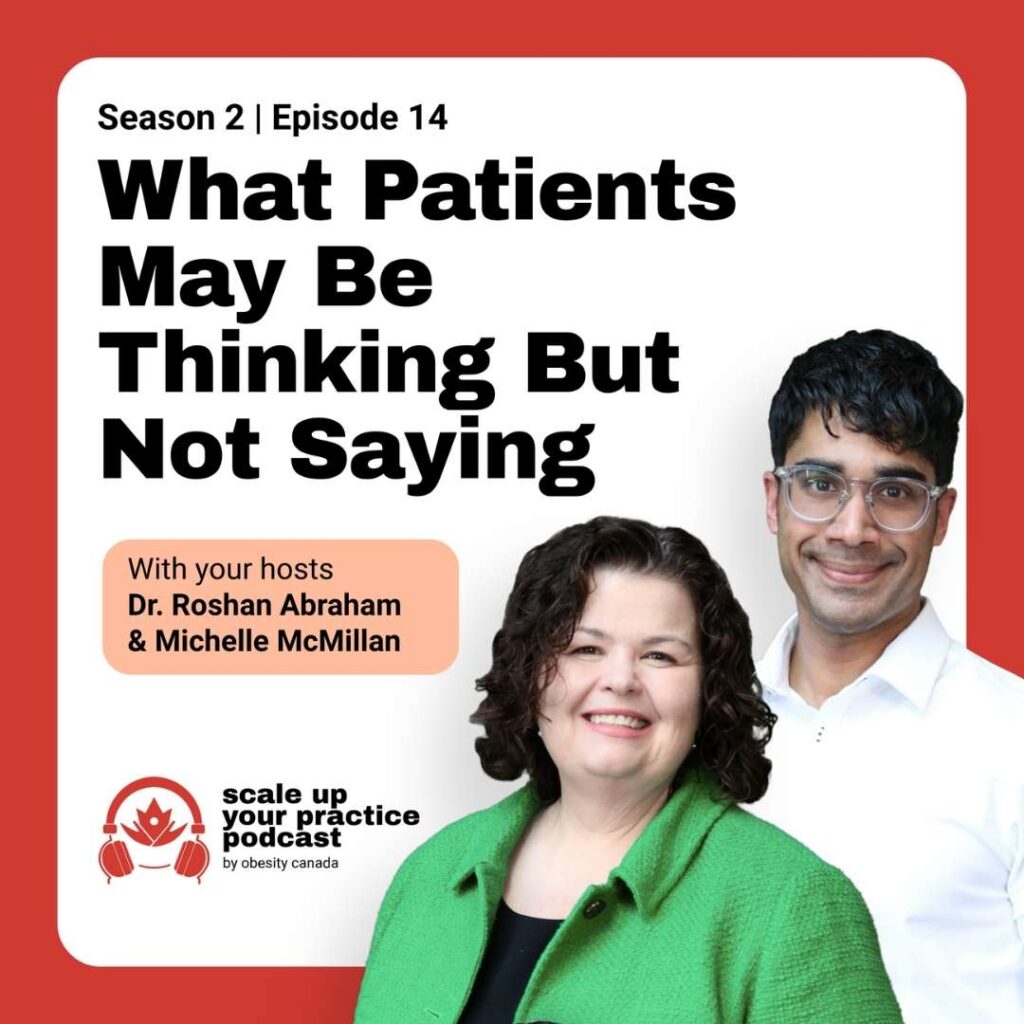
In this episode, Dr. Roshan Abraham and Michelle McMillan explore what can sit beneath silence, hesitation or agreement, especially after past experiences with weight bias or stigma. They share practical ways clinicians can build trust, ask better questions and make follow-up feel safer.
Today’s conversation is a good reminder that obesity care takes knowledge, compassion and a commitment to reducing stigma. For healthcare professionals with experience in obesity care, Obesity Canada’s Certified Bariatric Educator exam is one way to have that knowledge recognized and stand out in the field.
The next CBE exam takes place on November 28, 2026, and applications must be submitted by November 2 to be eligible to write.
Support Scale Up Your Practice by:
Email us at scaleuppod@obesitycanada.ca
This episode script was developed using NotebookLM to synthesize complex source materials into a structured educational format. The tool was used to analyze the Canadian Obesity Education Competencies (COECs), the Obesity Canada Strategic Plan, and guest-specific research. Specific prompts were utilized to extract relevant learning objectives, map them to CanMEDS roles, and generate competency-based interview questions.
While NotebookLM assisted in drafting the narrative arc and educational framework, all content has been reviewed, fact-checked, and refined by the podcast hosts and Obesity Canada’s clinical experts. This ensures the script aligns with current Clinical Practice Guidelines and authentically represents the lived experience perspective.
00:00:00:02 – 00:00:05:18
Dr. Roshan Abraham
A curious clinician makes for better care.
00:00:05:20 – 00:00:24:06
Dr. Roshan Abraham
If you are willing to be curious and just open your mind up to what a patient has experienced in the past, you won’t actually lead with the templated treatment.
00:00:24:08 – 00:00:34:12
Michelle McMillan
Hello and welcome to the Scale Up Your Practice podcast, brought to you by Obesity Canada. I’m Michelle McMillan, a lived experience advocate with Obesity Canada.
00:00:34:14 – 00:00:34:20
Dr. Roshan Abraham
And
00:00:34:20 – 00:00:40:12
Dr. Roshan Abraham
I’m Dr. Roshan Abraham, family physician and associate professor at the University of Alberta.
00:00:40:14 – 00:00:41:15
Michelle McMillan
In obesity care,
00:00:41:21 – 00:00:57:14
Michelle McMillan
some of the most important things patients are thinking may never be said out loud. A patient may not say, I’m scared you’re gonna blame me. They may not say, I’ve already tried more than you think.
00:00:57:16 – 00:01:09:21
Michelle McMillan
They may not say, I don’t trust this conversation yet. And they may not say, I want help, but I’m tired of being disappointed and feeling like I’ve failed.
00:01:09:23 – 00:01:33:07
Michelle McMillan
Those thoughts can shape how safe the conversation feels for patients, whether they engage in care, consider treatment options, and come back for follow-up. And sometimes the patient is smiling, nodding, and agreeing with you. While they’ve already decided they’re never coming back.
00:01:33:09 – 00:01:53:03
Michelle McMillan
So today we’re talking about what may be happening under the surface when a patient seems quiet, hesitant, or guarded in clinical conversations, and how you, as a clinician, can respond in ways that build trust and move the conversation forward.
00:01:53:05 – 00:02:00:04
Dr. Roshan Abraham
We’re really excited about today’s episode. And although it is a departure, we know that you’re going to enjoy it.
00:02:00:06 – 00:02:11:11
Dr. Roshan Abraham
Today’s episode is supported by an unrestricted educational grant from Eli Lilly Canada. We thank them for helping us bring this podcast to clinicians across the country.
00:02:11:13 – 00:02:15:02
Michelle McMillan
As Roshan said, this episode is a little different for us.
00:02:15:04 – 00:02:33:11
Michelle McMillan
We don’t have a guest today. It’s just Roshan and me talking about the moments in obesity care when what a patient says out loud may not tell the whole story, especially if they have experienced weight bias or weight stigma before.
00:02:33:13 – 00:02:43:18
Michelle McMillan
The goal of the podcast is to help clinicians recognize what might be happening beneath the surface and respond in a way that keeps the door open.
00:02:43:20 – 00:03:08:20
Dr. Roshan Abraham
That distinction is essential. Silence or hesitation can sometimes be misread as disinterest, resistance, or lack of motivation. But it may reflect something very different. It may reflect past experiences, fear of judgment, internalized weight bias, or uncertainty about whether this conversation will be different from previous ones.
00:03:08:22 – 00:03:27:08
Michelle McMillan
Exactly. So today we’re going to talk through some of those unspoken patient-side truths and bring each one back to a practical question. What can a clinician do with that information?
00:03:27:10 – 00:03:41:16
Dr. Roshan Abraham
And hopefully by the end of today’s episode, clinicians will have language they can use in the room, not as a script to memorize, but as a way to approach obesity care with more curiosity, clarity, and respect.
00:03:41:18 – 00:03:44:18
Michelle McMillan
Because sometimes the most important answer
00:03:44:20 – 00:03:49:10
Michelle McMillan
is the one a patient does not feel safe enough to say yet.
00:03:49:12 – 00:03:52:09
Michelle McMillan
I think the first thing we have to talk about is trust.
00:03:52:11 – 00:03:56:10
Michelle McMillan
Because when a patient living with obesity walks into an appointment,
00:03:56:10 – 00:03:59:00
Michelle McMillan
they are not coming in with a blank slate.
00:03:59:02 – 00:04:15:17
Michelle McMillan
Obesity is not appendicitis, right? It didn’t come on suddenly. People living with obesity have been probably living with it for a very long time, which means they may be carrying years of advice that sounded simple but did not actually help.
00:04:15:21 – 00:04:27:22
Michelle McMillan
They may have been told to eat less, move more, try harder, or be more disciplined. All things, honestly, I’ve been told throughout my entire life
00:04:28:00 – 00:04:34:07
Michelle McMillan
and even when the advice was well-intentioned, and I honestly believe that in most
00:04:34:12 – 00:04:35:17
Michelle McMillan
of the interactions I’ve had with
00:04:35:19 – 00:04:37:00
Michelle McMillan
healthcare professionals.
00:04:37:00 – 00:04:42:11
Michelle McMillan
It was very well intentioned. Unfortunately, it often
00:04:42:13 – 00:04:43:08
Michelle McMillan
left me
00:04:43:14 – 00:04:50:03
Michelle McMillan
feeling like I was a personal failure because I hadn’t been able to succeed with the advice that they’d given me.
00:04:50:09 – 00:04:54:01
Michelle McMillan
So when a clinician today says, “Would you be okay
00:04:54:03 – 00:04:58:09
Michelle McMillan
to talk about your weight?” A patient may not hear
00:04:58:14 – 00:05:07:12
Michelle McMillan
the new evidence-based conversation is gonna happen. What they hear in the back of their mind and in their history is that
00:05:07:15 – 00:05:18:04
Michelle McMillan
this may be the same old conversation I’ve had for years and years. And I’ve already put up a moat and some castle walls.
00:05:18:06 – 00:05:20:00
Michelle McMillan
And,
00:05:20:02 – 00:05:39:05
Michelle McMillan
I hate to say it, but I may not even be really listening to what you’re saying at the beginning of the conversation because I’m like, I’ve heard this a million times, right? So we’re hoping that today, this conversation between Roshan and I will help break down some of those castle walls.
00:05:39:07 – 00:05:43:15
Dr. Roshan Abraham
And clinically, we may know obesity care has changed.
00:05:43:17 – 00:05:56:03
Dr. Roshan Abraham
We may be thinking about chronic disease management, the Five A’s, treatment options, drivers, and barriers. But the patient may not trust that this conversation is going to be different yet.
00:05:56:04 – 00:05:59:17
Dr. Roshan Abraham
So let’s start there. Michelle, from the patient side,
00:05:59:19 – 00:06:05:02
Dr. Roshan Abraham
what might that lack of trust look like or feel like in the room?
00:06:05:04 – 00:06:06:03
Michelle McMillan
So
00:06:06:05 – 00:06:07:17
Michelle McMillan
after you’ve asked the question,
00:06:07:18 – 00:06:10:07
Michelle McMillan
you may get one of two reactions. You may get a lot, but
00:06:10:10 – 00:06:15:12
Michelle McMillan
I think they fall into a couple of categories. One may simply be
00:06:15:14 – 00:06:25:20
Michelle McMillan
a sigh, right? Some quiet, vague, trying to be personable and agreeable interaction with you about this.
00:06:25:20 – 00:06:35:02
Michelle McMillan
The other might be people who are totally disengaged entirely. The mere fact that you’ve mentioned it, they’re like, seen this, been there, done this.
00:06:35:04 – 00:06:40:18
Michelle McMillan
Nothing has changed, and I’m tired of being blamed for things that I can’t change. And so
00:06:40:20 – 00:06:51:08
Michelle McMillan
I think these things, as a clinician, you’re sitting there going, I’m trying to help you. And you’re feeling like the person really isn’t engaging.
00:06:51:10 – 00:07:01:08
Michelle McMillan
But I think what they’re communicating to you in their body language, in their sighs, maybe in their lack of eye contact, is that
00:07:01:09 – 00:07:14:07
Michelle McMillan
I don’t trust this conversation yet. And so it’s really a matter of, people living with obesity, there is a lot of trust that needs to be built.
00:07:14:09 – 00:07:24:03
Michelle McMillan
We deal with a lot of weight stigma and weight bias, both in the system and waiting for coffee at the Starbucks. It’s there all the time.
00:07:24:05 – 00:07:26:23
Michelle McMillan
Unlike a lot of other chronic conditions,
00:07:27:03 – 00:07:36:17
Michelle McMillan
lots of people can walk by me and decide to diagnose me, right? And so think about that, that person is dealing with that all the time,
00:07:36:21 – 00:07:42:09
Michelle McMillan
not just in the office, when you’re asking them to engage with you about a conversation.
00:07:42:11 – 00:07:48:18
Michelle McMillan
One of our podcast guests, Dr. Michael Vallis, has spoken about
00:07:48:20 – 00:07:55:02
Michelle McMillan
the medical community needing to give what he calls the grand apology to people living with obesity.
00:07:55:04 – 00:08:00:18
Michelle McMillan
Now, I think it’s a very fanciful term, but it really
00:08:00:18 – 00:08:14:16
Michelle McMillan
is something that when I first heard it, actually from Dr. Vallis himself many years ago, it really struck my heart as someone living with obesity. Because basically, the grand apology
00:08:14:19 – 00:08:24:01
Michelle McMillan
is an acknowledgement that someone living with obesity may have not had the most patient-centred treatment.
00:08:24:04 – 00:08:24:08
Michelle McMillan
They
00:08:24:08 – 00:08:29:03
Michelle McMillan
may have been judged, they may have been stigmatized by the system. And so
00:08:29:05 – 00:08:37:09
Michelle McMillan
it isn’t about you personally apologizing. It is about acknowledging that the person you’re trying to engage with
00:08:37:14 – 00:08:45:04
Michelle McMillan
has had many bad experiences in the past. I’m sure they’ve had good ones too, but bad ones tend to stay at the top of your mind.
00:08:45:06 – 00:08:49:03
Michelle McMillan
So, really, that beginning conversation of,
00:08:49:05 – 00:09:18:23
Michelle McMillan
I acknowledge that maybe you haven’t always been given the best treatment, but we have learned a lot in the past 10, 20 years. We now have evidence-based treatments for your chronic condition. And that may be the first time that someone living with obesity has actually heard that it’s actually a chronic condition and not a personal failure.
00:09:19:01 – 00:09:39:12
Dr. Roshan Abraham
There’s so much to unpack there. So bringing it back to the trust piece, I think, is important. So what are some of those tangible, I guess, pieces of communication, if you will, that our clinicians who are listening can take with them.
00:09:39:14 – 00:09:42:15
Dr. Roshan Abraham
I think the grand apology is a great start.
00:09:42:17 – 00:09:52:01
Dr. Roshan Abraham
I do want to make a comment, though, that it isn’t for everyone. And by that I mean,
00:09:52:03 – 00:10:12:06
Dr. Roshan Abraham
I’ve tried it with a lot of my patients, and I would still say it is a great way to get the conversation started and to really tease out whether or not trust is an issue in your relationship. But there are people who are so burned by the system
00:10:12:08 – 00:10:18:00
Dr. Roshan Abraham
that it’s even hard for them to take in that comment, right?
00:10:18:02 – 00:10:24:02
Dr. Roshan Abraham
There are people in my practice, and it’s not just around them living with obesity, but
00:10:24:03 – 00:10:36:22
Dr. Roshan Abraham
what are some of those drivers of obesity that make them feel distrustful of a lot of institutions? And with the healthcare being the one that they’re interacting with at this current moment.
00:10:37:02 – 00:10:40:00
Dr. Roshan Abraham
So I do think, I’m not saying that we shouldn’t do it.
00:10:40:00 – 00:10:45:17
Dr. Roshan Abraham
I do encourage all clinicians to try some form of the grand apology.
00:10:45:20 – 00:11:02:00
Dr. Roshan Abraham
And it doesn’t have to be that you are personally apologizing for every bad experience a patient has had, but recognizing that those experiences may be in the room, I think is really important. And I think it’s important for the patients to recognize that.
00:11:02:01 – 00:11:26:10
Dr. Roshan Abraham
But I think with the systemic factors that play into obesity as a chronic disease, I think it would be foolish for us to realize or to think that that in and of itself is going to rebuild trust when there’s so many factors. You even mentioned the star– the line at Starbucks, right? Like the line at Starbucks, some of which can be populated by healthcare providers, right.
00:11:26:12 – 00:11:38:16
Dr. Roshan Abraham
Who outside of their regular job are doling out stigma and bias on a regular basis because that’s how we’ve been conditioned, not just within our healthcare world, but also outside of it.
00:11:38:18 – 00:11:41:23
Dr. Roshan Abraham
So I do think it is a great start. And
00:11:42:01 – 00:11:46:01
Dr. Roshan Abraham
even before that, just the asking permission.
00:11:46:03 – 00:11:49:02
Dr. Roshan Abraham
Is it okay if we talked about obesity treatment today?
00:11:49:04 – 00:11:51:23
Dr. Roshan Abraham
I try, when I’m talking to patients,
00:11:52:01 – 00:11:56:15
Dr. Roshan Abraham
I really try to link it to what it is that we’re talking about, right.
00:11:56:20 – 00:12:11:20
Dr. Roshan Abraham
I really try. I don’t, I mean, I don’t like awkward segues. I don’t think we’ve had too many of them on the podcast so far in the last few seasons. But awkward segues can feel like even more
00:12:11:21 – 00:12:14:10
Dr. Roshan Abraham
trust is going to be compromised, right?
00:12:14:13 – 00:12:37:16
Dr. Roshan Abraham
To feel like, I have an agenda. The physician has an agenda in their mind that we need to talk about obesity. What I find is helpful is if someone is coming with common other comorbidities, such as osteoarthritis, high blood pressure. Right. So diabetes, for instance, chronic diseases overall.
00:12:37:23 – 00:12:59:06
Dr. Roshan Abraham
Would it be okay if we talked about obesity treatment today? Yes. Did you know that there are links between a lot of these chronic diseases? Did you know, do you want me to explain some of those links, right? Because yes, you can say, we are, are you interested in talking about obesity treatment today? But if you start with that, it’s
00:12:59:06 – 00:13:09:16
Dr. Roshan Abraham
really hard to get that buy-in from patients who have, as you said, gone through years of a certain type of messaging about our healthcare system.
00:13:09:21 – 00:13:10:06
Dr. Roshan Abraham
And
00:13:10:10 – 00:13:31:12
Dr. Roshan Abraham
so I think it is important to try to explain why you want to bring up obesity treatment. And so I do think that that’s important in managing the trust and then acknowledging, even if you don’t want to actually use the word apologize. “I know many people have had frustrating or hurtful conversations about weight and healthcare.
00:13:31:14 – 00:13:36:03
Dr. Roshan Abraham
I don’t want this conversation to feel like that,” is a really powerful message.
00:13:36:05 – 00:13:50:21
Dr. Roshan Abraham
And so the last thing I’m gonna say, and this is something that I try to impart to my patients. If today is not the day, that’s okay, right? We can come back to this another time. I want you to feel like you’re in the driver’s seat.
00:13:51:01 – 00:14:04:13
Dr. Roshan Abraham
This is not my prescription. This is our decision making, right? And I need to communicate that early and often, as much as possible.
00:14:04:15 – 00:14:05:00
Michelle McMillan
Yeah.
00:14:05:01 – 00:14:17:23
Michelle McMillan
And I love the fact that you’re talking about linking it to the reason the person came into your office, right? You’re not just springing this on someone.
00:14:18:01 – 00:14:28:16
Michelle McMillan
I have a story. I was probably about 27, 28 years old. I had moved to a new place, so I had a new doctor, and I came in to meet him for the first time.
00:14:28:21 – 00:14:31:17
Michelle McMillan
I think I had strep throat or something. There was
00:14:31:21 – 00:14:47:18
Michelle McMillan
there was a clinical reason to go in. I wasn’t feeling well and I needed a prescription and all these things. And I remember him saying to me, as someone who lived in a larger body my entire life, and I’m sure he thought he was being helpful. I have to believe it.
00:14:47:19 – 00:14:57:00
Michelle McMillan
He said to me, have you ever considered losing weight? And I just, it took me a moment because I was like,
00:14:57:02 – 00:15:07:21
Michelle McMillan
I live in this society where everyone tells me every second of every day that my body is not the right shape. Have I ever thought about changing the shape? I was like, I don’t even know what to say to this.
00:15:07:22 – 00:15:14:04
Michelle McMillan
Of course I’ve thought about it. I thought about it 15 minutes before I walked into your office, too, right? And
00:15:14:06 – 00:15:30:07
Michelle McMillan
so I say that as an example of, you need to link it to something and not just spring it on people. And also this was many, many years ago. And so his treatment option, and it was the best that they had at the time.
00:15:30:07 – 00:15:35:07
Michelle McMillan
He’s like, have you ever considered joining Weight Watchers?
00:15:35:20 – 00:15:54:11
Michelle McMillan
Yes, I joined Weight Watchers the first time I was eight years old. So yeah, I’ve been there many, many times, right? So the reason I bring that up is that that would, I, please don’t give that advice of eat less and move more. But it gives you an opportunity to step in with,
00:15:54:13 – 00:15:57:06
Michelle McMillan
that we have three pillars of treatment now.
00:15:57:06 – 00:16:21:03
Michelle McMillan
And we have clinical-based treatment methods that I can talk with you about. So you’re segueing from, can I talk to you about this? I came in for something, my knees are killing me, right? To, okay, there’s an opportunity for a treatment that could make your life better. I think that gives buy-in to the conversation.
00:16:21:04 – 00:16:30:04
Michelle McMillan
People are more interested in it. Like, this is gonna make, actually make my life better. I’m willing to have this conversation with you.
00:16:30:06 – 00:16:59:23
Dr. Roshan Abraham
A very, I hope there is a listener who is smarter than me that can explain to me the link between strep throat and obesity because I am struggling. And this is what I mean: if we can’t make the link in our own mind, how are we supposed to gain the trust of our patient? How are we expected to
00:17:00:01 – 00:17:04:01
Dr. Roshan Abraham
have them trust us with a shared care model?
00:17:04:01 – 00:17:15:18
Dr. Roshan Abraham
If we want to work towards a team-based shared care model, how do we have the patient involved when this happens, and many times in a well-intentioned manner? And so how do, then
00:17:15:23 – 00:17:23:11
Dr. Roshan Abraham
how, I mean, then this is moving a few steps ahead and we might get there in this episode, is then how do we empower our patients to then ask?
00:17:23:17 – 00:17:31:03
Dr. Roshan Abraham
Well, I’m actually struggling to understand the link between strep throat and obesity.
00:17:31:05 – 00:17:46:00
Dr. Roshan Abraham
And so the education realm, for me, it’s important that we teach our colleagues, future colleagues, especially no matter the profession, is what are some of those fundamental, what we call physiology or pathophysiology.
00:17:46:03 – 00:17:56:06
Dr. Roshan Abraham
Foundations around obesity that link it, that make it the, a condition that links to so many other conditions.
00:17:56:10 – 00:18:19:06
Dr. Roshan Abraham
Because I think if we can provide that, and it’s not there in our curriculum, we know that. So if we can provide more of that in our curriculum, we can empower then our clinicians to have better conversations with patients and not get our patients to be pushing back and resisting and asking for clarification.
00:18:19:06 – 00:18:20:21
Dr. Roshan Abraham
That should be our job to
00:18:20:21 – 00:18:40:20
Dr. Roshan Abraham
say, this is why it’s important. I think that is a small step. It’s amazing how much that makes a difference, right? If we say, can we talk to you about obesity treatment? A patient may be like, okay, I kind of understand why my knee pain might be related to it, but then I might just think it has to do with excess weight, right.
00:18:40:21 – 00:18:57:11
Dr. Roshan Abraham
And that’s just gravity having its effect. And I try to actively discourage that as being the sole reason for why that pain is happening. There’s a lot that we’re learning about around inflammation, especially around inflammation, and how actually a lot of the new medications that are coming out
00:18:57:17 – 00:19:16:05
Dr. Roshan Abraham
are elucidating how inflammation and our metabolic, let’s say, blueprint interact with one another and how these medications ultimately influence that, and how it gives us a basis for how a lot of chronic diseases actually interact with one another.
00:19:16:08 – 00:19:40:04
Dr. Roshan Abraham
Instead of these siloed approaches. We actually have something that comes together in a more reasonable manner, and we have to do our best to communicate that to patients and not just say, here’s a drug for this, but probably make your knee pain better. Go for it. Right. Let’s make the link for patients so that they actually feel that they can trust us with their care.
00:19:40:06 – 00:19:47:03
Michelle McMillan
True. I love that you brought it up that way because I can imagine a conversation where,
00:19:47:08 – 00:20:05:08
Michelle McMillan
a healthcare provider can link between inflammation, right? Because we know from clinical research that people living with obesity have more inflammation than regular everyday Joes or Joettes or whatever. So
00:20:05:10 – 00:20:15:20
Michelle McMillan
you are moving past the noise in people’s heads about it to a point where you’re talking about a specific item
00:20:15:22 – 00:20:27:16
Michelle McMillan
which may be related to your obesity and may be related to the symptoms that you’re having, and then you’re having a conversation not about how many carrots you ate last week,
00:20:27:22 – 00:20:36:21
Michelle McMillan
but you’re having a conversation about inflammation, which you have limited control over that. I
00:20:36:23 – 00:20:53:14
Michelle McMillan
my understanding is, I have limited control over inflammation, right? And so you’ve moved this out of this, this is a you problem, patient, to a, this is an issue that we could talk about and there are treatments
00:20:53:16 – 00:21:00:02
Michelle McMillan
for. You see how simply you’ve moved from a person who feels like they’ve constantly been blamed
00:21:00:04 – 00:21:08:19
Michelle McMillan
for their condition to a position where we’re gonna talk about something that may help you, but it is beyond your control.
00:21:08:19 – 00:21:17:21
Michelle McMillan
It is not your fault. And can you see how a person would suddenly step into that conversation rather than step back from that conversation?
00:21:17:21 – 00:21:19:07
Dr. Roshan Abraham
Yeah. Yeah.
00:21:19:11 – 00:21:30:13
Michelle McMillan
So I’m gonna say, speaking as a patient, this is something that I’ve felt quite often in health interactions,
00:21:30:15 – 00:21:41:19
Michelle McMillan
but I don’t say it. So I think it at almost every health interaction. But I rarely say it. And what the thought is,
00:21:41:21 – 00:21:57:14
Michelle McMillan
I’ve already tried more things than you can truly appreciate, and I have already put more effort into things to try to change my body size and my life living with obesity.
00:21:57:16 – 00:22:01:14
Michelle McMillan
Than probably you can ever, ever imagine. And the mental
00:22:01:18 – 00:22:05:21
Michelle McMillan
work that it takes to do these kind of things and
00:22:05:23 – 00:22:19:21
Michelle McMillan
in the past really not succeed because we didn’t have successful treatment options, right? So if you could imagine someone who puts in lots and lots of effort. So I’m gonna give the extreme example,
00:22:20:00 – 00:22:21:04
Michelle McMillan
if someone has
00:22:21:08 – 00:22:24:03
Michelle McMillan
the willpower to live on
00:22:24:05 – 00:22:25:19
Michelle McMillan
lemon juice with cayenne
00:22:25:21 – 00:22:29:01
Michelle McMillan
powder in it for five to seven days,
00:22:29:03 – 00:22:32:19
Michelle McMillan
please do not tell me that that person doesn’t have any willpower.
00:22:32:21 – 00:22:35:08
Michelle McMillan
They have willpower. What they don’t have
00:22:35:08 – 00:22:36:01
Michelle McMillan
is
00:22:36:03 – 00:22:42:12
Michelle McMillan
a treatment plan that’s actually effective because that is a very short-term goal, right? To live on lemon juice.
00:22:42:17 – 00:22:57:10
Michelle McMillan
And so when you think about people living with obesity, we have spent years trying to change our weight, improve our health. We have done diets, we have used the apps, we have done the meal plans, we have done the exercise programs.
00:22:57:13 – 00:23:04:08
Michelle McMillan
We have hired all private dietitians and exercise coaches.
00:23:04:13 – 00:23:13:23
Michelle McMillan
We have been on everything that’s been advertised on TV, right? We’ve been doing it publicly. We’ve been doing it privately,
00:23:14:02 – 00:23:18:17
Michelle McMillan
all in hopes that things would change. And when things don’t change,
00:23:18:19 – 00:23:24:00
Michelle McMillan
we’re dealing with the shame because we feel like it’s a personal failure. So,
00:23:24:02 – 00:23:28:05
Michelle McMillan
when we hear someone say, you must not have tried hard enough.
00:23:28:07 – 00:23:32:00
Michelle McMillan
And I guarantee you that’s probably not what the healthcare person said.
00:23:32:03 – 00:23:37:10
Michelle McMillan
They probably said something like, this treatment plan isn’t working for you.
00:23:37:15 – 00:23:41:15
Michelle McMillan
And I took it as, I’m just not trying hard enough.
00:23:41:17 – 00:23:42:18
Michelle McMillan
So we’re not actually communicating
00:23:42:18 – 00:23:44:07
Michelle McMillan
the same conversation,
00:23:44:09 – 00:23:46:03
Michelle McMillan
which is a problem in itself.
00:23:46:05 – 00:23:59:23
Michelle McMillan
To, I think we need to move that conversation to a place that’s collaborative, that you are providing your expert advice, and I am providing how I can accomplish that within my lifestyle.
00:24:00:01 – 00:24:04:09
Michelle McMillan
And then I think there’s somewhere to go with that.
00:24:04:10 – 00:24:05:20
Dr. Roshan Abraham
Yes.
00:24:05:22 – 00:24:18:07
Dr. Roshan Abraham
There’s, over the last couple of episodes, so people, I don’t know when this is going to be showing up in people’s feeds. But a thought came to me during our last podcast episode recording
00:24:18:12 – 00:24:38:22
Dr. Roshan Abraham
that a curious clinician makes for better care. If you are willing to be curious and just open your mind up to what a patient has experienced in the past, you won’t actually lead with the templated treatment.
00:24:38:22 – 00:24:42:08
Dr. Roshan Abraham
And I say this with,
00:24:42:10 – 00:25:09:14
Dr. Roshan Abraham
recognizing that I was in that spot when I started. I trained learners who know the work that I do around obesity education, for instance, and will approach patients in a very similar way. And we will have conversations about how some of those initial statements around treatment, although they come across in the least biased way possible, they attempt to couch it in language that is not very biased.
00:25:09:16 – 00:25:27:19
Dr. Roshan Abraham
The content of that can still be extremely biased, and probably best case scenario, the patient will shut it off but still be willing to come back to you. Worst case scenario, it can actually dissuade people from ever coming back to talk to you about that ever again, right? So
00:25:28:01 – 00:25:37:12
Dr. Roshan Abraham
I think starting with curiosity and asking. Now there are tools to broaden out that curiosity, to ask about the full extent.
00:25:37:12 – 00:25:57:04
Dr. Roshan Abraham
And I do think there’s some great primary care tools that have been tested and used in these spaces that do provide us with that opportunity. But even if you don’t have that time, many of us are struggle with the amount of time that we can actually spend with patients because of some of the systemic barriers that exist within healthcare,
00:25:57:10 – 00:26:09:23
Dr. Roshan Abraham
patients may not be able to disclose everything that they’ve tried, but at the very least, being curious about what they have, even if it’s just one instance of what they have tried, again, it comes back to that trust.
00:26:10:01 – 00:26:33:20
Dr. Roshan Abraham
It can significantly improve trust if we’re just willing to be curious about what has been tried before, before mentioning about any sort of treatment options about, have you tried this? Have you tried this? Have you tried this? Why not be curious and ask, well, tell me what it’s been like for you to try things, right? To try these types of things.
00:26:33:22 – 00:27:01:01
Dr. Roshan Abraham
And if you feel comfortable, right? This is after you’ve actually asked for permission to start talking about that, connecting it with the condition that they’re coming in with, not coming in randomly, like a missile out of nowhere, right? That is just gonna explode. Right. It is connecting it, asking for permission, connecting it to something that is relating to their function at this current time and then opening up with curiosity.
00:27:01:02 – 00:27:16:07
Dr. Roshan Abraham
Right. And hopefully with that curiosity, when you open that up, then really thinking about what are places where you can address internalized weight bias, because there are often times where patients feel that they’ve failed
00:27:16:09 – 00:27:21:10
Dr. Roshan Abraham
the plan, they feel like it was all on their shoulders. But it wasn’t realistic. It wasn’t sustainable.
00:27:21:10 – 00:27:23:16
Dr. Roshan Abraham
It wasn’t appropriate for their
00:27:23:19 – 00:27:50:17
Dr. Roshan Abraham
not only their baseline biology, but even the biology of their body at that time. Because our bodies change, our bodies change. We are not the same body that we were born with. We are, yes, we are overall pretty similar, but we change dramatically, especially one half of the population that changes dramatically multiple times over.
00:27:50:19 – 00:28:07:01
Dr. Roshan Abraham
Right? Right. And the fact that that one plan could have been, and I’ve seen this numerous times, that one plan could have worked at a certain time in your life, and it will not work in the same way literally 10, 15 years afterwards.
00:28:07:06 – 00:28:12:01
Dr. Roshan Abraham
So that means understanding the full story. And there are different ways to approach that.
00:28:12:01 – 00:28:22:17
Dr. Roshan Abraham
There are lots of modules and webinars that we’ve developed. And I think the courses that are available through the organization definitely speak to that.
00:28:22:20 – 00:28:31:21
Dr. Roshan Abraham
But you do need a full story. And sometimes it’s hard to do that in the small amount of time that you have. So try and find one instance of where you can tease some of that out and
00:28:31:22 – 00:28:34:15
Dr. Roshan Abraham
then really address internalized weight bias in the process.
00:28:34:15 – 00:28:40:16
Dr. Roshan Abraham
I think is really powerful for me in primary care to chipping away at some of the mistrust in the system.
00:28:40:18 – 00:28:58:15
Michelle McMillan
Yeah, I entirely agree with you. I mean, a family physician does not have an hour to do an intake on someone, right? So you’re going to have to pick and choose a small aspect because obesity is a, it’s a complex disease and there are many things that impact it. And
00:28:58:15 – 00:29:03:22
Michelle McMillan
not every comorbid disorder happens to every person living with obesity.
00:29:03:23 – 00:29:04:11
Michelle McMillan
Right. So
00:29:04:11 – 00:29:08:10
Michelle McMillan
I agree with you. If you can tease out one thing, maybe it’s like,
00:29:08:11 – 00:29:22:04
Michelle McMillan
I come in and I’m like, I am really not sleeping well. I don’t know why. I’m going to sleep, but I wake up in the morning and I’m entirely exhausted. And my partner says, I snore like a Mack truck.
00:29:22:06 – 00:29:37:01
Michelle McMillan
I think this would be your example to step in and start talking about sleep. Maybe you’re talking about sleep apnea. Maybe you’re talking about things that are adjacent to obesity, which would open the door to having that discussion. Right.
00:29:37:03 – 00:29:38:03
Dr. Roshan Abraham
Absolutely.
00:29:38:03 – 00:29:42:16
Michelle McMillan
And I also like to, one of the things that I like in an appointment when you’re dealing with,
00:29:42:18 – 00:29:47:11
Michelle McMillan
changes, which may be difficult, right.
00:29:47:12 – 00:30:15:10
Michelle McMillan
So you may be giving someone a medication which will eventually help them, but it may be the side effects and getting used to it and getting up to the proper dosage, maybe a challenge. Having that conversation with your patient. Yes, there is a defined clinical treatment method, but having that conversation with your patient about, okay, how many days a week do
00:30:15:12 – 00:30:28:02
Michelle McMillan
you think you can do this? Right. So you’re not telling me, you know in your head what the clinical recommendation is, right? And maybe you can gently lead. I would say maybe
00:30:28:04 – 00:30:37:11
Michelle McMillan
not. And just ask the patient for buy-in. And because, and be careful of patients who agree
00:30:37:13 – 00:30:40:14
Michelle McMillan
to anything, right? Be careful. And you may have to ask the question a second time.
00:30:40:17 – 00:30:48:20
Michelle McMillan
Right. So the patient will be like, yeah, no problem. I’ll do it seven days a week, morning, noon, night. It’s easy. I can do it. And you know that
00:30:48:20 – 00:30:55:18
Michelle McMillan
maybe they’re a single parent, or maybe they’re looking after aging parents, or maybe they have a really demanding job. Right? And
00:30:55:20 – 00:31:01:05
Michelle McMillan
so you may have to step back and say, love your enthusiasm.
00:31:01:07 – 00:31:27:02
Michelle McMillan
This is great. But I’m not sure that’s a practical point of view for us to start with. Maybe we start with, and you could give us a gentle suggestion at that point. Right. So, and what you’re doing, and the patient may not even realize it, is you’re building trust and relationship, and you’re building a goal that they can succeed at, which then they will show up at the next appointment.
00:31:27:02 – 00:31:32:21
Michelle McMillan
Because if you have impossible goals, no one likes to fail.
00:31:32:23 – 00:31:40:06
Michelle McMillan
So no one wants to show up at the next appointment and say, yeah, I said I was gonna do it seven days a week, morning, noon and night, and I did it like twice and I feel really bad about it. They might not even show up.
00:31:40:06 – 00:31:41:22
Dr. Roshan Abraham
Yeah.
00:31:42:00 – 00:32:17:18
Dr. Roshan Abraham
And I’ve been in this situation a lot where I feel like I’ve gotten buy-in, but I haven’t. Right. And it’s not just around obesity as a chronic disease but a lot of chronic disease in general, both physical, mental health. And I think knowing, especially in primary care, that you have that continuity of care, and in a lot of specialties as well, that you can be curious about why something didn’t go as planned.
00:32:17:20 – 00:32:24:06
Dr. Roshan Abraham
But instead of asking, what is it that you could have done differently? That’s pointing to the patient.
00:32:24:08 – 00:32:42:06
Dr. Roshan Abraham
And I think this is again where that grand apology can find ways of embedding itself in everything that we talk about, which is ultimately about empathy and recognizing that we are humans as the clinicians. We are not all-knowing, and we make mistakes.
00:32:42:08 – 00:33:09:13
Dr. Roshan Abraham
And so, what is it that I missed? Right. What is it that I didn’t get in our last encounter that I might have missed, that there’s a gap here that I didn’t address, and not putting it on the patient, that it’s their fault that the treatment plan didn’t succeed, but that it was, essentially… And think about any sort of interaction that you have where something doesn’t go as planned.
00:33:09:18 – 00:33:29:11
Dr. Roshan Abraham
One of the first things you think about outside in the real world is, where was the communication breakdown, right? You don’t, you actually assume that everyone was trying their best. There was probably some sort of communication breakdown that fixed, that sink needed to get fixed. Was it just like I didn’t explain it well enough? Or, right.
00:33:29:12 – 00:33:36:19
Dr. Roshan Abraham
And so there’s usually, there’s less blame. But in medicine, because of how the hierarchy has been established and embedded in the system,
00:33:36:21 – 00:33:56:23
Dr. Roshan Abraham
there’s this assumption, whether it’s from the patient or even from the physician implicitly, that it’s the patient’s fault for not following through with the evidence-based recommendations. What if we simply asked and was curious, what is it that I forgot to ask or our team didn’t necessarily address?
00:33:57:01 – 00:34:04:19
Dr. Roshan Abraham
Because clearly that’s a barrier for treatment. And so how do we start exploring that?
00:34:05:00 – 00:34:27:04
Dr. Roshan Abraham
And the one other comment I’m going to make is that that can actually tie into some of those Four M’s that we talk about, or what are some of those barriers, right. It’s not about getting those all at once. It’s about finding them as the story evolves, as the patient’s story evolves and becomes more apparent to you as a clinician and as a team.
00:34:27:09 – 00:34:50:01
Dr. Roshan Abraham
How are you actually recognizing that that is a barrier, and it might actually be more apparent to you that this is a barrier, as opposed to them stating it in your checklist of, okay, is this, are these barriers or facilitators for treatment? Because we talk about that in obesity assessment. What’s one of the most powerful ways to find out if it’s a barrier when a treatment plan didn’t actually go through.
00:34:50:02 – 00:35:12:02
Dr. Roshan Abraham
Right. And it’s not because it was the patient’s fault, it’s that the care team couldn’t really discern that. Right? Maybe it was a trust issue, maybe it was how it was actually communicated. But in the end, as long as that trust isn’t significantly changed, you still now know about what a barrier, what a potential barrier is.
00:35:12:03 – 00:35:14:12
Dr. Roshan Abraham
And that’s actually a good thing. So
00:35:14:16 – 00:35:26:12
Dr. Roshan Abraham
we shouldn’t be beating ourselves up. And I do think when we talk about a lot of these in these podcasts and these go for all healthcare podcasts, I think a lot of clinicians feel like, there’s so much that I have to know and do right the first time.
00:35:26:13 – 00:35:28:07
Dr. Roshan Abraham
You’re a human, too.
00:35:28:09 – 00:35:45:02
Dr. Roshan Abraham
You’re going to make mistakes. I’ve made mistakes. I will continue to make mistakes, recognizing that we will. Admitting to your patients that you are infallible because you are, and recognizing that you will make mistakes and that you learn from those mistakes, I think is really important.
00:35:45:07 – 00:35:55:10
Dr. Roshan Abraham
And so having that continuity of care, if you don’t have an hour to do it, as we’ve talked about numerous times, learning from those mistakes later on is sometimes even more valuable because
00:35:55:12 – 00:36:02:02
Dr. Roshan Abraham
you actually show that you’re not somebody dictating, you’re somebody collaborating.
00:36:02:04 – 00:36:04:23
Michelle McMillan
I love what you just said because
00:36:05:03 – 00:36:13:02
Michelle McMillan
I know the medical system has changed and trying to get the education of medical students to change as well.
00:36:13:04 – 00:36:23:07
Michelle McMillan
And it’s definitely changed from, I am the physician, I am God. You shall do what I tell you to do. And if you can’t do it, well, it’s a you problem, not a me problem.
00:36:23:09 – 00:36:33:11
Michelle McMillan
And we talked a little bit about the grand apology. And I don’t know if apology is necessary. If you simply admit that I’m a human
00:36:35:03 – 00:36:50:16
Michelle McMillan
being too. I don’t do everything perfectly. So when a patient comes into your office on the second or third visit and she’s like, I’m really sorry. I tried, but I didn’t do it. I think that you would gain a lot of trust by saying, listen, I’m a human being, too.
00:36:50:18 – 00:36:52:21
Dr. Roshan Abraham
Yep.
00:36:52:23 – 00:36:54:07
Michelle McMillan
I don’t do everything perfectly, including my interactions with
00:36:54:07 – 00:36:59:22
Michelle McMillan
my patients. So let’s figure out what didn’t work. And let’s work
00:36:59:22 – 00:37:05:24
Michelle McMillan
collaboratively to try to figure out a plan forward for a different plan that hopefully works for you.
00:37:05:25 – 00:37:21:14
Dr. Roshan Abraham
Yeah. And maybe there’s something that I missed. I try to put that in every once in a while, because I do think it’s important, because even if it’s a collaborative effort, it can sometimes almost feel like a parent-child relationship where there is collaboration, but that there’s this,
00:37:21:14 – 00:37:37:14
Dr. Roshan Abraham
any unequal footing. But when we’ve talked about the importance, especially in that patient charter episode that we just recorded, again, I don’t know how in sync this will be, but the, I think it’s so important to think of lived experience and the patient experience as an equal
00:37:37:20 – 00:37:44:23
Dr. Roshan Abraham
part of patient care, because it fills in so many of the gaps that clinical research just can’t.
00:37:45:01 – 00:38:05:14
Dr. Roshan Abraham
Right. And so when you acknowledge that, you, by, you’re acknowledging that through admitting that you yourself have flaws as a human being and that you need help with the plan occasionally, and that includes identifying those barriers, because I have caught myself occasionally saying, okay, we’ll work collaboratively, but I still feel almost like a
00:38:05:16 – 00:38:08:00
Dr. Roshan Abraham
parent talking to a child that way.
00:38:08:00 – 00:38:27:09
Dr. Roshan Abraham
And I don’t like the way that feels. And instead, when I back up and say, okay, there was something that I potentially missed or that we missed as part of the team, right? This is why team is important too. When you talk about when we’re delegating care to our nutrition supports, to dietitians, to our exercise
00:38:27:11 – 00:38:33:11
Dr. Roshan Abraham
specialists, especially here in Alberta, that we have access to our behavioural health consultants or psychologists or psychiatrists.
00:38:33:11 – 00:38:38:22
Dr. Roshan Abraham
Right. That we have a whole team that’s responsible. The we part of it, I think, is essential.
00:38:39:03 – 00:38:44:20
Dr. Roshan Abraham
But yeah, to your point, it’s still extremely valuable to just, the first thing to hear is about
00:38:45:01 – 00:38:49:04
Dr. Roshan Abraham
it being collaborative. And that’s a huge way of
00:38:49:06 – 00:38:52:17
Dr. Roshan Abraham
showing that it’s not all up to the patient.
00:38:52:19 – 00:38:55:09
Michelle McMillan
Yeah, yeah. And I’m gonna echo, I
00:38:55:09 – 00:38:59:00
Michelle McMillan
everyone in the room has a piece to add. Right.
00:38:59:00 – 00:39:04:11
Michelle McMillan
The healthcare professional is a medical specialist, right? In whatever their field is.
00:39:04:13 – 00:39:09:19
Michelle McMillan
The person living with obesity is a specialist in living with obesity because
00:39:09:20 – 00:39:10:08
Dr. Roshan Abraham
Yep.
00:39:10:11 – 00:39:13:15
Michelle McMillan
they’ve been living with obesity for a long time. And so
00:39:13:17 – 00:39:23:18
Michelle McMillan
I liked what you said about not making it a parent-child, superior, inferior. It’s really we are bringing different
00:39:23:22 – 00:39:32:08
Michelle McMillan
experiences and different information and different knowledge. And we’re bringing it together to work on a treatment plan.
00:39:32:13 – 00:39:40:14
Michelle McMillan
Today’s conversation is a good reminder that obesity care takes knowledge, compassion, and a commitment to reducing stigma.
00:39:40:16 – 00:40:06:22
Dr. Roshan Abraham
If you’re a healthcare professional with experience in obesity care, Obesity Canada’s Certified Bariatric Educator exam is one way to have that knowledge recognized to stand out in your field. The next CBE exam takes place on November 28th, and applications must be submitted by November 2nd to be eligible to write. Scan the QR code on screen or visit the link in the show notes to learn more and apply.
00:40:07:00 – 00:40:32:23
Michelle McMillan
All right. So we talked a little bit about that first interaction. We’re talking, we’re bringing up the concept of obesity as linked to the reason the patient has come into the office. And hopefully things have gone successfully. And you’ve talked about some things that the patient is going to take away and try. And there’s going to be a follow-up appointment.
00:40:33:01 – 00:40:42:23
Michelle McMillan
Now, what I can tell you as a patient is that sometimes I really dread those follow-up appointments because
00:40:43:01 – 00:41:03:22
Michelle McMillan
I own a scale at home. I know if the treatment’s working or not. I don’t need to come into your office and stand on that terrifyingly large scale and have them clink the little thing across. So I may, if I feel the treatment isn’t working, I might be really afraid to come back because
00:41:04:00 – 00:41:14:04
Michelle McMillan
We do not want to waste your time. We know that you are very, very busy people and that you have many people to see. And so
00:41:14:06 – 00:41:25:01
Michelle McMillan
I don’t want to feel like I’m wasting your time by coming in and saying, yeah, we said we were gonna do this, and I did most of it, but not all of it.
00:41:25:01 – 00:41:36:09
Michelle McMillan
And we’re not really seeing the results that I hoped for. I may or may not want to come back for that appointment. Right. And so
00:41:36:11 – 00:41:45:01
Michelle McMillan
maybe at the end of that first appointment as we lead into the next one, just saying, okay, we’ve worked collaboratively.
00:41:45:02 – 00:41:51:17
Michelle McMillan
We’re on this treatment plan. I want you to come back whether you feel it’s worked or hasn’t worked.
00:41:51:22 – 00:42:10:10
Michelle McMillan
If it’s worked, great, then we can build on it. If it hasn’t worked, then that’s an opportunity for us to actually talk about what we should do in next steps and how we change things and move things forward. And I think that’s really important to not leave that out of that first discussion.
00:42:10:12 – 00:42:24:17
Michelle McMillan
Because if you have that discussion, then I know as a patient whether I feel it was successful or not, to whatever good degree, because it’s a spectrum, right? Nothing’s usually ever a hundred percent disaster or a hundred percent successful.
00:42:24:17 – 00:42:36:02
Michelle McMillan
It opens the door to whatever I think, which may be different from how the clinician is evaluating how things went, to coming back and at least having a discussion about it.
00:42:36:03 – 00:43:05:07
Dr. Roshan Abraham
That is so pertinent. And before we get into that, I just wanna make a comment because something that you said really resonated with me about how, and I think there are a lot of people with chronic disease feel this way, that they’re wasting the time of their clinicians when things haven’t gone so well, or maybe things are going just okay, and they don’t want to waste the time of the clinicians.
00:43:05:08 – 00:43:19:06
Dr. Roshan Abraham
I just want to say on behalf of all providers, hopefully, is that you matter as a patient. So it does matter that you come and follow up with us.
00:43:19:08 – 00:43:29:14
Dr. Roshan Abraham
You are not wasting our time. And I think we need to communicate that often, as much as possible. It matters to us,
00:43:29:20 – 00:43:33:13
Dr. Roshan Abraham
especially those of us that are in chronic disease management full-time.
00:43:33:13 – 00:44:01:00
Dr. Roshan Abraham
As primary care providers, we want to see people come back. Not only does it give us satisfaction knowing that sometimes things have succeeded, because oftentimes they don’t. But knowing that we are continuing to work on the relationship is extremely valuable to a lot of us. And that gives meaning to us, not just in the work that we do, but in our life more broadly.
00:44:01:05 – 00:44:03:03
Dr. Roshan Abraham
So you do matter.
00:44:03:08 – 00:44:24:14
Dr. Roshan Abraham
It is, if you don’t feel up to following up, then that’s fine. But you are not wasting our time. And that’s a really salient point, because that’s not something that I’ve always considered as a reason for why patients don’t follow up. But I do think it’s valuable not just to people who live with obesity, but with chronic disease in general.
00:44:24:16 – 00:44:51:08
Dr. Roshan Abraham
Your point is bang on in terms of setting those expectations at that first visit, arguably at the start of the visit. But the reality is sometimes we don’t know what those goals are gonna look like and what we wanna work towards. So oftentimes, you’re right. What it looks like is that it’s at the end of that first visit that you’re getting towards what those functional goals are, what the goals are that we want, and setting those realistic expectations about
00:44:51:08 – 00:44:53:07
Dr. Roshan Abraham
when we do meet up, whenever that is.
00:44:53:07 – 00:44:59:03
Dr. Roshan Abraham
Hopefully it’s within this time frame because we want to see how the treatment schedule has worked out.
00:44:59:06 – 00:45:11:07
Dr. Roshan Abraham
What are those goals? How are we getting closer to those goals? It’s not that we’ve achieved those goals. It’s not that we haven’t. How are we moving towards that goal? It’s a continuum, right?
00:45:11:08 – 00:45:13:18
Dr. Roshan Abraham
We can move back. We can move forward.
00:45:13:20 – 00:45:35:08
Dr. Roshan Abraham
There are a lot of different ways that we can actually get to that endpoint, but it is about the journey, not to be too cliched. It’s about the journey, not the destination, especially in chronic disease management. And so hopefully that can help the conversation a bit more to move the internalized weight bias off a little bit of the shoulders of the patient.
00:45:35:10 – 00:45:44:23
Dr. Roshan Abraham
And so then it makes them feel like, yes, as part of a continuity of care and chronic care that we are looking at those goals, and how we move towards them.
00:45:45:03 – 00:46:06:09
Dr. Roshan Abraham
The scale, to me, as soon as I started entering this work a bit more, it seemed very obvious to me that if our, if the metrics that we need to move away from including BMI and towards things like EOSS, like Edmonton Obesity Staging System, then the scale, it plays a very small part.
00:46:06:10 – 00:46:11:12
Dr. Roshan Abraham
Not a minuscule part, but a very small part in those initial follow-ups.
00:46:11:16 – 00:46:29:00
Dr. Roshan Abraham
And arguably in the treatment plan overall, you want to prioritize what the overall picture looks like for the patient. And so my patients know right at the first visit. And hopefully this is something that others can impart as well, is that we’re not trying to chase a number.
00:46:29:02 – 00:46:34:08
Dr. Roshan Abraham
If we’re trying to chase a number, then we are, we’re chasing after nothing.
00:46:34:10 – 00:46:47:15
Dr. Roshan Abraham
We’re really not getting towards what a patient and a collaborative goal would actually look like that really focuses around what the patient is needing at the time. And then there’s less things for them to dread.
00:46:47:18 – 00:46:52:01
Dr. Roshan Abraham
But I think what you mentioned about setting those expectations is just so important.
00:46:52:05 – 00:46:58:15
Michelle McMillan
I really liked what you said as well. And many people living with obesity do not
00:46:58:15 – 00:47:27:13
Michelle McMillan
know or accept or haven’t been even told that it’s a chronic disease, right? And so if you can compare it to your patients living with obesity, other chronic diseases, let’s just pick one, hypertension or diabetes, regular check-ins with your physician are really important, right? Whether things are going well or not going well, this is a chronic disease. And I’d like to tell you that we could cure it, but we cannot. And so this is
00:47:27:15 – 00:47:37:16
Michelle McMillan
really a long-term relationship where we’re gonna be talking about goals. And to go back to what you said, the body that you have five years from now may be different from
00:47:37:18 – 00:47:38:13
Michelle McMillan
what you have now.
00:47:38:13 – 00:47:48:08
Michelle McMillan
And we have to change and adjust. And what works now may not work five years from now, or what didn’t work five years ago may work now.
00:47:48:10 – 00:47:50:08
Michelle McMillan
It’s really complex and I
00:47:50:12 – 00:48:03:21
Michelle McMillan
love the fact that if you can bring that up with your patients about it being a chronic disease, which we need to manage, not, it’s, cure is not a thing with a chronic disease, then it involves us working together.
00:48:03:22 – 00:48:06:04
Michelle McMillan
Right? So I really like that.
00:48:06:06 – 00:48:07:05
Dr. Roshan Abraham
Yeah.
00:48:07:07 – 00:48:10:22
Dr. Roshan Abraham
And that’s something that I’m, as the space evolves
00:48:11:01 – 00:48:26:11
Dr. Roshan Abraham
treatment responses vary. Right. And I think of, again, high blood pressure and diabetes are two easy ones that we can compare to. If somebody doesn’t do well on one type of medication, right.
00:48:26:13 – 00:48:34:18
Dr. Roshan Abraham
Because of the stigma that’s attached to it typically, or the minimal stigma that is typically attached to, I should put it that way, hypertension,
00:48:34:20 – 00:48:38:22
Dr. Roshan Abraham
because there is still stigma that’s attached more broadly to chronic disease.
00:48:39:00 – 00:48:53:17
Dr. Roshan Abraham
A lot of patients are very open to saying, okay, so what’s next? Right. They don’t necessarily heap on this blame. There’s not as much internalized stigma and bias that stops them in their tracks
00:48:53:21 – 00:49:08:02
Dr. Roshan Abraham
as opposed to when a particular treatment option in obesity doesn’t work. It’s not a reflection of the individual patient’s failure to adhere to treatment.
00:49:08:08 – 00:49:14:05
Dr. Roshan Abraham
It might be, again, thinking about that curiosity, maybe we haven’t actually explored collaboratively
00:49:14:07 – 00:49:31:21
Dr. Roshan Abraham
what some of the driving factors are to, with, and what some of the barriers and what some of the facilitators are of this chronic disease. When we’re, sorry, for management or treatment of this chronic disease. So I think thinking about that curiosity is important because treatment response varies.
00:49:32:00 – 00:50:03:14
Dr. Roshan Abraham
When we have something with somebody with diabetes or with high blood pressure, we just, okay, this didn’t work. We’re gonna try something else. Right. And the patient just, yeah, that’s true. This didn’t work. We’re gonna try something else. Obesity, because of internalized weight bias, because of externalized weight bias and stigma, because of the complexity of it as a disease process, as a chronic disease process, it is hard for patients not to feel like this is their fault because they see other people doing perfectly fine on the same treatment, right?
00:50:03:16 – 00:50:27:09
Dr. Roshan Abraham
Comparing themselves to other people who have, by the way, just because you lose a ton of weight doesn’t mean that you’re going to gain all of that function that you need back, right? So, and so just because you see that change in your friend or colleague or family member, doesn’t mean that we’re addressing the root cause of what’s getting you to there in the first place,
00:50:27:12 – 00:50:33:12
Dr. Roshan Abraham
which oftentimes relies on a variety of factors, including biology, including all of
00:50:33:14 – 00:50:37:18
Dr. Roshan Abraham
the influencing factors that we have towards diabetes.
00:50:37:19 – 00:50:54:04
Dr. Roshan Abraham
Sorry towards obesity, I think it’s really essential that we recognize that treatment responses do vary, and that we do need to be curious about what might be driving that treatment response, and not just, and for both patients as well as care providers.
00:50:54:04 – 00:50:54:11
Michelle McMillan
Yeah.
00:50:54:12 – 00:51:01:18
Michelle McMillan
And I think that’s an important thing to bring up with your patients. Right. Because we sometimes live in a world
00:51:01:21 – 00:51:04:06
Michelle McMillan
particularly now with the world of social
00:51:04:08 – 00:51:22:00
Michelle McMillan
media where you can find lots of people who did a specific treatment. Oh my God, they had a miraculous results. Right? And I think it’s an important conversation to have with your patient that, yeah, you don’t have to go into too much of social
00:51:22:02 – 00:51:26:23
Michelle McMillan
media, but trust me, if the treatment didn’t work, that person would not be on social media talking about how great the treatment was.
00:51:27:00 – 00:51:31:18
Michelle McMillan
Right? That would not be what they were uploading. So you’re getting a very selected
00:51:31:20 – 00:51:33:23
Michelle McMillan
view of treatments and what works.
00:51:33:23 – 00:51:44:20
Michelle McMillan
And also, I love the fact that, and maybe you link it to diabetes or hypertension, right? Like diabetes, you don’t just come into the office and the doctor’s like, okay, here’s the specific doses of insulin you should take.
00:51:44:22 – 00:52:03:07
Michelle McMillan
Right. Human beings are more complex than that, and obesity is perhaps maybe even more complex than diabetes, which is a very complex chronic disease. So helping that patient maybe make that link that they haven’t made
00:52:03:09 – 00:52:08:11
Michelle McMillan
before, I think will move it a long way to, for the patient to be understanding that our goal,
00:52:08:13 – 00:52:10:23
Michelle McMillan
I think the goal should be good health, right.
00:52:11:03 – 00:52:13:02
Michelle McMillan
That’s what we should be looking for
00:52:13:04 – 00:52:18:08
Michelle McMillan
because trust me, there are probably lots of super unhealthy ways to move that scale number
00:52:18:12 – 00:52:20:04
Dr. Roshan Abraham
Correct.
00:52:20:06 – 00:52:22:01
Michelle McMillan
down, which will not improve your health whatsoever.
00:52:22:03 – 00:52:24:07
Dr. Roshan Abraham
And I do bring that up.
00:52:24:09 – 00:52:48:03
Dr. Roshan Abraham
I do bring that up at every point, at every possible point in the conversation, whether it’s at the first visit or the fifteenth visit, is that there are many, many unhealthy ways for us to dramatically lose weight. And if we focus on that metric alone, we will not actually feel better. You will not feel better.
00:52:48:09 – 00:53:00:09
Dr. Roshan Abraham
The way that you feel better is to address the health goals that you have. And everyone’s is different and everyone is different at a different point in time in their life, and that includes medications too.
00:53:00:14 – 00:53:20:06
Dr. Roshan Abraham
One medication might have worked in a certain way before, but again, for that 50% of our population where dramatic changes happen multiple times across the lifespan, maybe the first time isn’t going to equal the second time, right?
00:53:20:12 – 00:53:45:13
Dr. Roshan Abraham
So recognizing that this is a continuum, this is a chronic disease, that treatment responses will vary over that time will hopefully lessen some of that internalized weight bias. It’s not going to take it all away. We still have so many factors that tell us otherwise that it’s individually our fault for looking the way that we do. And again, social media has only amplified that.
00:53:45:14 – 00:53:56:18
Dr. Roshan Abraham
Right. And we do have to combat that as physicians, we have to be really curious again as to where people are getting some of their information and what they are comparing to.
00:53:56:20 – 00:54:05:15
Dr. Roshan Abraham
And so oftentimes we do need to have a little bit more of an open mind as to what people are consuming to really understand what their expectations are.
00:54:05:21 – 00:54:32:22
Dr. Roshan Abraham
And sometimes we do have to be a bit more realistic about, well, these are some of the expectations you can get. But then on the side, and that’s really what’s more important, is what are your goals? What do you want out of your health? What is it that you want to be able to do? And what I found that shifting that approach has, it changes even the vocabulary or communication that we have with patients is that they’re not talking about weight.
00:54:33:00 – 00:54:37:04
Dr. Roshan Abraham
They automatically talk about goals. And you would think that it’s.
00:54:37:07 – 00:54:54:05
Dr. Roshan Abraham
Patients are, patients know immediately. My every single one I was like, okay, what do you want to get out of your care for today? What are the goals? It’s not like, I don’t know. I have not thought about this. I’ve only thought about this for my whole life, right?
00:54:54:08 – 00:55:18:10
Dr. Roshan Abraham
It’s, there’s a certain, it’s pain. There’s mood. There is, there’s social pieces to it. That’s a big part of it. I want to be able to do these things with these people at this time, in this parts of the world, right? Find out what your patient wants, find out what the person in front of you wants as a health goal, and then let’s find ways to reach it.
00:55:18:10 – 00:55:22:21
Dr. Roshan Abraham
And it’s not just medications. There are, is a comprehensive, as you mentioned,
00:55:23:02 – 00:55:30:17
Dr. Roshan Abraham
multiple pillars to how we specifically we look at obesity. And one of them is medication. But it’s not all medication either.
00:55:30:19 – 00:55:38:23
Michelle McMillan
Yeah. And what you’ve spoken about is just, to circle back to the beginning, it’s going back to
00:55:39:01 – 00:55:43:23
Michelle McMillan
making that person feel like they’re in a trusted place.
00:55:44:02 – 00:55:45:05
Dr. Roshan Abraham
Yeah.
00:55:45:07 – 00:55:53:16
Michelle McMillan
And we know from psychology that if you put goals based on values,
00:55:53:18 – 00:55:55:20
Michelle McMillan
people are more likely to achieve them because
00:55:55:20 – 00:55:56:14
Dr. Roshan Abraham
Correct.
00:55:56:19 – 00:55:57:23
Michelle McMillan
they’ve put the goal to a value.
00:55:58:02 – 00:55:58:16
Dr. Roshan Abraham
Yep.
00:55:58:16 – 00:56:03:00
Michelle McMillan
Very few people have a value goal
00:56:03:02 – 00:56:04:09
Michelle McMillan
based around a number, right?
00:56:04:09 – 00:56:04:21
Dr. Roshan Abraham
Yeah
00:56:04:23 – 00:56:11:10
Michelle McMillan
It’s really hard. There’s not an intrinsic goal of a number. And so
00:56:11:12 – 00:56:19:11
Michelle McMillan
I loved what you said about that, because tying those things together are more likely to have successful outcomes for your patient,
00:56:19:11 – 00:56:22:20
Michelle McMillan
because they have a goal that’s important to them.
00:56:22:22 – 00:56:23:18
Dr. Roshan Abraham
Yeah.
00:56:23:20 – 00:56:26:08
Michelle McMillan
Is it important to play on the ground with their grandchildren?
00:56:26:12 – 00:56:27:03
Dr. Roshan Abraham
Yep
00:56:27:05 – 00:56:32:07
Michelle McMillan
Is it important to, I don’t know, feel comfortable in an airplane seat?
00:56:32:07 – 00:56:32:21
Michelle McMillan
I mean,
00:56:33:01 – 00:56:33:13
Dr. Roshan Abraham
Yep
00:56:33:19 – 00:56:36:20
Michelle McMillan
there are simple little things that people have goals about
00:56:36:21 – 00:56:37:12
Dr. Roshan Abraham
Yep
00:56:37:14 – 00:56:40:02
Michelle McMillan
that have nothing to do with a number on a scale.
00:56:40:07 – 00:56:40:17
Dr. Roshan Abraham
Yep.
00:56:40:19 – 00:56:58:21
Dr. Roshan Abraham
You want to travel to another country to attend a ceremony, for instance, that has real value to you, both from a cultural and religious standpoint, right? That has immense value to you. That’s a goal, right.
00:56:58:23 – 00:57:09:11
Dr. Roshan Abraham
So we need to be curious about where our patients are in their current journey and be open to what those goals could be, and try to work with them as best as you can,
00:57:09:15 – 00:57:13:18
Dr. Roshan Abraham
as a team, to collaboratively get to those goals.
00:57:13:20 – 00:57:17:09
Michelle McMillan
I love that point. That’s fantastic.
00:57:17:11 – 00:57:23:14
Michelle McMillan
If there’s one thing I hope healthcare professionals take away from this conversation, it’s that
00:57:23:17 – 00:57:30:10
Michelle McMillan
silence or hesitation or guardedness does not mean your patient doesn’t care.
00:57:30:12 – 00:57:36:19
Michelle McMillan
Sometimes it means that they’re trying to decide whether this is a conversation that they feel safe in having.
00:57:36:21 – 00:57:57:01
Dr. Roshan Abraham
And from the clinical side, you do not need perfect words, but you can make the conversation safer by asking permission, acknowledging past experiences, avoiding blame, exploring drivers and barriers in a variety of ways, as we mentioned, and making it clear that treatment plans can be adjusted.
00:57:57:02 – 00:58:08:01
Michelle McMillan
A better conversation does not erase the history many patients are carrying, but it can stop history from being repeated.
00:58:08:03 – 00:58:14:03
Dr. Roshan Abraham
And most importantly for me as a provider, it can help patients stay connected to care.
00:58:14:05 – 00:58:25:10
Michelle McMillan
So today we talked about what patients may or may not feel safe saying out loud during obesity care conversations and why silence, hesitation, or even agreement
00:58:25:13 – 00:58:29:09
Michelle McMillan
may not always mean what clinicians think it means.
00:58:29:11 – 00:58:41:17
Dr. Roshan Abraham
We discussed why trust has to come before advice, why previous treatment experiences can shape the conversation, and how to make follow-up feel safe when something does not go as expected.
00:58:41:19 – 00:58:51:00
Dr. Roshan Abraham
You can find links to Obesity Canada resources, education courses, and the Canadian Adult Obesity Clinical Practice Guidelines in our show notes.
00:58:51:02 – 00:58:59:11
Michelle McMillan
As a reminder, new episodes of Scale Up Your Practice drop every second Thursday, so make sure you are subscribed so you never miss an episode.
00:58:59:17 – 00:59:16:16
Dr. Roshan Abraham
If you found value, and Michelle is right, I’m assuming you did, in today’s conversation, please take a moment to rate and review us on your favourite podcast platform. It helps other healthcare professionals find this podcast.
00:59:16:18 – 00:59:32:11
Michelle McMillan
Until next time, stay curious, stay kind, and keep scaling up your practice.
00:59:32:13 – 01:00:03:15
Dr. Roshan Abraham
This podcast is intended for informational and educational purposes only and does not constitute medical advice. The content shared in this podcast should never be used as a substitute for professional medical advice, diagnosis or treatment. Always seek the guidance of a qualified health care professional with any questions you may have regarding your health or a medical condition. The information and treatments discussed in this podcast are based on Canadian guidelines and approved practices as of the time of recording.
01:00:03:17 – 01:00:21:15
Dr. Roshan Abraham
If you are listening from outside of Canada, please consult your local health care professional to ensure compliance with your region’s medical standards, guidelines and recommendations. The creators of this podcast disclaim all liability for any decisions or actions taken based on the content discussed. Listening to this podcast does not establish a professional or patient client relationship.
Be the first to know about new education and resources for healthcare professionals from Obesity Canada.